

It has often been interpreted and used in a different context than its original concept,
resulting in a multitude of misapplications [30].
4 Long-Term Fluctuations of Microbiological Water
Quality in the Seine and Marne Rivers
The microbiological quality of the Seine River in the Paris area has been studied
regularly since 1911. All data were collected in historical lab books from the Ville de
Paris laboratory (called CRECEP data) and from the drinking water treatment plant
quality laboratory (called EdP data) and carefully double-checked. SIAAP measurements were also added to the timeline. E. coli measurements were used when
available (mainly in more recent years), or alternatively thermotolerant coliform
measurements (called Bacterium coli, B. coli, or Th. coliforme in the lab books). All
fecal coliform concentrations were transformed into E. coli concentrations using a
ratio of 0.77. This conversion factor was established by comparing the numbers of
thermotolerant coliforms measured on plate counts and the numbers of E. coli
enumerated using the most probable number microplate method (ISO 9308-3) in a
set of samples collected in rivers in the Seine watershed [31]. This ratio is in
accordance with the ratio observed (E. coli/thermotolerant coliforms ¼ 0.8,
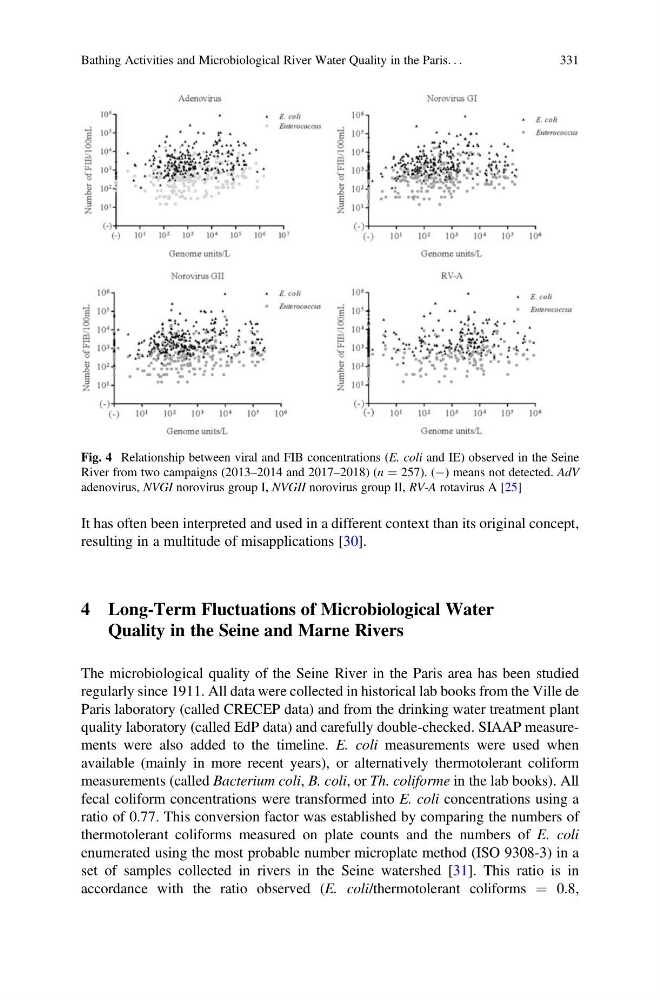
Fig. 4 Relationship between viral and FIB concentrations (E. coli and IE) observed in the Seine
River from two campaigns (2013–2014 and 2017–2018) (n ¼ 257). (À) means not detected. AdV
adenovirus, NVGI norovirus group I, NVGII norovirus group II, RV-A rotavirus A [25]
Bathing Activities and Microbiological River Water Quality in the Paris. . .
331
resulting in a multitude of misapplications [30].
4 Long-Term Fluctuations of Microbiological Water
Quality in the Seine and Marne Rivers
The microbiological quality of the Seine River in the Paris area has been studied
regularly since 1911. All data were collected in historical lab books from the Ville de
Paris laboratory (called CRECEP data) and from the drinking water treatment plant
quality laboratory (called EdP data) and carefully double-checked. SIAAP measurements were also added to the timeline. E. coli measurements were used when
available (mainly in more recent years), or alternatively thermotolerant coliform
measurements (called Bacterium coli, B. coli, or Th. coliforme in the lab books). All
fecal coliform concentrations were transformed into E. coli concentrations using a
ratio of 0.77. This conversion factor was established by comparing the numbers of
thermotolerant coliforms measured on plate counts and the numbers of E. coli
enumerated using the most probable number microplate method (ISO 9308-3) in a
set of samples collected in rivers in the Seine watershed [31]. This ratio is in
accordance with the ratio observed (E. coli/thermotolerant coliforms ¼ 0.8,
Fig. 4 Relationship between viral and FIB concentrations (E. coli and IE) observed in the Seine
River from two campaigns (2013–2014 and 2017–2018) (n ¼ 257). (À) means not detected. AdV
adenovirus, NVGI norovirus group I, NVGII norovirus group II, RV-A rotavirus A [25]
Bathing Activities and Microbiological River Water Quality in the Paris. . .
331