

2.4 A Social Control More Than a Matter of Public
Sanitation
The regulation of bathing in the Seine River can be divided chronologically into
three periods [8]. The first corresponds to the eighteenth century: bathing is allowed
in Paris but is confined to certain places chosen with the main intention of ensuring
respect for morality and regulating conflicting uses of the river banks. The second
period is a transitional period during which swimming became strictly forbidden in
Paris in 1867, extended to the nearest suburbs in 1923, except for certain places
authorized by the Police Prefecture. The last period begins in the middle of the
twentieth century with repeated closures of bathing areas due to episodes of pollution. Bathing is completely prohibited in the Marne River in 1970 by prefectural
decree. Finally in 2003, it was also forbidden in the Seine River within the limits of
the Val-de-Marne department. Despite this legal and administrative regulation, the
practice of wild bathing in the Seine and Marne rivers persisted until the end of the
1960s, a period that represents a shift in the public’s perception of the health risk
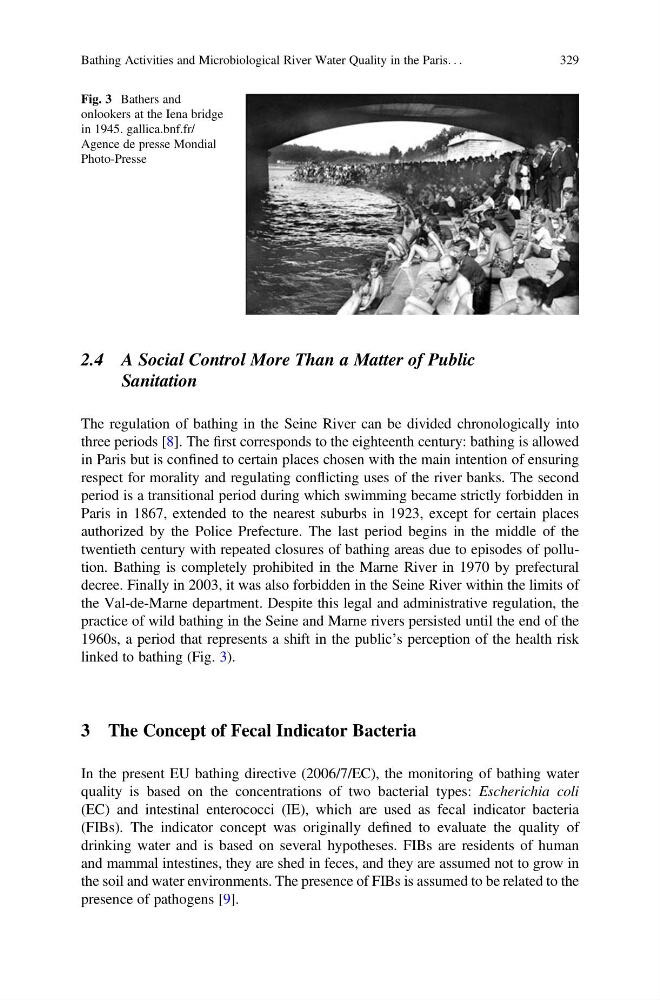
linked to bathing (Fig. 3).
3 The Concept of Fecal Indicator Bacteria
In the present EU bathing directive (2006/7/EC), the monitoring of bathing water
quality is based on the concentrations of two bacterial types: Escherichia coli
(EC) and intestinal enterococci (IE), which are used as fecal indicator bacteria
(FIBs). The indicator concept was originally defined to evaluate the quality of
drinking water and is based on several hypotheses. FIBs are residents of human
and mammal intestines, they are shed in feces, and they are assumed not to grow in
the soil and water environments. The presence of FIBs is assumed to be related to the
presence of pathogens [9].
Fig. 3 Bathers and
onlookers at the Iena bridge
in 1945. gallica.bnf.fr/
Agence de presse Mondial
Photo-Presse
Bathing Activities and Microbiological River Water Quality in the Paris. . .
329
Sanitation
The regulation of bathing in the Seine River can be divided chronologically into
three periods [8]. The first corresponds to the eighteenth century: bathing is allowed
in Paris but is confined to certain places chosen with the main intention of ensuring
respect for morality and regulating conflicting uses of the river banks. The second
period is a transitional period during which swimming became strictly forbidden in
Paris in 1867, extended to the nearest suburbs in 1923, except for certain places
authorized by the Police Prefecture. The last period begins in the middle of the
twentieth century with repeated closures of bathing areas due to episodes of pollution. Bathing is completely prohibited in the Marne River in 1970 by prefectural
decree. Finally in 2003, it was also forbidden in the Seine River within the limits of
the Val-de-Marne department. Despite this legal and administrative regulation, the
practice of wild bathing in the Seine and Marne rivers persisted until the end of the
1960s, a period that represents a shift in the public’s perception of the health risk
linked to bathing (Fig. 3).
3 The Concept of Fecal Indicator Bacteria
In the present EU bathing directive (2006/7/EC), the monitoring of bathing water
quality is based on the concentrations of two bacterial types: Escherichia coli
(EC) and intestinal enterococci (IE), which are used as fecal indicator bacteria
(FIBs). The indicator concept was originally defined to evaluate the quality of
drinking water and is based on several hypotheses. FIBs are residents of human
and mammal intestines, they are shed in feces, and they are assumed not to grow in
the soil and water environments. The presence of FIBs is assumed to be related to the
presence of pathogens [9].
Fig. 3 Bathers and
onlookers at the Iena bridge
in 1945. gallica.bnf.fr/
Agence de presse Mondial
Photo-Presse
Bathing Activities and Microbiological River Water Quality in the Paris. . .
329