

boaters and walkers often coming from the capital for a “partie de campagne” on
Sundays [1].
During the second half of the nineteenth century, Joinville-le-Pont, on the Marne
River, became a major spot for water sports activities. The recognition of swimming
as a sport owes much to the military. The teaching of swimming in the army had to
be done in the river, because of a lack of other facilities. The Joinville Gymnastics
School was created in 1852; swimming took place in the Marne River from a
pontoon. For 80 years instructors at the military schools were trained here and
then civilians. The first swimming and diving competitions at the national and
international level were organized on the banks of the Marne River at Joinville.
From the beginning of the twentieth century, various establishments were multiplying along the Marne River to meet the demand for an emerging sport: swimming
schools, diving boards, and landscaped pools. During the summer, thousands of
Parisians and suburbanites bathed in the water of the Marne River without a second
thought. These practices were banned at the end of the summer of 1970 by a
prefectural decree prohibiting bathing in the Marne River because of the poor quality
of the water.
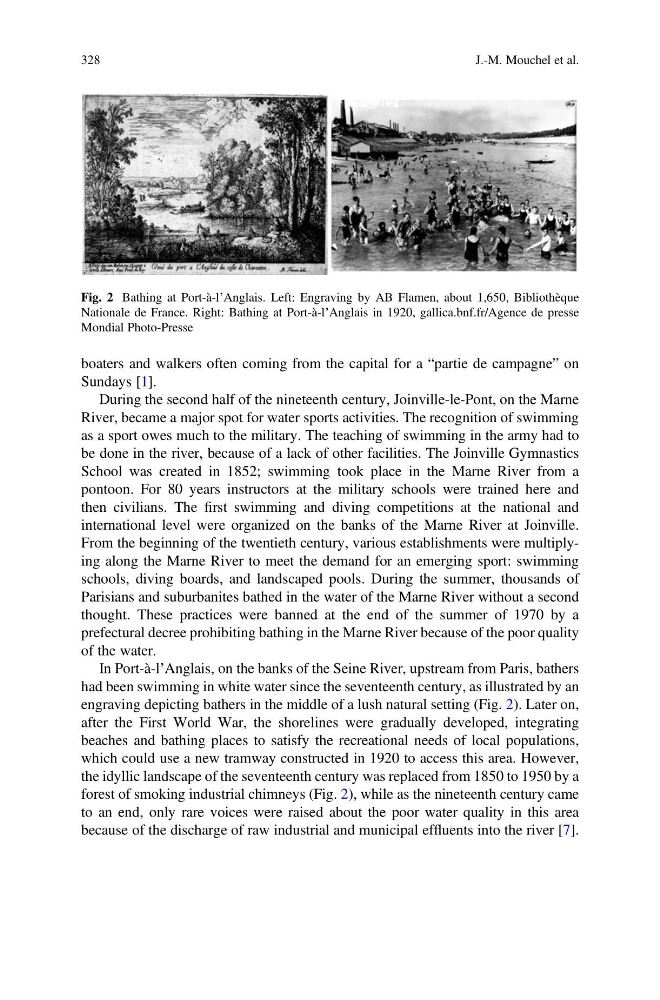
In Port-à-l’Anglais, on the banks of the Seine River, upstream from Paris, bathers
had been swimming in white water since the seventeenth century, as illustrated by an
engraving depicting bathers in the middle of a lush natural setting (Fig. 2). Later on,
after the First World War, the shorelines were gradually developed, integrating
beaches and bathing places to satisfy the recreational needs of local populations,
which could use a new tramway constructed in 1920 to access this area. However,
the idyllic landscape of the seventeenth century was replaced from 1850 to 1950 by a
forest of smoking industrial chimneys (Fig. 2), while as the nineteenth century came
to an end, only rare voices were raised about the poor water quality in this area
because of the discharge of raw industrial and municipal effluents into the river [7].
Fig. 2 Bathing at Port-à-l’Anglais. Left: Engraving by AB Flamen, about 1,650, Bibliothèque
Nationale de France. Right: Bathing at Port-à-l’Anglais in 1920, gallica.bnf.fr/Agence de presse
Mondial Photo-Presse
328
J.-M. Mouchel et al.
Sundays [1].
During the second half of the nineteenth century, Joinville-le-Pont, on the Marne
River, became a major spot for water sports activities. The recognition of swimming
as a sport owes much to the military. The teaching of swimming in the army had to
be done in the river, because of a lack of other facilities. The Joinville Gymnastics
School was created in 1852; swimming took place in the Marne River from a
pontoon. For 80 years instructors at the military schools were trained here and
then civilians. The first swimming and diving competitions at the national and
international level were organized on the banks of the Marne River at Joinville.
From the beginning of the twentieth century, various establishments were multiplying along the Marne River to meet the demand for an emerging sport: swimming
schools, diving boards, and landscaped pools. During the summer, thousands of
Parisians and suburbanites bathed in the water of the Marne River without a second
thought. These practices were banned at the end of the summer of 1970 by a
prefectural decree prohibiting bathing in the Marne River because of the poor quality
of the water.
In Port-à-l’Anglais, on the banks of the Seine River, upstream from Paris, bathers
had been swimming in white water since the seventeenth century, as illustrated by an
engraving depicting bathers in the middle of a lush natural setting (Fig. 2). Later on,
after the First World War, the shorelines were gradually developed, integrating
beaches and bathing places to satisfy the recreational needs of local populations,
which could use a new tramway constructed in 1920 to access this area. However,
the idyllic landscape of the seventeenth century was replaced from 1850 to 1950 by a
forest of smoking industrial chimneys (Fig. 2), while as the nineteenth century came
to an end, only rare voices were raised about the poor water quality in this area
because of the discharge of raw industrial and municipal effluents into the river [7].
Fig. 2 Bathing at Port-à-l’Anglais. Left: Engraving by AB Flamen, about 1,650, Bibliothèque
Nationale de France. Right: Bathing at Port-à-l’Anglais in 1920, gallica.bnf.fr/Agence de presse
Mondial Photo-Presse
328
J.-M. Mouchel et al.