

7 Circulation of Material Within Basins and Its Impact
on River Fluxes
In a fully sustainable society, the products and goods containing potentially harmful
substances should circulate without any leak into the environment (air, soil, water,
coastal zone). The previous sections have shown that this is not the case and that
river SPMs are a very good indicator of the way a society is handling these
environmental issues. Sedimentary archives add a precious time-depth to this question, provided that additional information on the general circulation of targeted
materials within the anthroposystem are available. This approach has been applied
to establish the metal circulation patterns in Western European rivers (Steps G–K,
Fig. 1).
7.1 Leakage Ratio of Metals Within the Seine River Basin
(1950–2005)
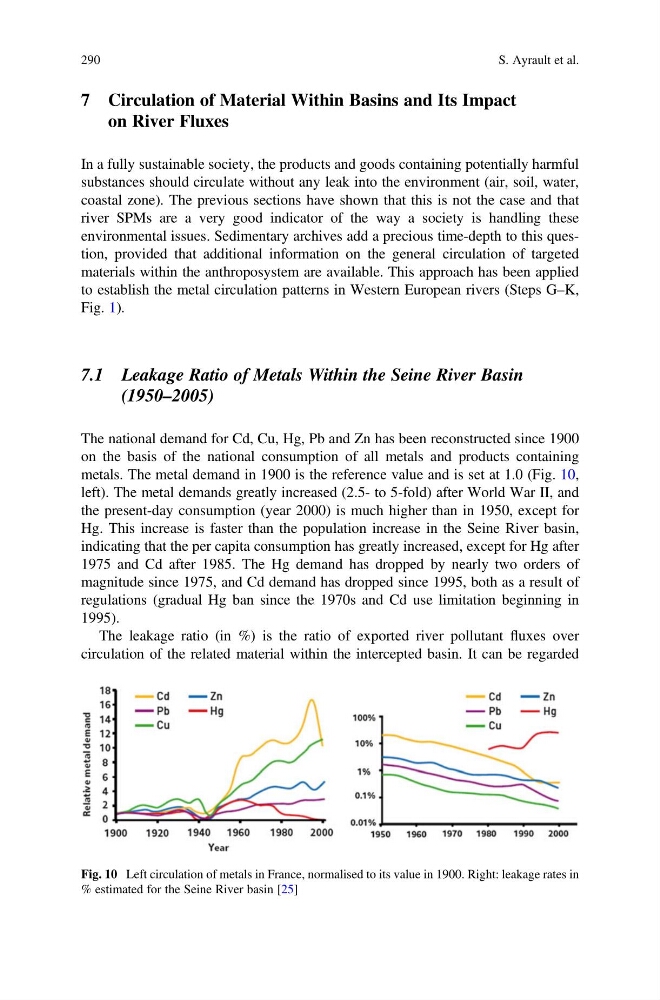
The national demand for Cd, Cu, Hg, Pb and Zn has been reconstructed since 1900
on the basis of the national consumption of all metals and products containing
metals. The metal demand in 1900 is the reference value and is set at 1.0 (Fig. 10,
left). The metal demands greatly increased (2.5- to 5-fold) after World War II, and
the present-day consumption (year 2000) is much higher than in 1950, except for
Hg. This increase is faster than the population increase in the Seine River basin,
indicating that the per capita consumption has greatly increased, except for Hg after
1975 and Cd after 1985. The Hg demand has dropped by nearly two orders of
magnitude since 1975, and Cd demand has dropped since 1995, both as a result of
regulations (gradual Hg ban since the 1970s and Cd use limitation beginning in
1995).
The leakage ratio (in %) is the ratio of exported river pollutant fluxes over
circulation of the related material within the intercepted basin. It can be regarded
Fig. 10 Left circulation of metals in France, normalised to its value in 1900. Right: leakage rates in
% estimated for the Seine River basin [25]
290
S. Ayrault et al.
on River Fluxes
In a fully sustainable society, the products and goods containing potentially harmful
substances should circulate without any leak into the environment (air, soil, water,
coastal zone). The previous sections have shown that this is not the case and that
river SPMs are a very good indicator of the way a society is handling these
environmental issues. Sedimentary archives add a precious time-depth to this question, provided that additional information on the general circulation of targeted
materials within the anthroposystem are available. This approach has been applied
to establish the metal circulation patterns in Western European rivers (Steps G–K,
Fig. 1).
7.1 Leakage Ratio of Metals Within the Seine River Basin
(1950–2005)
The national demand for Cd, Cu, Hg, Pb and Zn has been reconstructed since 1900
on the basis of the national consumption of all metals and products containing
metals. The metal demand in 1900 is the reference value and is set at 1.0 (Fig. 10,
left). The metal demands greatly increased (2.5- to 5-fold) after World War II, and
the present-day consumption (year 2000) is much higher than in 1950, except for
Hg. This increase is faster than the population increase in the Seine River basin,
indicating that the per capita consumption has greatly increased, except for Hg after
1975 and Cd after 1985. The Hg demand has dropped by nearly two orders of
magnitude since 1975, and Cd demand has dropped since 1995, both as a result of
regulations (gradual Hg ban since the 1970s and Cd use limitation beginning in
1995).
The leakage ratio (in %) is the ratio of exported river pollutant fluxes over
circulation of the related material within the intercepted basin. It can be regarded
Fig. 10 Left circulation of metals in France, normalised to its value in 1900. Right: leakage rates in
% estimated for the Seine River basin [25]
290
S. Ayrault et al.