

by erosion-derived SPM, while the Rhine and Seine Rivers show opposite
characteristics.
The level of contamination of river sediment strongly depends on the ratio of the
pressure over the dilution power (sediment load derived from erosion). The Seine
River at its mouth has a much higher ratio than the Rhône or the Mississippi. Similar
control is observed for PAH contamination when comparing the Orge River, an
urban sub-catchment of the Seine River, and other worldwide urban catchments [71].
Compared to the rivers cited above, the Seine River outlet exhibits the highest
metal concentrations for the 1940–1960 period, but small rivers impacted by big
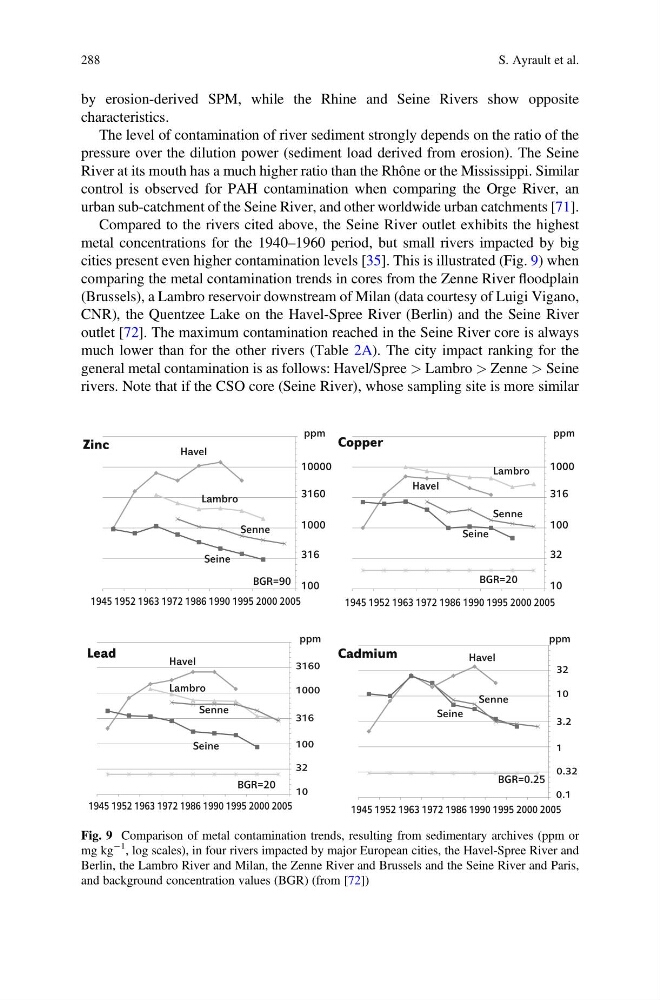
cities present even higher contamination levels [35]. This is illustrated (Fig. 9) when
comparing the metal contamination trends in cores from the Zenne River floodplain
(Brussels), a Lambro reservoir downstream of Milan (data courtesy of Luigi Vigano,
CNR), the Quentzee Lake on the Havel-Spree River (Berlin) and the Seine River
outlet [72]. The maximum contamination reached in the Seine River core is always
much lower than for the other rivers (Table 2A). The city impact ranking for the
general metal contamination is as follows: Havel/Spree > Lambro > Zenne > Seine
rivers. Note that if the CSO core (Seine River), whose sampling site is more similar
Fig. 9 Comparison of metal contamination trends, resulting from sedimentary archives (ppm or
mg kg
À1
, log scales), in four rivers impacted by major European cities, the Havel-Spree River and
Berlin, the Lambro River and Milan, the Zenne River and Brussels and the Seine River and Paris,
and background concentration values (BGR) (from [72])
288
S. Ayrault et al.
characteristics.
The level of contamination of river sediment strongly depends on the ratio of the
pressure over the dilution power (sediment load derived from erosion). The Seine
River at its mouth has a much higher ratio than the Rhône or the Mississippi. Similar
control is observed for PAH contamination when comparing the Orge River, an
urban sub-catchment of the Seine River, and other worldwide urban catchments [71].
Compared to the rivers cited above, the Seine River outlet exhibits the highest
metal concentrations for the 1940–1960 period, but small rivers impacted by big
cities present even higher contamination levels [35]. This is illustrated (Fig. 9) when
comparing the metal contamination trends in cores from the Zenne River floodplain
(Brussels), a Lambro reservoir downstream of Milan (data courtesy of Luigi Vigano,
CNR), the Quentzee Lake on the Havel-Spree River (Berlin) and the Seine River
outlet [72]. The maximum contamination reached in the Seine River core is always
much lower than for the other rivers (Table 2A). The city impact ranking for the
general metal contamination is as follows: Havel/Spree > Lambro > Zenne > Seine
rivers. Note that if the CSO core (Seine River), whose sampling site is more similar
Fig. 9 Comparison of metal contamination trends, resulting from sedimentary archives (ppm or
mg kg
À1
, log scales), in four rivers impacted by major European cities, the Havel-Spree River and
Berlin, the Lambro River and Milan, the Zenne River and Brussels and the Seine River and Paris,
and background concentration values (BGR) (from [72])
288
S. Ayrault et al.