

prescription strategies of practitioners, (2) a general decrease in antimicrobial consumption between 2000 and 2005 and (3) constant improvements made in the
collection and treatment of wastewater coming from Paris and its suburbs during
the last 40 years. Sulfamethoxazole has the least regular record and its detection lags
12 years behind its assumed first use. The regularity and the coherence of these
profiles are encouraging: this is the first demonstration that an antibiotic’s history can
be recorded in sedimentary archives, extending this approach to other types of
environmental indicators (e.g. [20]).
5 Intra-basin Comparisons in the Seine River Basin Reveal
Contrasted Trends in Subbasins
5.1 Compared Metal Contamination History: The Cadmium
Example
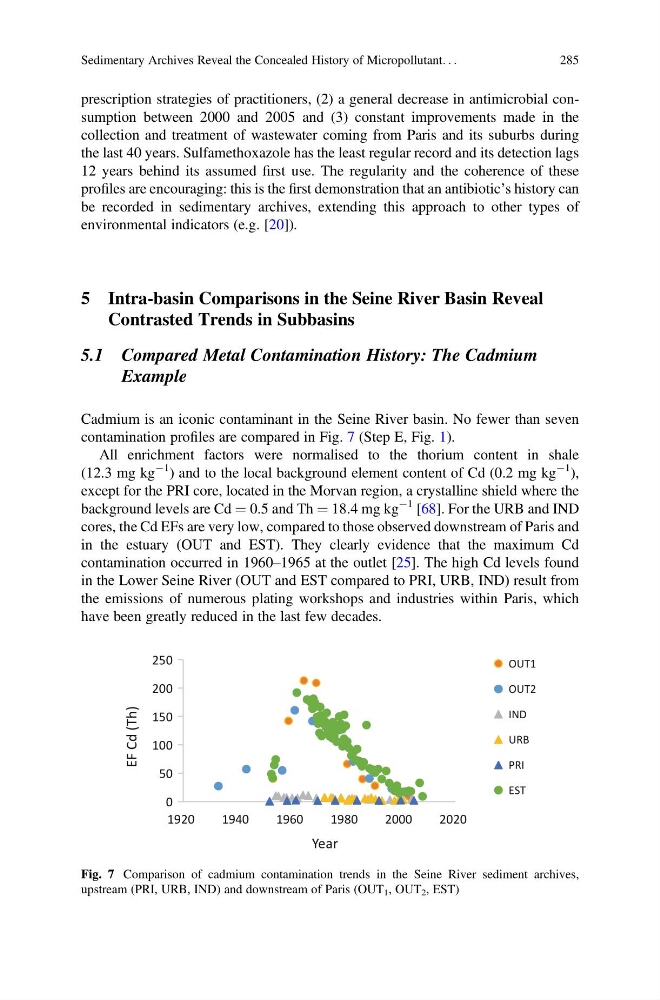
Cadmium is an iconic contaminant in the Seine River basin. No fewer than seven
contamination profiles are compared in Fig. 7 (Step E, Fig. 1).
All enrichment factors were normalised to the thorium content in shale
(12.3 mg kg
À1
) and to the local background element content of Cd (0.2 mg kg
À1 ),
except for the PRI core, located in the Morvan region, a crystalline shield where the
background levels are Cd ¼ 0.5 and Th ¼ 18.4 mg kg
À1 [68]. For the URB and IND
cores, the Cd EFs are very low, compared to those observed downstream of Paris and
in the estuary (OUT and EST). They clearly evidence that the maximum Cd
contamination occurred in 1960–1965 at the outlet [25]. The high Cd levels found
in the Lower Seine River (OUT and EST compared to PRI, URB, IND) result from
the emissions of numerous plating workshops and industries within Paris, which
have been greatly reduced in the last few decades.
0
50
100
150
200
250
1920
1940
1960
1980
2000
2020
EF Cd (Th)
Year
OUT1
OUT2
IND
URB
PRI
EST
Fig. 7 Comparison of cadmium contamination trends in the Seine River sediment archives,
upstream (PRI, URB, IND) and downstream of Paris (OUT 1 , OUT 2 , EST)
Sedimentary Archives Reveal the Concealed History of Micropollutant. . .
285
collection and treatment of wastewater coming from Paris and its suburbs during
the last 40 years. Sulfamethoxazole has the least regular record and its detection lags
12 years behind its assumed first use. The regularity and the coherence of these
profiles are encouraging: this is the first demonstration that an antibiotic’s history can
be recorded in sedimentary archives, extending this approach to other types of
environmental indicators (e.g. [20]).
5 Intra-basin Comparisons in the Seine River Basin Reveal
Contrasted Trends in Subbasins
5.1 Compared Metal Contamination History: The Cadmium
Example
Cadmium is an iconic contaminant in the Seine River basin. No fewer than seven
contamination profiles are compared in Fig. 7 (Step E, Fig. 1).
All enrichment factors were normalised to the thorium content in shale
(12.3 mg kg
À1
) and to the local background element content of Cd (0.2 mg kg
À1 ),
except for the PRI core, located in the Morvan region, a crystalline shield where the
background levels are Cd ¼ 0.5 and Th ¼ 18.4 mg kg
À1 [68]. For the URB and IND
cores, the Cd EFs are very low, compared to those observed downstream of Paris and
in the estuary (OUT and EST). They clearly evidence that the maximum Cd
contamination occurred in 1960–1965 at the outlet [25]. The high Cd levels found
in the Lower Seine River (OUT and EST compared to PRI, URB, IND) result from
the emissions of numerous plating workshops and industries within Paris, which
have been greatly reduced in the last few decades.
0
50
100
150
200
250
1920
1940
1960
1980
2000
2020
EF Cd (Th)
Year
OUT1
OUT2
IND
URB
PRI
EST
Fig. 7 Comparison of cadmium contamination trends in the Seine River sediment archives,
upstream (PRI, URB, IND) and downstream of Paris (OUT 1 , OUT 2 , EST)
Sedimentary Archives Reveal the Concealed History of Micropollutant. . .
285