

conventions may have evolved over the last 50 years, for instance, for the sum of
PCBs, one must check if the same basket of molecules is considered.
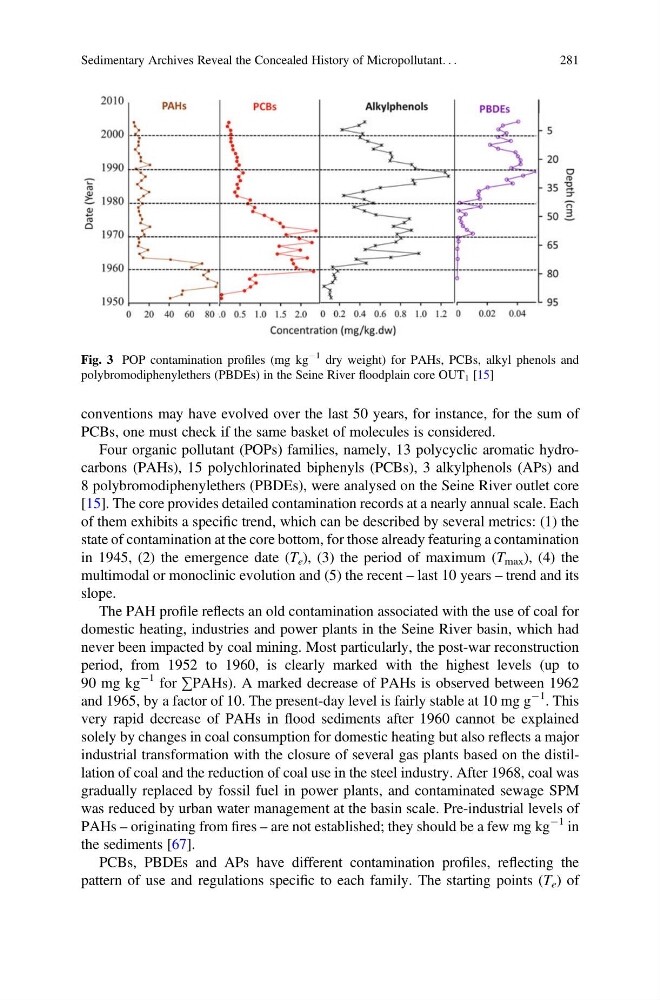
Four organic pollutant (POPs) families, namely, 13 polycyclic aromatic hydrocarbons (PAHs), 15 polychlorinated biphenyls (PCBs), 3 alkylphenols (APs) and
8 polybromodiphenylethers (PBDEs), were analysed on the Seine River outlet core
[15]. The core provides detailed contamination records at a nearly annual scale. Each
of them exhibits a specific trend, which can be described by several metrics: (1) the
state of contamination at the core bottom, for those already featuring a contamination
in 1945, (2) the emergence date (T e ), (3) the period of maximum (T max ), (4) the
multimodal or monoclinic evolution and (5) the recent – last 10 years – trend and its
slope.
The PAH profile reflects an old contamination associated with the use of coal for
domestic heating, industries and power plants in the Seine River basin, which had
never been impacted by coal mining. Most particularly, the post-war reconstruction
period, from 1952 to 1960, is clearly marked with the highest levels (up to
90 mg kg
À1 for ∑PAHs). A marked decrease of PAHs is observed between 1962
and 1965, by a factor of 10. The present-day level is fairly stable at 10 mg g
À1 . This
very rapid decrease of PAHs in flood sediments after 1960 cannot be explained
solely by changes in coal consumption for domestic heating but also reflects a major
industrial transformation with the closure of several gas plants based on the distillation of coal and the reduction of coal use in the steel industry. After 1968, coal was
gradually replaced by fossil fuel in power plants, and contaminated sewage SPM
was reduced by urban water management at the basin scale. Pre-industrial levels of
PAHs – originating from fires – are not established; they should be a few mg kg
À1 in
the sediments [67].
PCBs, PBDEs and APs have different contamination profiles, reflecting the
pattern of use and regulations specific to each family. The starting points (T e ) of
Fig. 3 POP contamination profiles (mg kg
À1 dry weight) for PAHs, PCBs, alkyl phenols and
polybromodiphenylethers (PBDEs) in the Seine River floodplain core OUT 1 [15]
Sedimentary Archives Reveal the Concealed History of Micropollutant. . .
281
PCBs, one must check if the same basket of molecules is considered.
Four organic pollutant (POPs) families, namely, 13 polycyclic aromatic hydrocarbons (PAHs), 15 polychlorinated biphenyls (PCBs), 3 alkylphenols (APs) and
8 polybromodiphenylethers (PBDEs), were analysed on the Seine River outlet core
[15]. The core provides detailed contamination records at a nearly annual scale. Each
of them exhibits a specific trend, which can be described by several metrics: (1) the
state of contamination at the core bottom, for those already featuring a contamination
in 1945, (2) the emergence date (T e ), (3) the period of maximum (T max ), (4) the
multimodal or monoclinic evolution and (5) the recent – last 10 years – trend and its
slope.
The PAH profile reflects an old contamination associated with the use of coal for
domestic heating, industries and power plants in the Seine River basin, which had
never been impacted by coal mining. Most particularly, the post-war reconstruction
period, from 1952 to 1960, is clearly marked with the highest levels (up to
90 mg kg
À1 for ∑PAHs). A marked decrease of PAHs is observed between 1962
and 1965, by a factor of 10. The present-day level is fairly stable at 10 mg g
À1 . This
very rapid decrease of PAHs in flood sediments after 1960 cannot be explained
solely by changes in coal consumption for domestic heating but also reflects a major
industrial transformation with the closure of several gas plants based on the distillation of coal and the reduction of coal use in the steel industry. After 1968, coal was
gradually replaced by fossil fuel in power plants, and contaminated sewage SPM
was reduced by urban water management at the basin scale. Pre-industrial levels of
PAHs – originating from fires – are not established; they should be a few mg kg
À1 in
the sediments [67].
PCBs, PBDEs and APs have different contamination profiles, reflecting the
pattern of use and regulations specific to each family. The starting points (T e ) of
Fig. 3 POP contamination profiles (mg kg
À1 dry weight) for PAHs, PCBs, alkyl phenols and
polybromodiphenylethers (PBDEs) in the Seine River floodplain core OUT 1 [15]
Sedimentary Archives Reveal the Concealed History of Micropollutant. . .
281