

(urban inputs), ruptures, and stepwise variations in the construction of infrastructures
(WWTPs and reservoirs) but also in terms of regulations (laws, pollutants bans),
notch patterns particularly for World War I and II or the 1929 economic crisis, as
well as tipping points (e.g. the collected/treated wastewater ratio). The comparison
of the trajectories of pressures/responses shows a temporal lag, sometimes over
several decades, typical of each issue [42].
3.3 Trajectories of River State and Societal Response to River
Issues
Analysing the trajectories of the river state indicators and their control factors and
investigating river-society interactions are now important topics of the PIRENSeine, which complement the description, functioning, and modelling of the hydrological and biogeochemical functioning of the Seine River system. Indeed, these
trajectories combine physical, ecological, chemical, and social attributes. They make
it possible to convert our relatively narrow window of observation (i.e. one to five
decades) into the longue durée observation (100 years and sometimes far more) with
which the complex relationships between man and river should be studied. In such a
time window, the severe chemical pollution of the river that characterized the
twentieth century is becoming a transient phenomenon for many issues.
Knowledge on the river basin shows a non-linear progression, with periods of
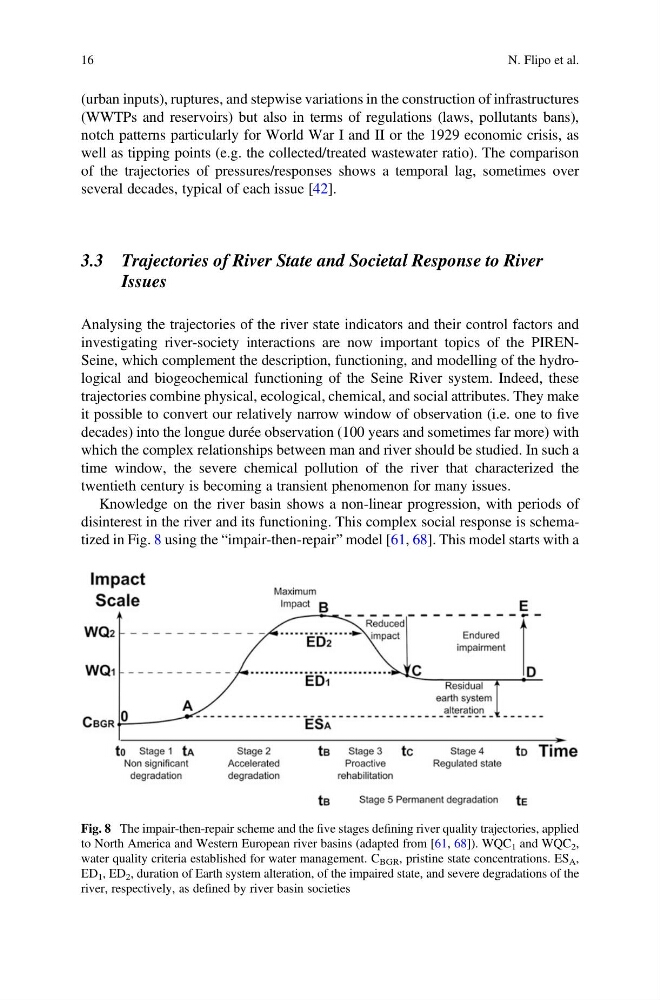
disinterest in the river and its functioning. This complex social response is schematized in Fig. 8 using the “impair-then-repair” model [61, 68]. This model starts with a
Fig. 8 The impair-then-repair scheme and the five stages defining river quality trajectories, applied
to North America and Western European river basins (adapted from [61, 68]). WQC 1 and WQC 2 ,
water quality criteria established for water management. C BGR , pristine state concentrations. ES A ,
ED 1 , ED 2 , duration of Earth system alteration, of the impaired state, and severe degradations of the
river, respectively, as defined by river basin societies
16
N. Flipo et al.
(WWTPs and reservoirs) but also in terms of regulations (laws, pollutants bans),
notch patterns particularly for World War I and II or the 1929 economic crisis, as
well as tipping points (e.g. the collected/treated wastewater ratio). The comparison
of the trajectories of pressures/responses shows a temporal lag, sometimes over
several decades, typical of each issue [42].
3.3 Trajectories of River State and Societal Response to River
Issues
Analysing the trajectories of the river state indicators and their control factors and
investigating river-society interactions are now important topics of the PIRENSeine, which complement the description, functioning, and modelling of the hydrological and biogeochemical functioning of the Seine River system. Indeed, these
trajectories combine physical, ecological, chemical, and social attributes. They make
it possible to convert our relatively narrow window of observation (i.e. one to five
decades) into the longue durée observation (100 years and sometimes far more) with
which the complex relationships between man and river should be studied. In such a
time window, the severe chemical pollution of the river that characterized the
twentieth century is becoming a transient phenomenon for many issues.
Knowledge on the river basin shows a non-linear progression, with periods of
disinterest in the river and its functioning. This complex social response is schematized in Fig. 8 using the “impair-then-repair” model [61, 68]. This model starts with a
Fig. 8 The impair-then-repair scheme and the five stages defining river quality trajectories, applied
to North America and Western European river basins (adapted from [61, 68]). WQC 1 and WQC 2 ,
water quality criteria established for water management. C BGR , pristine state concentrations. ES A ,
ED 1 , ED 2 , duration of Earth system alteration, of the impaired state, and severe degradations of the
river, respectively, as defined by river basin societies
16
N. Flipo et al.