

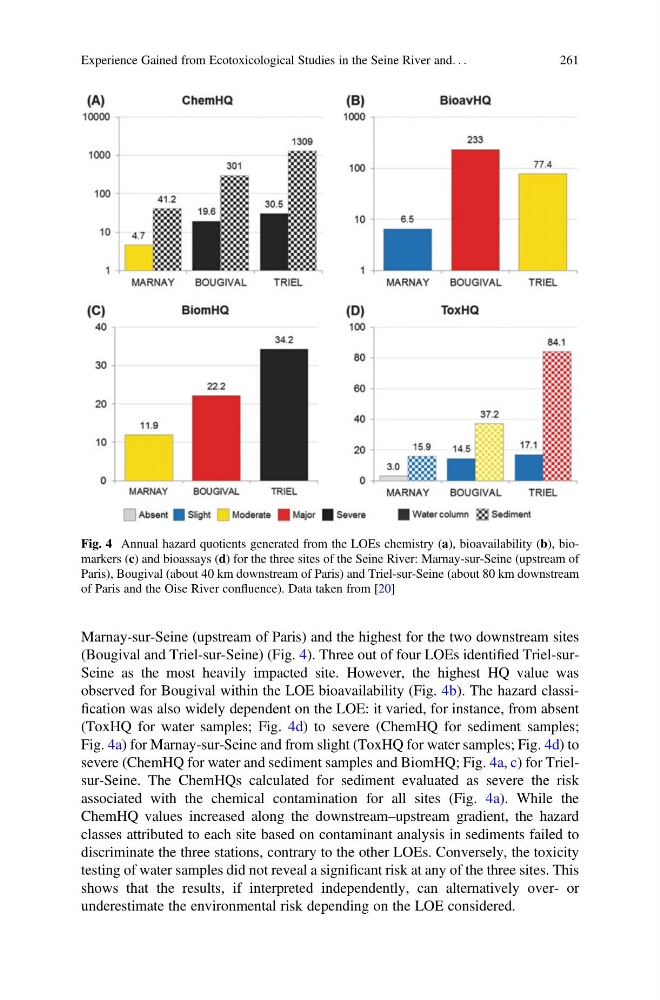
Marnay-sur-Seine (upstream of Paris) and the highest for the two downstream sites
(Bougival and Triel-sur-Seine) (Fig. 4). Three out of four LOEs identified Triel-surSeine as the most heavily impacted site. However, the highest HQ value was
observed for Bougival within the LOE bioavailability (Fig. 4b). The hazard classification was also widely dependent on the LOE: it varied, for instance, from absent
(ToxHQ for water samples; Fig. 4d) to severe (ChemHQ for sediment samples;
Fig. 4a) for Marnay-sur-Seine and from slight (ToxHQ for water samples; Fig. 4d) to
severe (ChemHQ for water and sediment samples and BiomHQ; Fig. 4a, c) for Trielsur-Seine. The ChemHQs calculated for sediment evaluated as severe the risk
associated with the chemical contamination for all sites (Fig. 4a). While the
ChemHQ values increased along the downstream–upstream gradient, the hazard
classes attributed to each site based on contaminant analysis in sediments failed to
discriminate the three stations, contrary to the other LOEs. Conversely, the toxicity
testing of water samples did not reveal a significant risk at any of the three sites. This
shows that the results, if interpreted independently, can alternatively over- or
underestimate the environmental risk depending on the LOE considered.
Fig. 4 Annual hazard quotients generated from the LOEs chemistry (a), bioavailability (b), biomarkers (c) and bioassays (d) for the three sites of the Seine River: Marnay-sur-Seine (upstream of
Paris), Bougival (about 40 km downstream of Paris) and Triel-sur-Seine (about 80 km downstream
of Paris and the Oise River confluence). Data taken from [20]
Experience Gained from Ecotoxicological Studies in the Seine River and. . .
261
(Bougival and Triel-sur-Seine) (Fig. 4). Three out of four LOEs identified Triel-surSeine as the most heavily impacted site. However, the highest HQ value was
observed for Bougival within the LOE bioavailability (Fig. 4b). The hazard classification was also widely dependent on the LOE: it varied, for instance, from absent
(ToxHQ for water samples; Fig. 4d) to severe (ChemHQ for sediment samples;
Fig. 4a) for Marnay-sur-Seine and from slight (ToxHQ for water samples; Fig. 4d) to
severe (ChemHQ for water and sediment samples and BiomHQ; Fig. 4a, c) for Trielsur-Seine. The ChemHQs calculated for sediment evaluated as severe the risk
associated with the chemical contamination for all sites (Fig. 4a). While the
ChemHQ values increased along the downstream–upstream gradient, the hazard
classes attributed to each site based on contaminant analysis in sediments failed to
discriminate the three stations, contrary to the other LOEs. Conversely, the toxicity
testing of water samples did not reveal a significant risk at any of the three sites. This
shows that the results, if interpreted independently, can alternatively over- or
underestimate the environmental risk depending on the LOE considered.
Fig. 4 Annual hazard quotients generated from the LOEs chemistry (a), bioavailability (b), biomarkers (c) and bioassays (d) for the three sites of the Seine River: Marnay-sur-Seine (upstream of
Paris), Bougival (about 40 km downstream of Paris) and Triel-sur-Seine (about 80 km downstream
of Paris and the Oise River confluence). Data taken from [20]
Experience Gained from Ecotoxicological Studies in the Seine River and. . .
261