

fecundity and fertility of the females subjected to a trophic stress [54]. Thus, the
disruption of the digestive capacity of animal organisms could, after 15 days of
exposure to trophic stress, induce a risk of reduction of the energy available for
reproduction. In the case of exposure to chemical contaminants, in addition to a
disruption of the digestive capacity of organisms, it should be noted that individuals
must allocate some of their energy to defend mechanisms, potentially to the detriment of reproduction. Therefore, the digestive enzymes studied show their relevance
as biomarkers in ecological risk assessment (ERA).
3.3.4 Field Applications
Following studies carried out under controlled conditions, a methodology was
established for the in situ studies of water quality assessment. The strategy adopted
consisted in an active approach to organisms, i.e. transplantation of organisms. Such
an approach makes it possible, using calibrated organisms, to limit as much as
possible the influence of both endogen (sex, age, etc.) and abiotic (temperature,
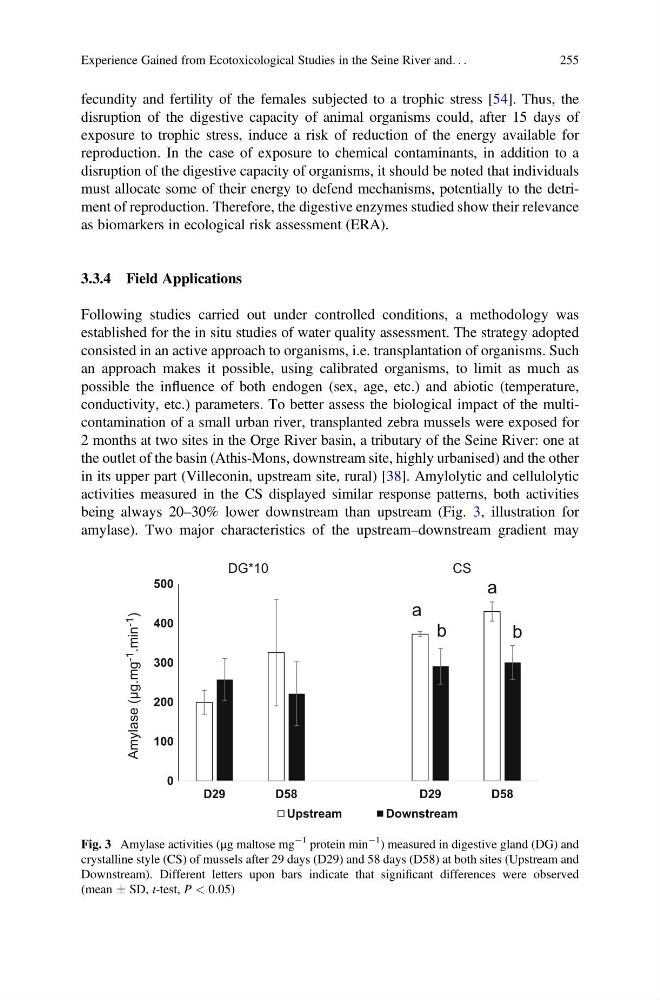
conductivity, etc.) parameters. To better assess the biological impact of the multicontamination of a small urban river, transplanted zebra mussels were exposed for
2 months at two sites in the Orge River basin, a tributary of the Seine River: one at
the outlet of the basin (Athis-Mons, downstream site, highly urbanised) and the other
in its upper part (Villeconin, upstream site, rural) [38]. Amylolytic and cellulolytic
activities measured in the CS displayed similar response patterns, both activities
being always 20–30% lower downstream than upstream (Fig. 3, illustration for
amylase). Two major characteristics of the upstream–downstream gradient may
0
100
200
300
400
500
D29
D58
D29
D58
Upstream
Downstream
DG*10
CS
a
a
b
b
Amylase (µg.mg -1
.min -1
)
Fig. 3 Amylase activities (μg maltose mg
À1 protein min
À1
) measured in digestive gland (DG) and
crystalline style (CS) of mussels after 29 days (D29) and 58 days (D58) at both sites (Upstream and
Downstream). Different letters upon bars indicate that significant differences were observed
(mean Æ SD, t-test, P < 0.05)
Experience Gained from Ecotoxicological Studies in the Seine River and. . .
255
disruption of the digestive capacity of animal organisms could, after 15 days of
exposure to trophic stress, induce a risk of reduction of the energy available for
reproduction. In the case of exposure to chemical contaminants, in addition to a
disruption of the digestive capacity of organisms, it should be noted that individuals
must allocate some of their energy to defend mechanisms, potentially to the detriment of reproduction. Therefore, the digestive enzymes studied show their relevance
as biomarkers in ecological risk assessment (ERA).
3.3.4 Field Applications
Following studies carried out under controlled conditions, a methodology was
established for the in situ studies of water quality assessment. The strategy adopted
consisted in an active approach to organisms, i.e. transplantation of organisms. Such
an approach makes it possible, using calibrated organisms, to limit as much as
possible the influence of both endogen (sex, age, etc.) and abiotic (temperature,
conductivity, etc.) parameters. To better assess the biological impact of the multicontamination of a small urban river, transplanted zebra mussels were exposed for
2 months at two sites in the Orge River basin, a tributary of the Seine River: one at
the outlet of the basin (Athis-Mons, downstream site, highly urbanised) and the other
in its upper part (Villeconin, upstream site, rural) [38]. Amylolytic and cellulolytic
activities measured in the CS displayed similar response patterns, both activities
being always 20–30% lower downstream than upstream (Fig. 3, illustration for
amylase). Two major characteristics of the upstream–downstream gradient may
0
100
200
300
400
500
D29
D58
D29
D58
Upstream
Downstream
DG*10
CS
a
a
b
b
Amylase (µg.mg -1
.min -1
)
Fig. 3 Amylase activities (μg maltose mg
À1 protein min
À1
) measured in digestive gland (DG) and
crystalline style (CS) of mussels after 29 days (D29) and 58 days (D58) at both sites (Upstream and
Downstream). Different letters upon bars indicate that significant differences were observed
(mean Æ SD, t-test, P < 0.05)
Experience Gained from Ecotoxicological Studies in the Seine River and. . .
255