

In the case of D. polymorpha, a 12-month active biomonitoring study was
conducted within the PIREN-Seine programme on the Vesle basin [39]. A clear
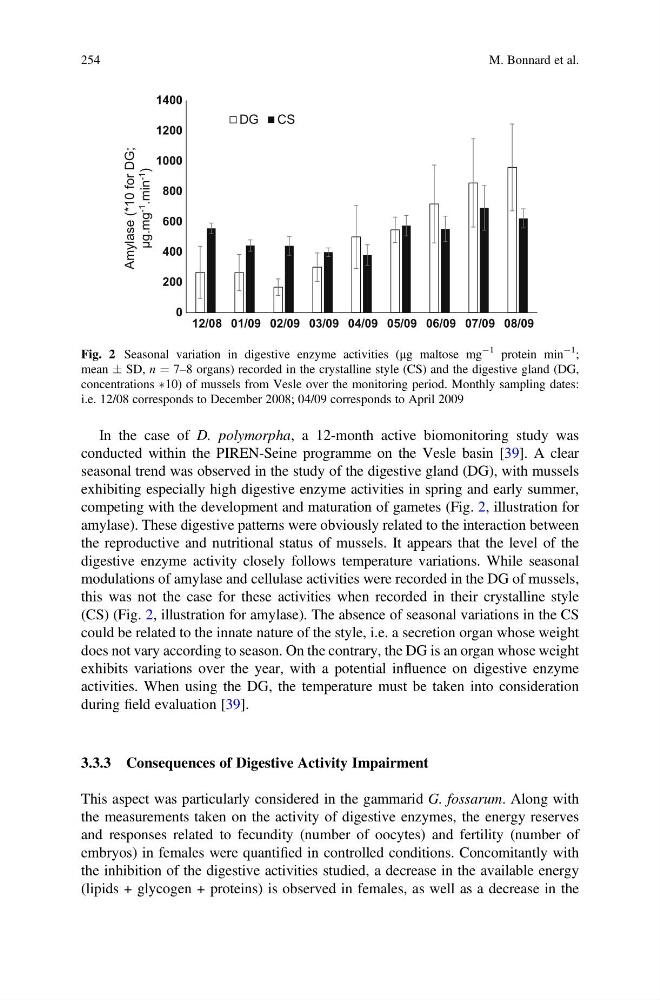
seasonal trend was observed in the study of the digestive gland (DG), with mussels
exhibiting especially high digestive enzyme activities in spring and early summer,
competing with the development and maturation of gametes (Fig. 2, illustration for
amylase). These digestive patterns were obviously related to the interaction between
the reproductive and nutritional status of mussels. It appears that the level of the
digestive enzyme activity closely follows temperature variations. While seasonal
modulations of amylase and cellulase activities were recorded in the DG of mussels,
this was not the case for these activities when recorded in their crystalline style
(CS) (Fig. 2, illustration for amylase). The absence of seasonal variations in the CS
could be related to the innate nature of the style, i.e. a secretion organ whose weight
does not vary according to season. On the contrary, the DG is an organ whose weight
exhibits variations over the year, with a potential influence on digestive enzyme
activities. When using the DG, the temperature must be taken into consideration
during field evaluation [39].
3.3.3 Consequences of Digestive Activity Impairment
This aspect was particularly considered in the gammarid G. fossarum. Along with
the measurements taken on the activity of digestive enzymes, the energy reserves
and responses related to fecundity (number of oocytes) and fertility (number of
embryos) in females were quantified in controlled conditions. Concomitantly with
the inhibition of the digestive activities studied, a decrease in the available energy
(lipids + glycogen + proteins) is observed in females, as well as a decrease in the
0
200
400
600
800
1000
1200
1400
12/08 01/09 02/09 03/09 04/09 05/09 06/09 07/09 08/09
DG CS
Amylase (*10 for DG;
µg.mg
-1
.min
-1
)
Fig. 2 Seasonal variation in digestive enzyme activities (μg maltose mg
À1 protein min
À1
;
mean Æ SD, n ¼ 7–8 organs) recorded in the crystalline style (CS) and the digestive gland (DG,
concentrations Ã10) of mussels from Vesle over the monitoring period. Monthly sampling dates:
i.e. 12/08 corresponds to December 2008; 04/09 corresponds to April 2009
254
M. Bonnard et al.
conducted within the PIREN-Seine programme on the Vesle basin [39]. A clear
seasonal trend was observed in the study of the digestive gland (DG), with mussels
exhibiting especially high digestive enzyme activities in spring and early summer,
competing with the development and maturation of gametes (Fig. 2, illustration for
amylase). These digestive patterns were obviously related to the interaction between
the reproductive and nutritional status of mussels. It appears that the level of the
digestive enzyme activity closely follows temperature variations. While seasonal
modulations of amylase and cellulase activities were recorded in the DG of mussels,
this was not the case for these activities when recorded in their crystalline style
(CS) (Fig. 2, illustration for amylase). The absence of seasonal variations in the CS
could be related to the innate nature of the style, i.e. a secretion organ whose weight
does not vary according to season. On the contrary, the DG is an organ whose weight
exhibits variations over the year, with a potential influence on digestive enzyme
activities. When using the DG, the temperature must be taken into consideration
during field evaluation [39].
3.3.3 Consequences of Digestive Activity Impairment
This aspect was particularly considered in the gammarid G. fossarum. Along with
the measurements taken on the activity of digestive enzymes, the energy reserves
and responses related to fecundity (number of oocytes) and fertility (number of
embryos) in females were quantified in controlled conditions. Concomitantly with
the inhibition of the digestive activities studied, a decrease in the available energy
(lipids + glycogen + proteins) is observed in females, as well as a decrease in the
0
200
400
600
800
1000
1200
1400
12/08 01/09 02/09 03/09 04/09 05/09 06/09 07/09 08/09
DG CS
Amylase (*10 for DG;
µg.mg
-1
.min
-1
)
Fig. 2 Seasonal variation in digestive enzyme activities (μg maltose mg
À1 protein min
À1
;
mean Æ SD, n ¼ 7–8 organs) recorded in the crystalline style (CS) and the digestive gland (DG,
concentrations Ã10) of mussels from Vesle over the monitoring period. Monthly sampling dates:
i.e. 12/08 corresponds to December 2008; 04/09 corresponds to April 2009
254
M. Bonnard et al.