

with field data provided by official water surveys or collected by the teams involved
in the PIREN-Seine programme. Mass balances at the scale of the Seine River basin
were undertaken for nitrogen [58], non-ferrous metals [59], and polycyclic aromatic
hydrocarbons (PAHs) [60].
The lack of available sources, either spatial or temporal, makes a retrospective
modelling approach to fill the gaps essential. Widely developed within the PIRENSeine, e.g. for water budget [32], oxygen budgets [41], or nitrogen circulation at the
watershed level [46], this approach remains original within the scientific community.
For centuries, the Seine River basin system was relatively closed, excepted for
some imported products carried through the river waterway. Nowadays, the socioeconomic system has been widely opened through massive imports and exports. The
basin exports a great quantity of agricultural, food, and manufactured products,
and it consumes a large quantity of imported animal feed, fossil fuels, mining, and
manufactured products. It also emits and receives atmospheric pollutants to and from
other basins through long-range transport.
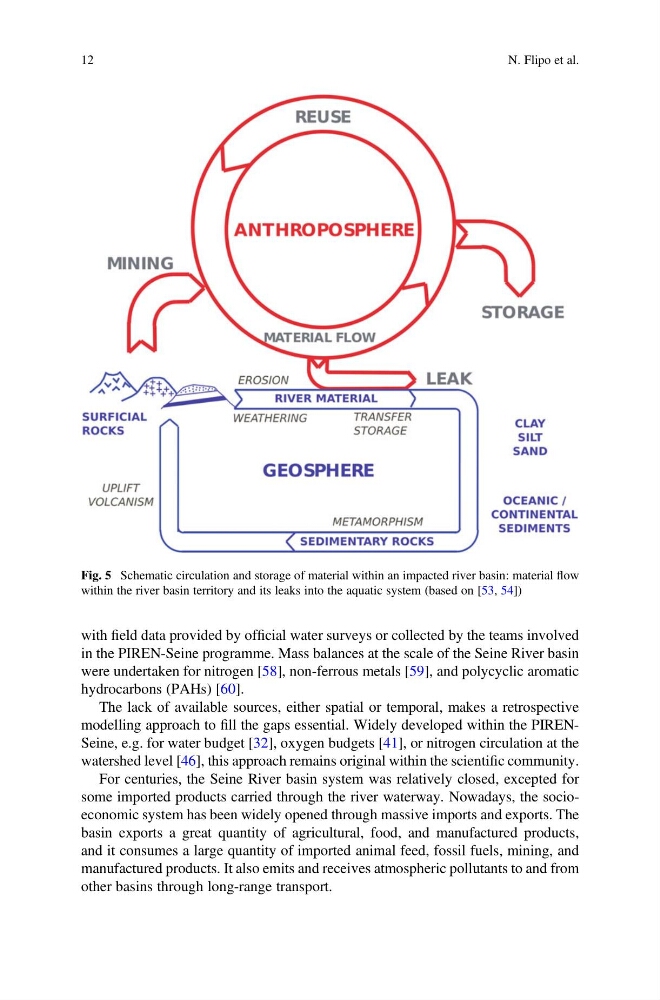
Fig. 5 Schematic circulation and storage of material within an impacted river basin: material flow
within the river basin territory and its leaks into the aquatic system (based on [53, 54])
12
N. Flipo et al.
in the PIREN-Seine programme. Mass balances at the scale of the Seine River basin
were undertaken for nitrogen [58], non-ferrous metals [59], and polycyclic aromatic
hydrocarbons (PAHs) [60].
The lack of available sources, either spatial or temporal, makes a retrospective
modelling approach to fill the gaps essential. Widely developed within the PIRENSeine, e.g. for water budget [32], oxygen budgets [41], or nitrogen circulation at the
watershed level [46], this approach remains original within the scientific community.
For centuries, the Seine River basin system was relatively closed, excepted for
some imported products carried through the river waterway. Nowadays, the socioeconomic system has been widely opened through massive imports and exports. The
basin exports a great quantity of agricultural, food, and manufactured products,
and it consumes a large quantity of imported animal feed, fossil fuels, mining, and
manufactured products. It also emits and receives atmospheric pollutants to and from
other basins through long-range transport.
Fig. 5 Schematic circulation and storage of material within an impacted river basin: material flow
within the river basin territory and its leaks into the aquatic system (based on [53, 54])
12
N. Flipo et al.