

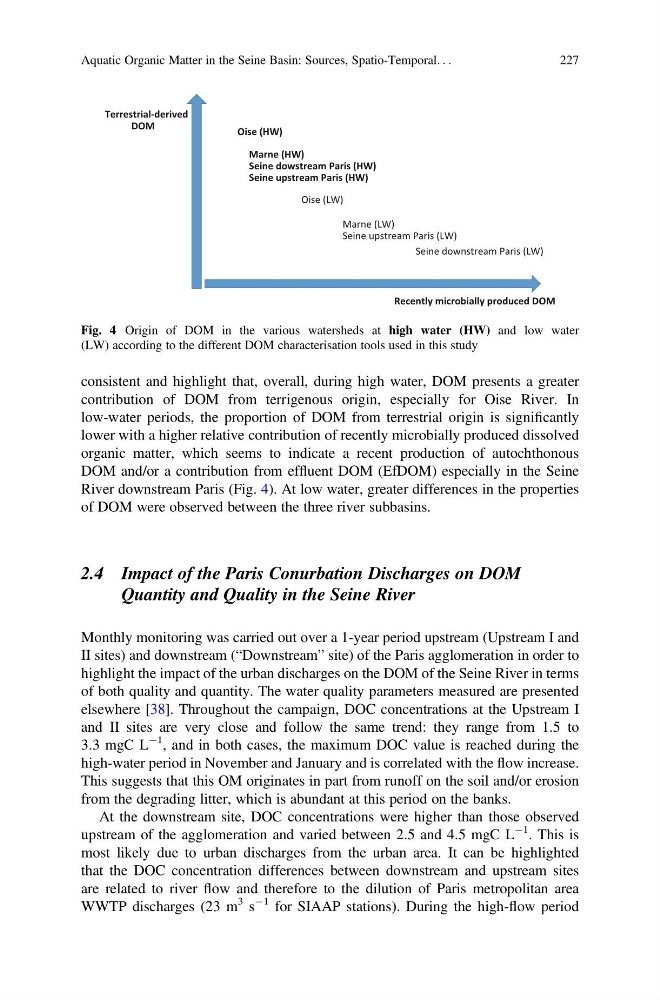
consistent and highlight that, overall, during high water, DOM presents a greater
contribution of DOM from terrigenous origin, especially for Oise River. In
low-water periods, the proportion of DOM from terrestrial origin is significantly
lower with a higher relative contribution of recently microbially produced dissolved
organic matter, which seems to indicate a recent production of autochthonous
DOM and/or a contribution from effluent DOM (EfDOM) especially in the Seine
River downstream Paris (Fig. 4). At low water, greater differences in the properties
of DOM were observed between the three river subbasins.
2.4 Impact of the Paris Conurbation Discharges on DOM
Quantity and Quality in the Seine River
Monthly monitoring was carried out over a 1-year period upstream (Upstream I and
II sites) and downstream (“Downstream” site) of the Paris agglomeration in order to
highlight the impact of the urban discharges on the DOM of the Seine River in terms
of both quality and quantity. The water quality parameters measured are presented
elsewhere [38]. Throughout the campaign, DOC concentrations at the Upstream I
and II sites are very close and follow the same trend: they range from 1.5 to
3.3 mgC L
À1 , and in both cases, the maximum DOC value is reached during the
high-water period in November and January and is correlated with the flow increase.
This suggests that this OM originates in part from runoff on the soil and/or erosion
from the degrading litter, which is abundant at this period on the banks.
At the downstream site, DOC concentrations were higher than those observed
upstream of the agglomeration and varied between 2.5 and 4.5 mgC L
À1 . This is
most likely due to urban discharges from the urban area. It can be highlighted
that the DOC concentration differences between downstream and upstream sites
are related to river flow and therefore to the dilution of Paris metropolitan area
WWTP discharges (23 m
3 s
À1 for SIAAP stations). During the high-flow period
Terrestrial-derived
DOM
Oise (LW)
Marne (LW)
Seine upstream Paris (LW)
Seine downstream Paris (LW)
Marne (HW)
Seine dowstream Paris (HW)
Seine upstream Paris (HW)
Oise (HW)
Recently microbially produced DOM
Fig. 4 Origin of DOM in the various watersheds at high water (HW) and low water
(LW) according to the different DOM characterisation tools used in this study
Aquatic Organic Matter in the Seine Basin: Sources, Spatio-Temporal. . .
227
contribution of DOM from terrigenous origin, especially for Oise River. In
low-water periods, the proportion of DOM from terrestrial origin is significantly
lower with a higher relative contribution of recently microbially produced dissolved
organic matter, which seems to indicate a recent production of autochthonous
DOM and/or a contribution from effluent DOM (EfDOM) especially in the Seine
River downstream Paris (Fig. 4). At low water, greater differences in the properties
of DOM were observed between the three river subbasins.
2.4 Impact of the Paris Conurbation Discharges on DOM
Quantity and Quality in the Seine River
Monthly monitoring was carried out over a 1-year period upstream (Upstream I and
II sites) and downstream (“Downstream” site) of the Paris agglomeration in order to
highlight the impact of the urban discharges on the DOM of the Seine River in terms
of both quality and quantity. The water quality parameters measured are presented
elsewhere [38]. Throughout the campaign, DOC concentrations at the Upstream I
and II sites are very close and follow the same trend: they range from 1.5 to
3.3 mgC L
À1 , and in both cases, the maximum DOC value is reached during the
high-water period in November and January and is correlated with the flow increase.
This suggests that this OM originates in part from runoff on the soil and/or erosion
from the degrading litter, which is abundant at this period on the banks.
At the downstream site, DOC concentrations were higher than those observed
upstream of the agglomeration and varied between 2.5 and 4.5 mgC L
À1 . This is
most likely due to urban discharges from the urban area. It can be highlighted
that the DOC concentration differences between downstream and upstream sites
are related to river flow and therefore to the dilution of Paris metropolitan area
WWTP discharges (23 m
3 s
À1 for SIAAP stations). During the high-flow period
Terrestrial-derived
DOM
Oise (LW)
Marne (LW)
Seine upstream Paris (LW)
Seine downstream Paris (LW)
Marne (HW)
Seine dowstream Paris (HW)
Seine upstream Paris (HW)
Oise (HW)
Recently microbially produced DOM
Fig. 4 Origin of DOM in the various watersheds at high water (HW) and low water
(LW) according to the different DOM characterisation tools used in this study
Aquatic Organic Matter in the Seine Basin: Sources, Spatio-Temporal. . .
227