

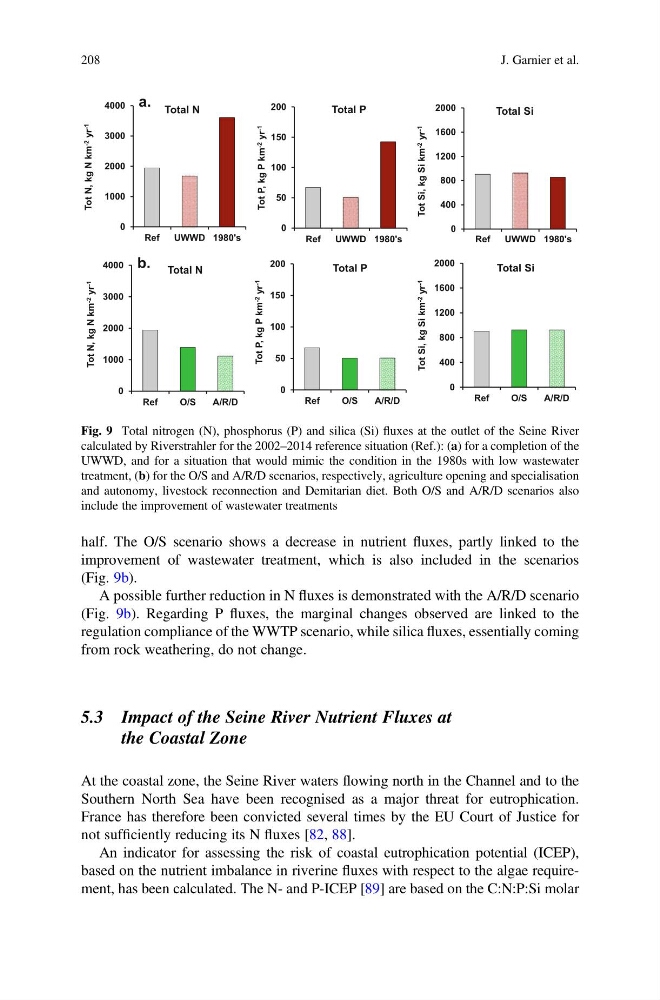
half. The O/S scenario shows a decrease in nutrient fluxes, partly linked to the
improvement of wastewater treatment, which is also included in the scenarios
(Fig. 9b).
A possible further reduction in N fluxes is demonstrated with the A/R/D scenario
(Fig. 9b). Regarding P fluxes, the marginal changes observed are linked to the
regulation compliance of the WWTP scenario, while silica fluxes, essentially coming
from rock weathering, do not change.
5.3 Impact of the Seine River Nutrient Fluxes at
the Coastal Zone
At the coastal zone, the Seine River waters flowing north in the Channel and to the
Southern North Sea have been recognised as a major threat for eutrophication.
France has therefore been convicted several times by the EU Court of Justice for
not sufficiently reducing its N fluxes [82, 88].
An indicator for assessing the risk of coastal eutrophication potential (ICEP),
based on the nutrient imbalance in riverine fluxes with respect to the algae requirement, has been calculated. The N- and P-ICEP [89] are based on the C:N:P:Si molar
0
1000
2000
3000
4000
Ref
UWWD 1980's
Tot N, kg N km -2
yr -1
Total N
0
1000
2000
3000
4000
Ref
O/S
A/R/D
Tot N, kg N km -2
yr -1
Total N
0
50
100
150
200
Ref
O/S
A/R/D
Tot P, kg P km -2
yr -1
Total P
0
400
800
1200
1600
2000
Ref
O/S
A/R/D
Tot Si, kg Si km -2
yr -1
Total Si
0
50
100
150
200
Ref
UWWD 1980's
Tot P, kg P km -2
yr -1
Total P
0
400
800
1200
1600
2000
Ref
UWWD 1980's
Tot Si, kg Si km -2
yr -1
Total Si
a.
b.
Fig. 9 Total nitrogen (N), phosphorus (P) and silica (Si) fluxes at the outlet of the Seine River
calculated by Riverstrahler for the 2002–2014 reference situation (Ref.): (a) for a completion of the
UWWD, and for a situation that would mimic the condition in the 1980s with low wastewater
treatment, (b) for the O/S and A/R/D scenarios, respectively, agriculture opening and specialisation
and autonomy, livestock reconnection and Demitarian diet. Both O/S and A/R/D scenarios also
include the improvement of wastewater treatments
208
J. Garnier et al.
improvement of wastewater treatment, which is also included in the scenarios
(Fig. 9b).
A possible further reduction in N fluxes is demonstrated with the A/R/D scenario
(Fig. 9b). Regarding P fluxes, the marginal changes observed are linked to the
regulation compliance of the WWTP scenario, while silica fluxes, essentially coming
from rock weathering, do not change.
5.3 Impact of the Seine River Nutrient Fluxes at
the Coastal Zone
At the coastal zone, the Seine River waters flowing north in the Channel and to the
Southern North Sea have been recognised as a major threat for eutrophication.
France has therefore been convicted several times by the EU Court of Justice for
not sufficiently reducing its N fluxes [82, 88].
An indicator for assessing the risk of coastal eutrophication potential (ICEP),
based on the nutrient imbalance in riverine fluxes with respect to the algae requirement, has been calculated. The N- and P-ICEP [89] are based on the C:N:P:Si molar
0
1000
2000
3000
4000
Ref
UWWD 1980's
Tot N, kg N km -2
yr -1
Total N
0
1000
2000
3000
4000
Ref
O/S
A/R/D
Tot N, kg N km -2
yr -1
Total N
0
50
100
150
200
Ref
O/S
A/R/D
Tot P, kg P km -2
yr -1
Total P
0
400
800
1200
1600
2000
Ref
O/S
A/R/D
Tot Si, kg Si km -2
yr -1
Total Si
0
50
100
150
200
Ref
UWWD 1980's
Tot P, kg P km -2
yr -1
Total P
0
400
800
1200
1600
2000
Ref
UWWD 1980's
Tot Si, kg Si km -2
yr -1
Total Si
a.
b.
Fig. 9 Total nitrogen (N), phosphorus (P) and silica (Si) fluxes at the outlet of the Seine River
calculated by Riverstrahler for the 2002–2014 reference situation (Ref.): (a) for a completion of the
UWWD, and for a situation that would mimic the condition in the 1980s with low wastewater
treatment, (b) for the O/S and A/R/D scenarios, respectively, agriculture opening and specialisation
and autonomy, livestock reconnection and Demitarian diet. Both O/S and A/R/D scenarios also
include the improvement of wastewater treatments
208
J. Garnier et al.