

WWTPs to the IC and OC inputs is comparatively low and accounts for 6.5% and
23.2%, respectively.
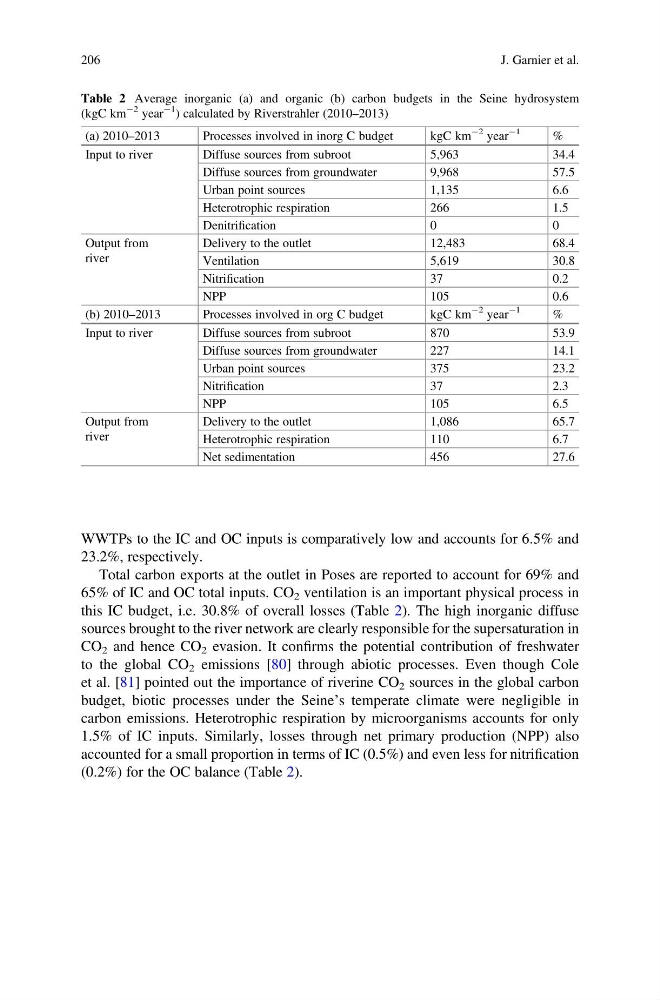
Total carbon exports at the outlet in Poses are reported to account for 69% and
65% of IC and OC total inputs. CO 2 ventilation is an important physical process in
this IC budget, i.e. 30.8% of overall losses (Table 2). The high inorganic diffuse
sources brought to the river network are clearly responsible for the supersaturation in
CO 2 and hence CO 2 evasion. It confirms the potential contribution of freshwater
to the global CO 2 emissions [80] through abiotic processes. Even though Cole
et al. [81] pointed out the importance of riverine CO 2 sources in the global carbon
budget, biotic processes under the Seine’s temperate climate were negligible in
carbon emissions. Heterotrophic respiration by microorganisms accounts for only
1.5% of IC inputs. Similarly, losses through net primary production (NPP) also
accounted for a small proportion in terms of IC (0.5%) and even less for nitrification
(0.2%) for the OC balance (Table 2).
Table 2 Average inorganic (a) and organic (b) carbon budgets in the Seine hydrosystem
(kgC km
À2 year
À1
) calculated by Riverstrahler (2010–2013)
(a) 2010–2013
Processes involved in inorg C budget
kgC km
À2 year
À1
%
Input to river
Diffuse sources from subroot
5,963
34.4
Diffuse sources from groundwater
9,968
57.5
Urban point sources
1,135
6.6
Heterotrophic respiration
266
1.5
Denitrification
0
0
Output from
river
Delivery to the outlet
12,483
68.4
Ventilation
5,619
30.8
Nitrification
37
0.2
NPP
105
0.6
(b) 2010–2013
Processes involved in org C budget
kgC km
À2 year
À1
%
Input to river
Diffuse sources from subroot
870
53.9
Diffuse sources from groundwater
227
14.1
Urban point sources
375
23.2
Nitrification
37
2.3
NPP
105
6.5
Output from
river
Delivery to the outlet
1,086
65.7
Heterotrophic respiration
110
6.7
Net sedimentation
456
27.6
206
J. Garnier et al.
23.2%, respectively.
Total carbon exports at the outlet in Poses are reported to account for 69% and
65% of IC and OC total inputs. CO 2 ventilation is an important physical process in
this IC budget, i.e. 30.8% of overall losses (Table 2). The high inorganic diffuse
sources brought to the river network are clearly responsible for the supersaturation in
CO 2 and hence CO 2 evasion. It confirms the potential contribution of freshwater
to the global CO 2 emissions [80] through abiotic processes. Even though Cole
et al. [81] pointed out the importance of riverine CO 2 sources in the global carbon
budget, biotic processes under the Seine’s temperate climate were negligible in
carbon emissions. Heterotrophic respiration by microorganisms accounts for only
1.5% of IC inputs. Similarly, losses through net primary production (NPP) also
accounted for a small proportion in terms of IC (0.5%) and even less for nitrification
(0.2%) for the OC balance (Table 2).
Table 2 Average inorganic (a) and organic (b) carbon budgets in the Seine hydrosystem
(kgC km
À2 year
À1
) calculated by Riverstrahler (2010–2013)
(a) 2010–2013
Processes involved in inorg C budget
kgC km
À2 year
À1
%
Input to river
Diffuse sources from subroot
5,963
34.4
Diffuse sources from groundwater
9,968
57.5
Urban point sources
1,135
6.6
Heterotrophic respiration
266
1.5
Denitrification
0
0
Output from
river
Delivery to the outlet
12,483
68.4
Ventilation
5,619
30.8
Nitrification
37
0.2
NPP
105
0.6
(b) 2010–2013
Processes involved in org C budget
kgC km
À2 year
À1
%
Input to river
Diffuse sources from subroot
870
53.9
Diffuse sources from groundwater
227
14.1
Urban point sources
375
23.2
Nitrification
37
2.3
NPP
105
6.5
Output from
river
Delivery to the outlet
1,086
65.7
Heterotrophic respiration
110
6.7
Net sedimentation
456
27.6
206
J. Garnier et al.