

Vigneron Champenois was especially useful for the reconstitution of phytosanitary
practices on Champagne vineyards since the 1970s [29]. However, because of the
large number of possible treatments, it was necessary to quantify and validate it with
“experts” [19–21]. Furthermore, we obtained sales for corn weed control products
since the 1970s from the main cooperative in the sector (Champagne Céréales).
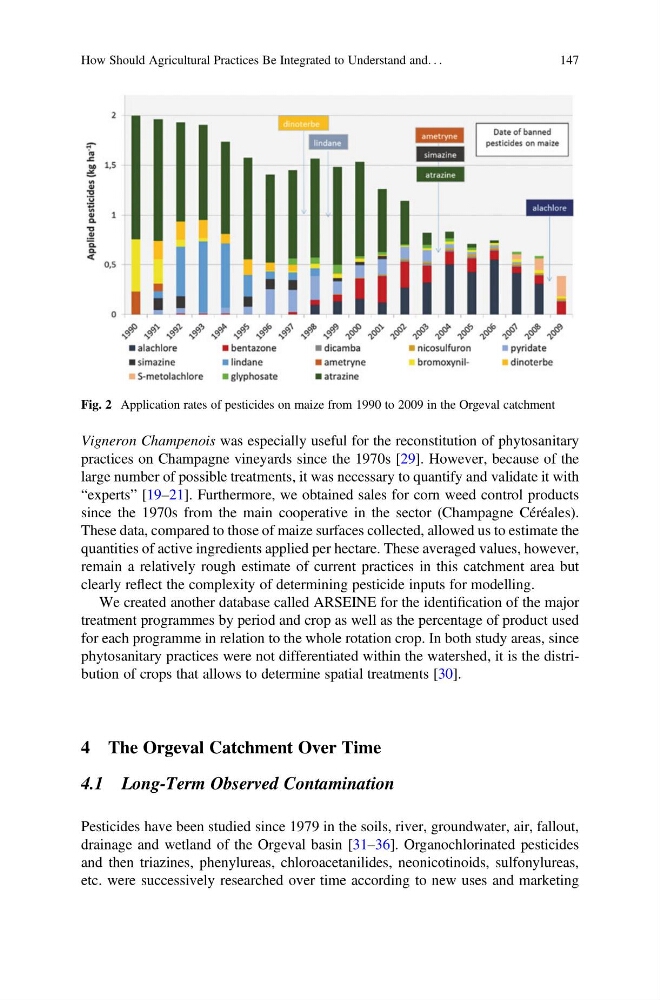
These data, compared to those of maize surfaces collected, allowed us to estimate the
quantities of active ingredients applied per hectare. These averaged values, however,
remain a relatively rough estimate of current practices in this catchment area but
clearly reflect the complexity of determining pesticide inputs for modelling.
We created another database called ARSEINE for the identification of the major
treatment programmes by period and crop as well as the percentage of product used
for each programme in relation to the whole rotation crop. In both study areas, since
phytosanitary practices were not differentiated within the watershed, it is the distribution of crops that allows to determine spatial treatments [30].
4 The Orgeval Catchment Over Time
4.1 Long-Term Observed Contamination
Pesticides have been studied since 1979 in the soils, river, groundwater, air, fallout,
drainage and wetland of the Orgeval basin [31–36]. Organochlorinated pesticides
and then triazines, phenylureas, chloroacetanilides, neonicotinoids, sulfonylureas,
etc. were successively researched over time according to new uses and marketing
Fig. 2 Application rates of pesticides on maize from 1990 to 2009 in the Orgeval catchment
How Should Agricultural Practices Be Integrated to Understand and. . .
147
practices on Champagne vineyards since the 1970s [29]. However, because of the
large number of possible treatments, it was necessary to quantify and validate it with
“experts” [19–21]. Furthermore, we obtained sales for corn weed control products
since the 1970s from the main cooperative in the sector (Champagne Céréales).
These data, compared to those of maize surfaces collected, allowed us to estimate the
quantities of active ingredients applied per hectare. These averaged values, however,
remain a relatively rough estimate of current practices in this catchment area but
clearly reflect the complexity of determining pesticide inputs for modelling.
We created another database called ARSEINE for the identification of the major
treatment programmes by period and crop as well as the percentage of product used
for each programme in relation to the whole rotation crop. In both study areas, since
phytosanitary practices were not differentiated within the watershed, it is the distribution of crops that allows to determine spatial treatments [30].
4 The Orgeval Catchment Over Time
4.1 Long-Term Observed Contamination
Pesticides have been studied since 1979 in the soils, river, groundwater, air, fallout,
drainage and wetland of the Orgeval basin [31–36]. Organochlorinated pesticides
and then triazines, phenylureas, chloroacetanilides, neonicotinoids, sulfonylureas,
etc. were successively researched over time according to new uses and marketing
Fig. 2 Application rates of pesticides on maize from 1990 to 2009 in the Orgeval catchment
How Should Agricultural Practices Be Integrated to Understand and. . .
147