

a profound change in the sociotechnical system associated with human excreta
management. It still represents a niche innovation, but it is currently gaining
attention in the Seine River basin. In October 2018, the Seine-Normandy Basin
Committee
7 voted up to an 80% subsidy to source-separating projects.
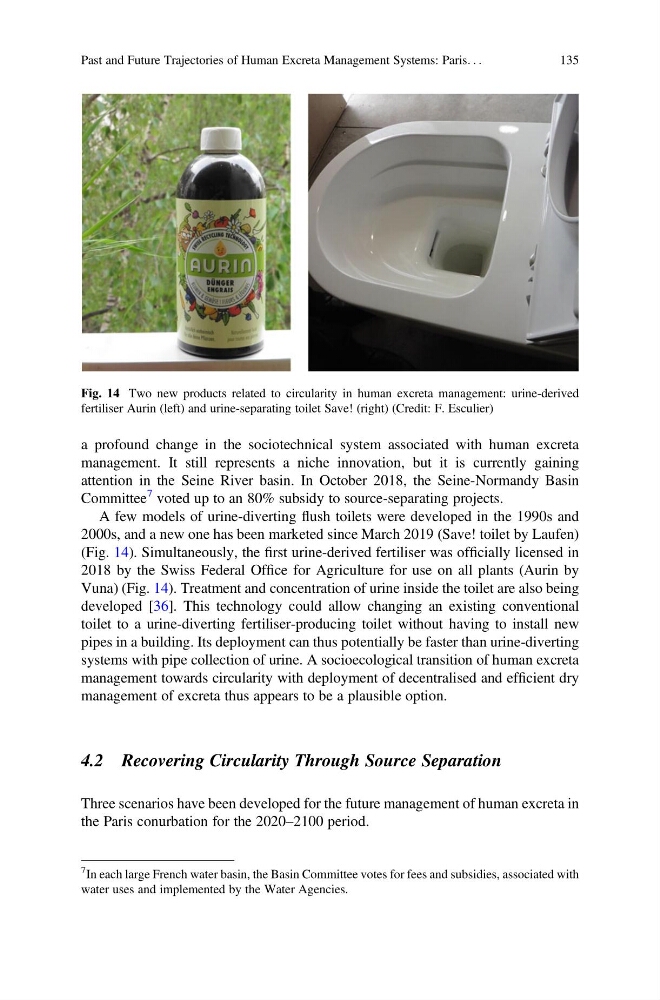
A few models of urine-diverting flush toilets were developed in the 1990s and
2000s, and a new one has been marketed since March 2019 (Save! toilet by Laufen)
(Fig. 14). Simultaneously, the first urine-derived fertiliser was officially licensed in
2018 by the Swiss Federal Office for Agriculture for use on all plants (Aurin by
Vuna) (Fig. 14). Treatment and concentration of urine inside the toilet are also being
developed [36]. This technology could allow changing an existing conventional
toilet to a urine-diverting fertiliser-producing toilet without having to install new
pipes in a building. Its deployment can thus potentially be faster than urine-diverting
systems with pipe collection of urine. A socioecological transition of human excreta
management towards circularity with deployment of decentralised and efficient dry
management of excreta thus appears to be a plausible option.
4.2 Recovering Circularity Through Source Separation
Three scenarios have been developed for the future management of human excreta in
the Paris conurbation for the 2020–2100 period.
Fig. 14 Two new products related to circularity in human excreta management: urine-derived
fertiliser Aurin (left) and urine-separating toilet Save! (right) (Credit: F. Esculier)
7 In each large French water basin, the Basin Committee votes for fees and subsidies, associated with
water uses and implemented by the Water Agencies.
Past and Future Trajectories of Human Excreta Management Systems: Paris. . .
135
management. It still represents a niche innovation, but it is currently gaining
attention in the Seine River basin. In October 2018, the Seine-Normandy Basin
Committee
7 voted up to an 80% subsidy to source-separating projects.
A few models of urine-diverting flush toilets were developed in the 1990s and
2000s, and a new one has been marketed since March 2019 (Save! toilet by Laufen)
(Fig. 14). Simultaneously, the first urine-derived fertiliser was officially licensed in
2018 by the Swiss Federal Office for Agriculture for use on all plants (Aurin by
Vuna) (Fig. 14). Treatment and concentration of urine inside the toilet are also being
developed [36]. This technology could allow changing an existing conventional
toilet to a urine-diverting fertiliser-producing toilet without having to install new
pipes in a building. Its deployment can thus potentially be faster than urine-diverting
systems with pipe collection of urine. A socioecological transition of human excreta
management towards circularity with deployment of decentralised and efficient dry
management of excreta thus appears to be a plausible option.
4.2 Recovering Circularity Through Source Separation
Three scenarios have been developed for the future management of human excreta in
the Paris conurbation for the 2020–2100 period.
Fig. 14 Two new products related to circularity in human excreta management: urine-derived
fertiliser Aurin (left) and urine-separating toilet Save! (right) (Credit: F. Esculier)
7 In each large French water basin, the Basin Committee votes for fees and subsidies, associated with
water uses and implemented by the Water Agencies.
Past and Future Trajectories of Human Excreta Management Systems: Paris. . .
135