

addressed, and the Seine’s good status has still not been reached downstream of the
Paris WWTPs. Circularity was only very recently conceptualised as a possible goal
of human excreta management in the twenty-first century [7].
Considering the sociotechnical lock-in around “toilet–sewage–wastewater treatment plant”, the less disruptive progression would be the transformation of WWTPs
into recycling facilities. Since the concept of a circular economy has stepped up, the
circular WWTP is very often put forward. However, it is subjected to many
limitations. No technology is available today to implement large-scale N recovery
from wastewater. The “circular wastewater treatment plant” is usually only circular
on one element, P, but not on N, C,
6 K, etc. [7]. An unfavourable C/N ratio in mixed
sewage water (too much urinary N as compared to total wastewater C) makes it very
difficult to valorise both C and N in large-scale plants [34]. Today, the best
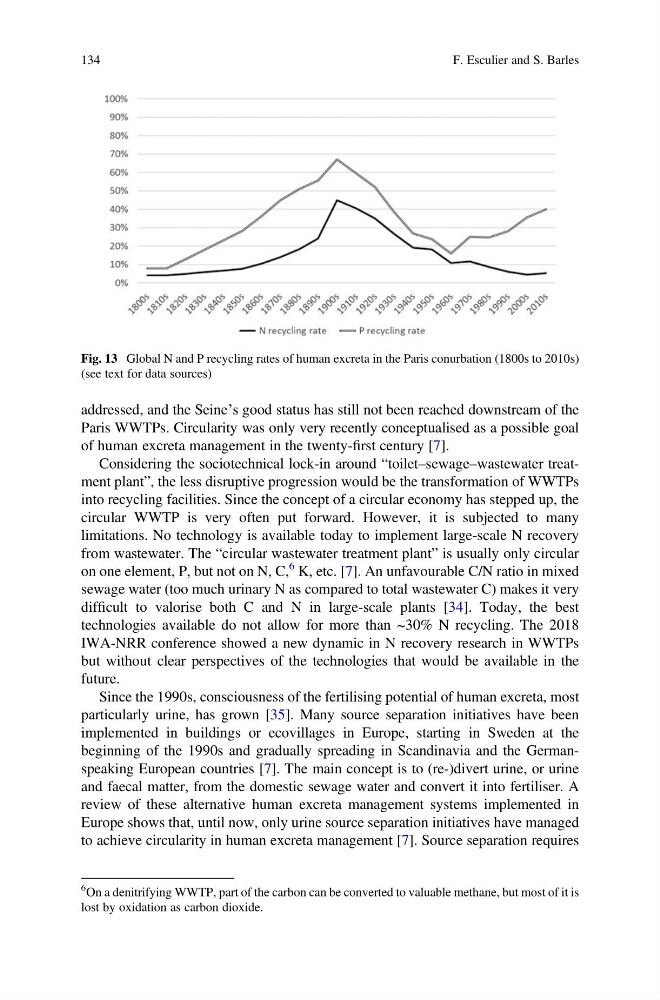
technologies available do not allow for more than ~30% N recycling. The 2018
IWA-NRR conference showed a new dynamic in N recovery research in WWTPs
but without clear perspectives of the technologies that would be available in the
future.
Since the 1990s, consciousness of the fertilising potential of human excreta, most
particularly urine, has grown [35]. Many source separation initiatives have been
implemented in buildings or ecovillages in Europe, starting in Sweden at the
beginning of the 1990s and gradually spreading in Scandinavia and the Germanspeaking European countries [7]. The main concept is to (re-)divert urine, or urine
and faecal matter, from the domestic sewage water and convert it into fertiliser. A
review of these alternative human excreta management systems implemented in
Europe shows that, until now, only urine source separation initiatives have managed
to achieve circularity in human excreta management [7]. Source separation requires
Fig. 13 Global N and P recycling rates of human excreta in the Paris conurbation (1800s to 2010s)
(see text for data sources)
6 On a denitrifying WWTP, part of the carbon can be converted to valuable methane, but most of it is
lost by oxidation as carbon dioxide.
134
F. Esculier and S. Barles
Paris WWTPs. Circularity was only very recently conceptualised as a possible goal
of human excreta management in the twenty-first century [7].
Considering the sociotechnical lock-in around “toilet–sewage–wastewater treatment plant”, the less disruptive progression would be the transformation of WWTPs
into recycling facilities. Since the concept of a circular economy has stepped up, the
circular WWTP is very often put forward. However, it is subjected to many
limitations. No technology is available today to implement large-scale N recovery
from wastewater. The “circular wastewater treatment plant” is usually only circular
on one element, P, but not on N, C,
6 K, etc. [7]. An unfavourable C/N ratio in mixed
sewage water (too much urinary N as compared to total wastewater C) makes it very
difficult to valorise both C and N in large-scale plants [34]. Today, the best
technologies available do not allow for more than ~30% N recycling. The 2018
IWA-NRR conference showed a new dynamic in N recovery research in WWTPs
but without clear perspectives of the technologies that would be available in the
future.
Since the 1990s, consciousness of the fertilising potential of human excreta, most
particularly urine, has grown [35]. Many source separation initiatives have been
implemented in buildings or ecovillages in Europe, starting in Sweden at the
beginning of the 1990s and gradually spreading in Scandinavia and the Germanspeaking European countries [7]. The main concept is to (re-)divert urine, or urine
and faecal matter, from the domestic sewage water and convert it into fertiliser. A
review of these alternative human excreta management systems implemented in
Europe shows that, until now, only urine source separation initiatives have managed
to achieve circularity in human excreta management [7]. Source separation requires
Fig. 13 Global N and P recycling rates of human excreta in the Paris conurbation (1800s to 2010s)
(see text for data sources)
6 On a denitrifying WWTP, part of the carbon can be converted to valuable methane, but most of it is
lost by oxidation as carbon dioxide.
134
F. Esculier and S. Barles