

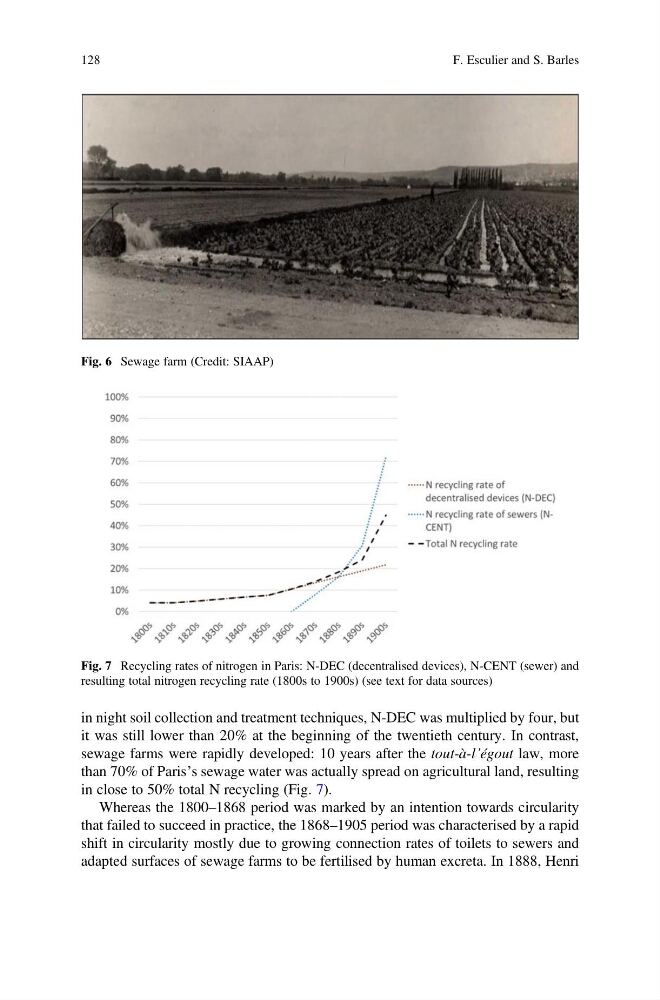
in night soil collection and treatment techniques, N-DEC was multiplied by four, but
it was still lower than 20% at the beginning of the twentieth century. In contrast,
sewage farms were rapidly developed: 10 years after the tout-à-l’égout law, more
than 70% of Paris’s sewage water was actually spread on agricultural land, resulting
in close to 50% total N recycling (Fig. 7).
Whereas the 1800–1868 period was marked by an intention towards circularity
that failed to succeed in practice, the 1868–1905 period was characterised by a rapid
shift in circularity mostly due to growing connection rates of toilets to sewers and
adapted surfaces of sewage farms to be fertilised by human excreta. In 1888, Henri
Fig. 6 Sewage farm (Credit: SIAAP)
Fig. 7 Recycling rates of nitrogen in Paris: N-DEC (decentralised devices), N-CENT (sewer) and
resulting total nitrogen recycling rate (1800s to 1900s) (see text for data sources)
128
F. Esculier and S. Barles
it was still lower than 20% at the beginning of the twentieth century. In contrast,
sewage farms were rapidly developed: 10 years after the tout-à-l’égout law, more
than 70% of Paris’s sewage water was actually spread on agricultural land, resulting
in close to 50% total N recycling (Fig. 7).
Whereas the 1800–1868 period was marked by an intention towards circularity
that failed to succeed in practice, the 1868–1905 period was characterised by a rapid
shift in circularity mostly due to growing connection rates of toilets to sewers and
adapted surfaces of sewage farms to be fertilised by human excreta. In 1888, Henri
Fig. 6 Sewage farm (Credit: SIAAP)
Fig. 7 Recycling rates of nitrogen in Paris: N-DEC (decentralised devices), N-CENT (sewer) and
resulting total nitrogen recycling rate (1800s to 1900s) (see text for data sources)
128
F. Esculier and S. Barles