

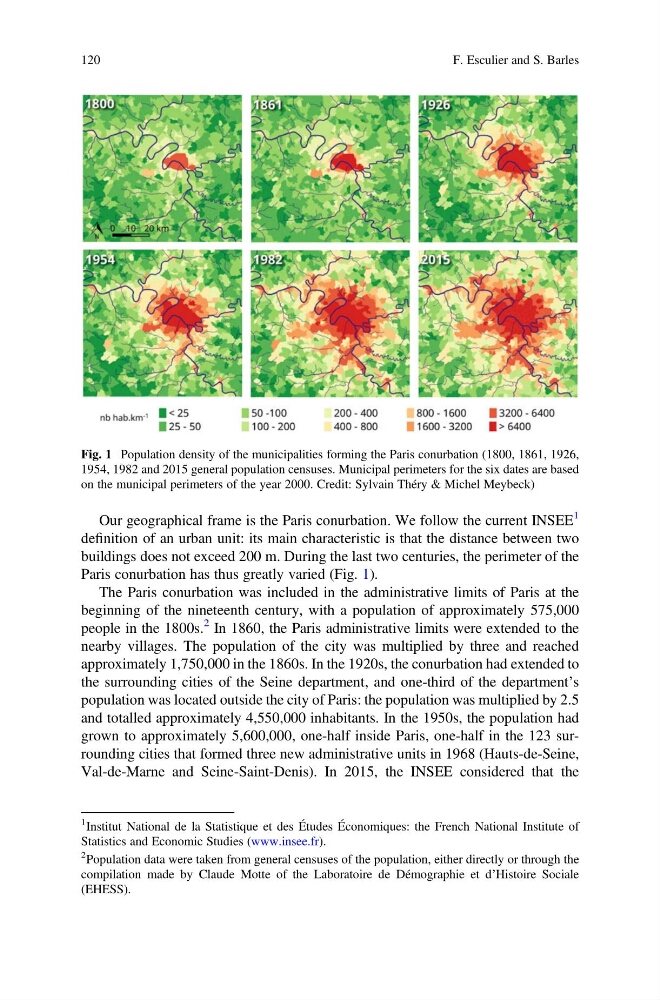
Our geographical frame is the Paris conurbation. We follow the current INSEE
1
definition of an urban unit: its main characteristic is that the distance between two
buildings does not exceed 200 m. During the last two centuries, the perimeter of the
Paris conurbation has thus greatly varied (Fig. 1).
The Paris conurbation was included in the administrative limits of Paris at the
beginning of the nineteenth century, with a population of approximately 575,000
people in the 1800s.
2 In 1860, the Paris administrative limits were extended to the
nearby villages. The population of the city was multiplied by three and reached
approximately 1,750,000 in the 1860s. In the 1920s, the conurbation had extended to
the surrounding cities of the Seine department, and one-third of the department’s
population was located outside the city of Paris: the population was multiplied by 2.5
and totalled approximately 4,550,000 inhabitants. In the 1950s, the population had
grown to approximately 5,600,000, one-half inside Paris, one-half in the 123 surrounding cities that formed three new administrative units in 1968 (Hauts-de-Seine,
Val-de-Marne and Seine-Saint-Denis). In 2015, the INSEE considered that the
Fig. 1 Population density of the municipalities forming the Paris conurbation (1800, 1861, 1926,
1954, 1982 and 2015 general population censuses. Municipal perimeters for the six dates are based
on the municipal perimeters of the year 2000. Credit: Sylvain Théry & Michel Meybeck)
1 Institut National de la Statistique et des Études Économiques: the French National Institute of
Statistics and Economic Studies (www.insee.fr).
2 Population data were taken from general censuses of the population, either directly or through the
compilation made by Claude Motte of the Laboratoire de Démographie et d’Histoire Sociale
(EHESS).
120
F. Esculier and S. Barles
1
definition of an urban unit: its main characteristic is that the distance between two
buildings does not exceed 200 m. During the last two centuries, the perimeter of the
Paris conurbation has thus greatly varied (Fig. 1).
The Paris conurbation was included in the administrative limits of Paris at the
beginning of the nineteenth century, with a population of approximately 575,000
people in the 1800s.
2 In 1860, the Paris administrative limits were extended to the
nearby villages. The population of the city was multiplied by three and reached
approximately 1,750,000 in the 1860s. In the 1920s, the conurbation had extended to
the surrounding cities of the Seine department, and one-third of the department’s
population was located outside the city of Paris: the population was multiplied by 2.5
and totalled approximately 4,550,000 inhabitants. In the 1950s, the population had
grown to approximately 5,600,000, one-half inside Paris, one-half in the 123 surrounding cities that formed three new administrative units in 1968 (Hauts-de-Seine,
Val-de-Marne and Seine-Saint-Denis). In 2015, the INSEE considered that the
Fig. 1 Population density of the municipalities forming the Paris conurbation (1800, 1861, 1926,
1954, 1982 and 2015 general population censuses. Municipal perimeters for the six dates are based
on the municipal perimeters of the year 2000. Credit: Sylvain Théry & Michel Meybeck)
1 Institut National de la Statistique et des Études Économiques: the French National Institute of
Statistics and Economic Studies (www.insee.fr).
2 Population data were taken from general censuses of the population, either directly or through the
compilation made by Claude Motte of the Laboratoire de Démographie et d’Histoire Sociale
(EHESS).
120
F. Esculier and S. Barles