

because their sorption behavior is far more complex than the partitioning of neutral
organic chemicals. In general, relevant sorption of IOCs can be expected, if the
sorption phase exhibits charged functional groups, as many environmental sorbents
do. Possible environmental sorption phases of concern include soil components with
high ion exchange capacity (e.g., clay minerals and organic matter) and biological
matrices such as proteins and zwitterionic head groups of phospholipids. This
manuscript outlines physicochemical principles of ion sorption and reviews the
current scientific knowledge regarding bioaccumulation and toxicity of IOCs. Furthermore, examples of experimental studies on ion sorption are presented and
existing modeling approaches for the sorption of IOCs are discussed.
2 Physicochemical Principles of Ion Sorption
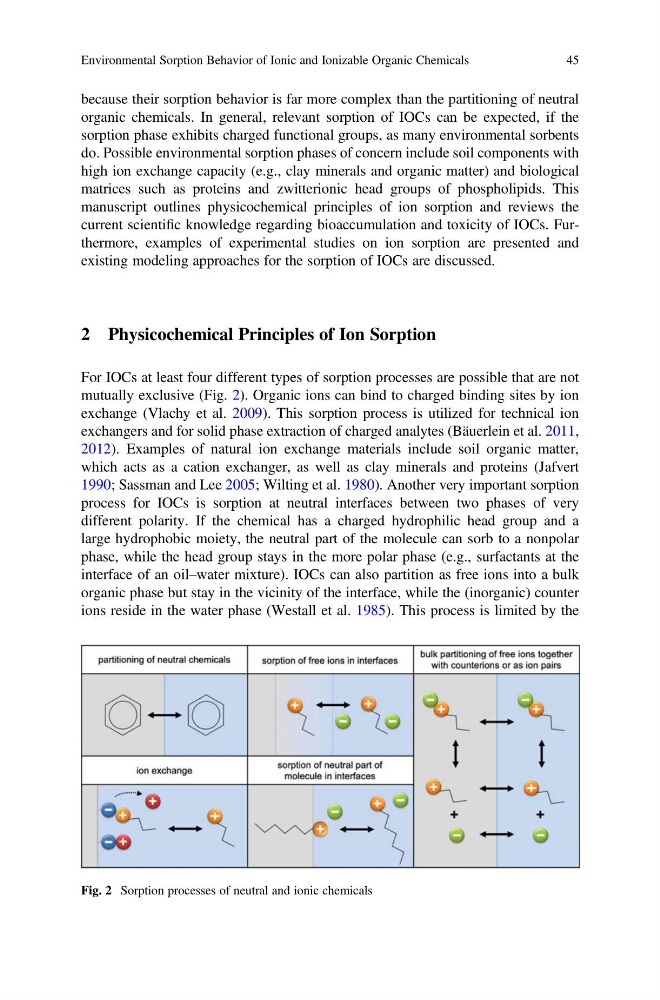
For IOCs at least four different types of sorption processes are possible that are not
mutually exclusive (Fig. 2). Organic ions can bind to charged binding sites by ion
exchange (Vlachy et al. 2009). This sorption process is utilized for technical ion
exchangers and for solid phase extraction of charged analytes (Bäuerlein et al. 2011,
2012). Examples of natural ion exchange materials include soil organic matter,
which acts as a cation exchanger, as well as clay minerals and proteins (Jafvert
1990; Sassman and Lee 2005; Wilting et al. 1980). Another very important sorption
process for IOCs is sorption at neutral interfaces between two phases of very
different polarity. If the chemical has a charged hydrophilic head group and a
large hydrophobic moiety, the neutral part of the molecule can sorb to a nonpolar
phase, while the head group stays in the more polar phase (e.g., surfactants at the
interface of an oil–water mixture). IOCs can also partition as free ions into a bulk
organic phase but stay in the vicinity of the interface, while the (inorganic) counter
ions reside in the water phase (Westall et al. 1985). This process is limited by the
Fig. 2 Sorption processes of neutral and ionic chemicals
Environmental Sorption Behavior of Ionic and Ionizable Organic Chemicals
45
organic chemicals. In general, relevant sorption of IOCs can be expected, if the
sorption phase exhibits charged functional groups, as many environmental sorbents
do. Possible environmental sorption phases of concern include soil components with
high ion exchange capacity (e.g., clay minerals and organic matter) and biological
matrices such as proteins and zwitterionic head groups of phospholipids. This
manuscript outlines physicochemical principles of ion sorption and reviews the
current scientific knowledge regarding bioaccumulation and toxicity of IOCs. Furthermore, examples of experimental studies on ion sorption are presented and
existing modeling approaches for the sorption of IOCs are discussed.
2 Physicochemical Principles of Ion Sorption
For IOCs at least four different types of sorption processes are possible that are not
mutually exclusive (Fig. 2). Organic ions can bind to charged binding sites by ion
exchange (Vlachy et al. 2009). This sorption process is utilized for technical ion
exchangers and for solid phase extraction of charged analytes (Bäuerlein et al. 2011,
2012). Examples of natural ion exchange materials include soil organic matter,
which acts as a cation exchanger, as well as clay minerals and proteins (Jafvert
1990; Sassman and Lee 2005; Wilting et al. 1980). Another very important sorption
process for IOCs is sorption at neutral interfaces between two phases of very
different polarity. If the chemical has a charged hydrophilic head group and a
large hydrophobic moiety, the neutral part of the molecule can sorb to a nonpolar
phase, while the head group stays in the more polar phase (e.g., surfactants at the
interface of an oil–water mixture). IOCs can also partition as free ions into a bulk
organic phase but stay in the vicinity of the interface, while the (inorganic) counter
ions reside in the water phase (Westall et al. 1985). This process is limited by the
Fig. 2 Sorption processes of neutral and ionic chemicals
Environmental Sorption Behavior of Ionic and Ionizable Organic Chemicals
45