

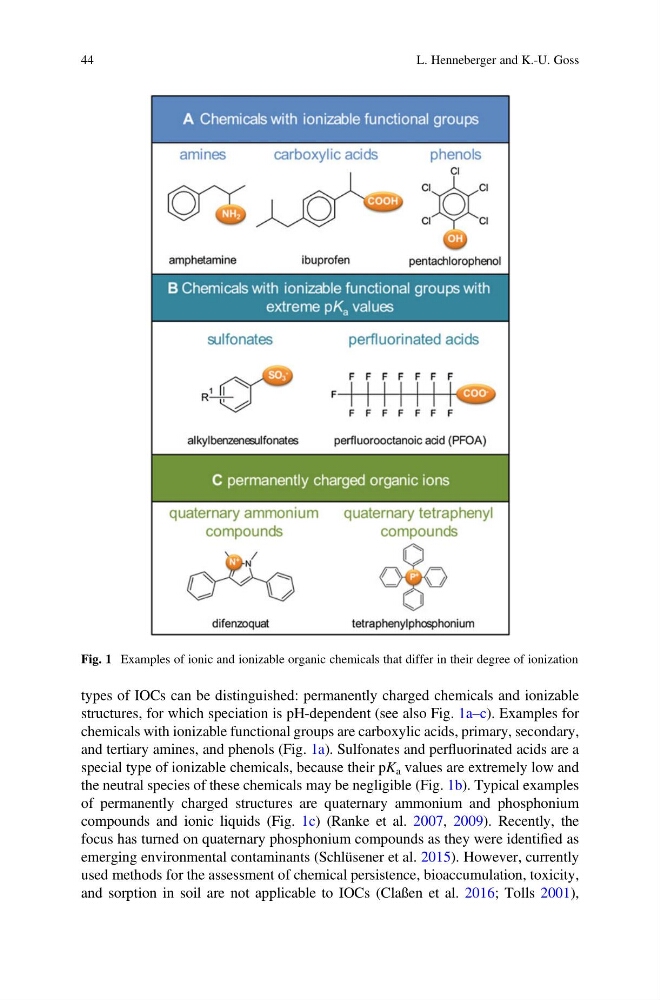
types of IOCs can be distinguished: permanently charged chemicals and ionizable
structures, for which speciation is pH-dependent (see also Fig. 1a–c). Examples for
chemicals with ionizable functional groups are carboxylic acids, primary, secondary,
and tertiary amines, and phenols (Fig. 1a). Sulfonates and perfluorinated acids are a
special type of ionizable chemicals, because their pK a values are extremely low and
the neutral species of these chemicals may be negligible (Fig. 1b). Typical examples
of permanently charged structures are quaternary ammonium and phosphonium
compounds and ionic liquids (Fig. 1c) (Ranke et al. 2007, 2009). Recently, the
focus has turned on quaternary phosphonium compounds as they were identified as
emerging environmental contaminants (Schlüsener et al. 2015). However, currently
used methods for the assessment of chemical persistence, bioaccumulation, toxicity,
and sorption in soil are not applicable to IOCs (Claßen et al. 2016; Tolls 2001),
Fig. 1 Examples of ionic and ionizable organic chemicals that differ in their degree of ionization
44
L. Henneberger and K.-U. Goss
structures, for which speciation is pH-dependent (see also Fig. 1a–c). Examples for
chemicals with ionizable functional groups are carboxylic acids, primary, secondary,
and tertiary amines, and phenols (Fig. 1a). Sulfonates and perfluorinated acids are a
special type of ionizable chemicals, because their pK a values are extremely low and
the neutral species of these chemicals may be negligible (Fig. 1b). Typical examples
of permanently charged structures are quaternary ammonium and phosphonium
compounds and ionic liquids (Fig. 1c) (Ranke et al. 2007, 2009). Recently, the
focus has turned on quaternary phosphonium compounds as they were identified as
emerging environmental contaminants (Schlüsener et al. 2015). However, currently
used methods for the assessment of chemical persistence, bioaccumulation, toxicity,
and sorption in soil are not applicable to IOCs (Claßen et al. 2016; Tolls 2001),
Fig. 1 Examples of ionic and ionizable organic chemicals that differ in their degree of ionization
44
L. Henneberger and K.-U. Goss