

2008, 2015). Besides isotopic ratio measurements, lipid content assessment is
recommended for studies focused on hydrophobic contaminants such as PCBs
(Walters et al. 2008; Coat et al. 2011). Although using stable isotopes of C and N
offers interesting perspectives to learn prey and consumer trophic positions and thus
demonstrate trophic transfer through food webs, the technique does require sophisticated and expensive equipment (Burns and Ryder 2001). Moreover, the results of
stable isotope measurements in microbial biofilms represent a “mean” of different
signatures (bacteria, algae), which could be a limiting factor for determining accurate
relationships between selective grazers and their specific food source within biofilm
communities.
4.2 Role of Microbial Biofilms in Contaminant Transfers
Through Aquatic Food Webs
The food web interactions of microbial biofilms concern insects, gastropods, fish,
and shrimps. Some of these grazers may exhibit food preferences and thus preferentially consume specific microbial groups or taxa. For instance, the shrimp Paratya
australiensis was shown to specifically reduce diatom biomass in grazed biofilms,
indirectly enhancing the green algal growth (Burns 1997). Besides affecting the
composition of biofilms, grazers can also impact their 3D architecture (Robson and
Barmuta 1998). However, in return, grazers can be influenced by the nutritional
quality of the biofilm as well as its contaminant content. It is well known that
microbial biofilms are a primary food resource in aquatic ecosystems, yet few studies
have investigated contaminants transfers from microbial biofilms through aquatic
food webs and the resulting bioaccumulation through trophic transfer (e.g., Jardine
et al. 2013; Walters et al. 2015), or feedback-loop control of other ecosystem
components on contaminant concentrations in periphytic communities (Roessink
et al. 2010). In addition, most of these studies focused on the trophic transfer of
contaminants from periphytic biofilms to primary consumers and, more rarely, to
predators, which limits the assessment of biomagnification processes (i.e., increasing
contaminant concentrations with increasing trophic levels) through food webs
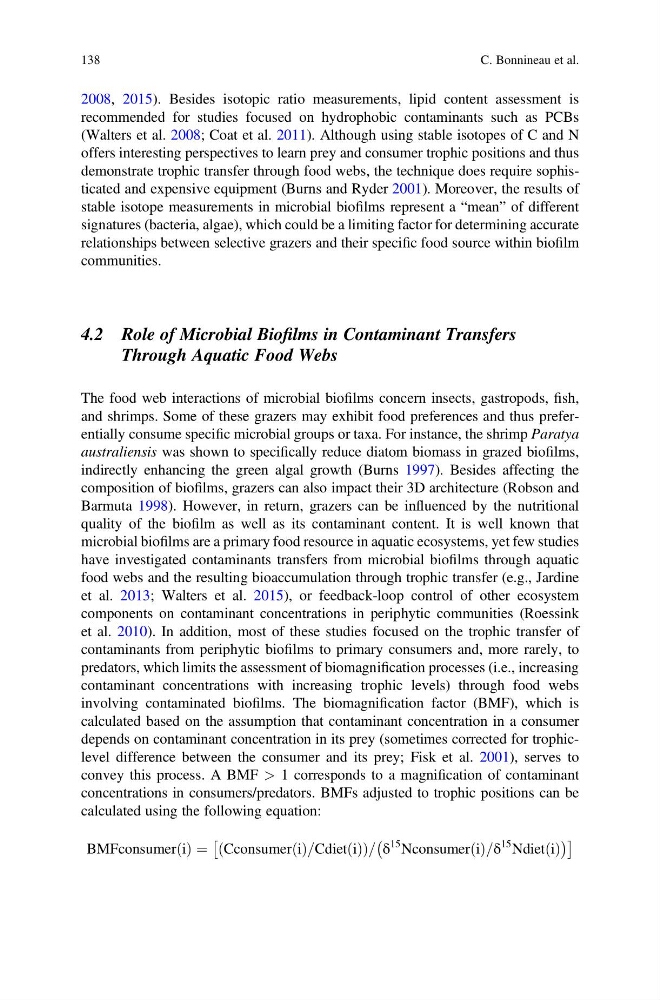
involving contaminated biofilms. The biomagnification factor (BMF), which is
calculated based on the assumption that contaminant concentration in a consumer
depends on contaminant concentration in its prey (sometimes corrected for trophiclevel difference between the consumer and its prey; Fisk et al. 2001), serves to
convey this process. A BMF > 1 corresponds to a magnification of contaminant
concentrations in consumers/predators. BMFs adjusted to trophic positions can be
calculated using the following equation:
BMFconsumer i
ð Þ ¼ Cconsumer i
ð Þ=Cdiet i
ð Þ
ð
Þ = δ
15 Nconsumer i
ð Þ=δ
15 Ndiet i
ð Þ
À
Á
Â
Ã
138
C. Bonnineau et al.
recommended for studies focused on hydrophobic contaminants such as PCBs
(Walters et al. 2008; Coat et al. 2011). Although using stable isotopes of C and N
offers interesting perspectives to learn prey and consumer trophic positions and thus
demonstrate trophic transfer through food webs, the technique does require sophisticated and expensive equipment (Burns and Ryder 2001). Moreover, the results of
stable isotope measurements in microbial biofilms represent a “mean” of different
signatures (bacteria, algae), which could be a limiting factor for determining accurate
relationships between selective grazers and their specific food source within biofilm
communities.
4.2 Role of Microbial Biofilms in Contaminant Transfers
Through Aquatic Food Webs
The food web interactions of microbial biofilms concern insects, gastropods, fish,
and shrimps. Some of these grazers may exhibit food preferences and thus preferentially consume specific microbial groups or taxa. For instance, the shrimp Paratya
australiensis was shown to specifically reduce diatom biomass in grazed biofilms,
indirectly enhancing the green algal growth (Burns 1997). Besides affecting the
composition of biofilms, grazers can also impact their 3D architecture (Robson and
Barmuta 1998). However, in return, grazers can be influenced by the nutritional
quality of the biofilm as well as its contaminant content. It is well known that
microbial biofilms are a primary food resource in aquatic ecosystems, yet few studies
have investigated contaminants transfers from microbial biofilms through aquatic
food webs and the resulting bioaccumulation through trophic transfer (e.g., Jardine
et al. 2013; Walters et al. 2015), or feedback-loop control of other ecosystem
components on contaminant concentrations in periphytic communities (Roessink
et al. 2010). In addition, most of these studies focused on the trophic transfer of
contaminants from periphytic biofilms to primary consumers and, more rarely, to
predators, which limits the assessment of biomagnification processes (i.e., increasing
contaminant concentrations with increasing trophic levels) through food webs
involving contaminated biofilms. The biomagnification factor (BMF), which is
calculated based on the assumption that contaminant concentration in a consumer
depends on contaminant concentration in its prey (sometimes corrected for trophiclevel difference between the consumer and its prey; Fisk et al. 2001), serves to
convey this process. A BMF > 1 corresponds to a magnification of contaminant
concentrations in consumers/predators. BMFs adjusted to trophic positions can be
calculated using the following equation:
BMFconsumer i
ð Þ ¼ Cconsumer i
ð Þ=Cdiet i
ð Þ
ð
Þ = δ
15 Nconsumer i
ð Þ=δ
15 Ndiet i
ð Þ
À
Á
Â
Ã
138
C. Bonnineau et al.