

2 Analytical Methods for Quantification of Contaminants
in Microbial Biofilms
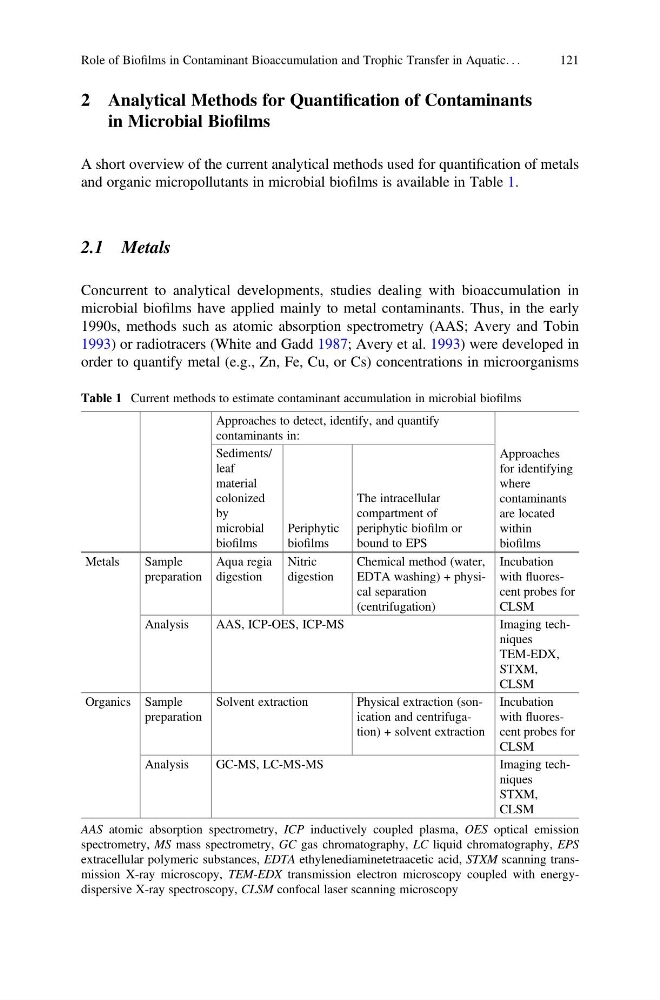
A short overview of the current analytical methods used for quantification of metals
and organic micropollutants in microbial biofilms is available in Table 1.
2.1 Metals
Concurrent to analytical developments, studies dealing with bioaccumulation in
microbial biofilms have applied mainly to metal contaminants. Thus, in the early
1990s, methods such as atomic absorption spectrometry (AAS; Avery and Tobin
1993) or radiotracers (White and Gadd 1987; Avery et al. 1993) were developed in
order to quantify metal (e.g., Zn, Fe, Cu, or Cs) concentrations in microorganisms
Table 1 Current methods to estimate contaminant accumulation in microbial biofilms
Approaches to detect, identify, and quantify
contaminants in:
Approaches
for identifying
where
contaminants
are located
within
biofilms
Sediments/
leaf
material
colonized
by
microbial
biofilms
Periphytic
biofilms
The intracellular
compartment of
periphytic biofilm or
bound to EPS
Metals
Sample
preparation
Aqua regia
digestion
Nitric
digestion
Chemical method (water,
EDTA washing) + physical separation
(centrifugation)
Incubation
with fluorescent probes for
CLSM
Analysis
AAS, ICP-OES, ICP-MS
Imaging techniques
TEM-EDX,
STXM,
CLSM
Organics Sample
preparation
Solvent extraction
Physical extraction (sonication and centrifugation) + solvent extraction
Incubation
with fluorescent probes for
CLSM
Analysis
GC-MS, LC-MS-MS
Imaging techniques
STXM,
CLSM
AAS atomic absorption spectrometry, ICP inductively coupled plasma, OES optical emission
spectrometry, MS mass spectrometry, GC gas chromatography, LC liquid chromatography, EPS
extracellular polymeric substances, EDTA ethylenediaminetetraacetic acid, STXM scanning transmission X-ray microscopy, TEM-EDX transmission electron microscopy coupled with energydispersive X-ray spectroscopy, CLSM confocal laser scanning microscopy
Role of Biofilms in Contaminant Bioaccumulation and Trophic Transfer in Aquatic. . .
121
in Microbial Biofilms
A short overview of the current analytical methods used for quantification of metals
and organic micropollutants in microbial biofilms is available in Table 1.
2.1 Metals
Concurrent to analytical developments, studies dealing with bioaccumulation in
microbial biofilms have applied mainly to metal contaminants. Thus, in the early
1990s, methods such as atomic absorption spectrometry (AAS; Avery and Tobin
1993) or radiotracers (White and Gadd 1987; Avery et al. 1993) were developed in
order to quantify metal (e.g., Zn, Fe, Cu, or Cs) concentrations in microorganisms
Table 1 Current methods to estimate contaminant accumulation in microbial biofilms
Approaches to detect, identify, and quantify
contaminants in:
Approaches
for identifying
where
contaminants
are located
within
biofilms
Sediments/
leaf
material
colonized
by
microbial
biofilms
Periphytic
biofilms
The intracellular
compartment of
periphytic biofilm or
bound to EPS
Metals
Sample
preparation
Aqua regia
digestion
Nitric
digestion
Chemical method (water,
EDTA washing) + physical separation
(centrifugation)
Incubation
with fluorescent probes for
CLSM
Analysis
AAS, ICP-OES, ICP-MS
Imaging techniques
TEM-EDX,
STXM,
CLSM
Organics Sample
preparation
Solvent extraction
Physical extraction (sonication and centrifugation) + solvent extraction
Incubation
with fluorescent probes for
CLSM
Analysis
GC-MS, LC-MS-MS
Imaging techniques
STXM,
CLSM
AAS atomic absorption spectrometry, ICP inductively coupled plasma, OES optical emission
spectrometry, MS mass spectrometry, GC gas chromatography, LC liquid chromatography, EPS
extracellular polymeric substances, EDTA ethylenediaminetetraacetic acid, STXM scanning transmission X-ray microscopy, TEM-EDX transmission electron microscopy coupled with energydispersive X-ray spectroscopy, CLSM confocal laser scanning microscopy
Role of Biofilms in Contaminant Bioaccumulation and Trophic Transfer in Aquatic. . .
121