

contaminants (e.g., metals, pesticides, or pharmaceuticals) or on biofilm growing on
one type of substratum (either cobbles, sediments, or leaf litter). An overview of the
methods available to detect, identify, quantify, and localize contaminants accumulated in biofilms growing on different types of substrata is clearly missing. Such a
methodological review is nevertheless helpful to identify conceptual and technological limitations as well as to guide method development effort. Since analytical
methods are the first essential step to measure contaminant bioaccumulation in
microbial biofilms, an overview of those methods and its specificities is essential
to facilitate the accurate interpretation of bioaccumulation results.
In this context, the present review aims to provide a critical report of:
• The analytical methods currently on use for detecting and quantifying contaminants in microbial biofilms developing in different benthic substrata (Sect. 2)
• The current state of knowledge and the future challenges concerning the role of
biofilms in contaminant accumulation (Sects. 3 and 5) as well as in trophic
transfers in the aquatic food web (Sects. 4 and 5)
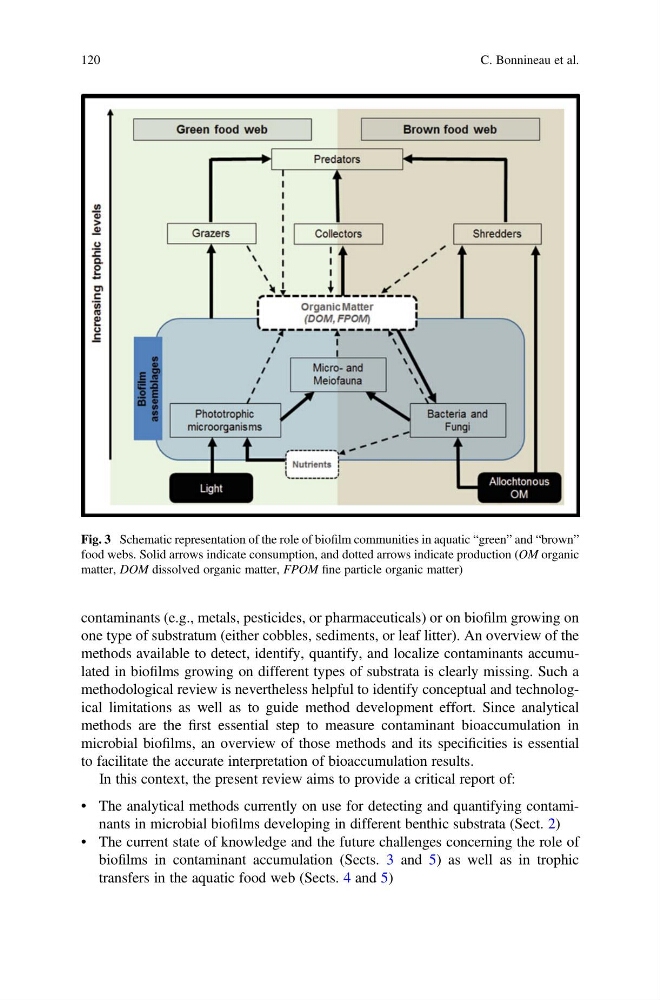
Fig. 3 Schematic representation of the role of biofilm communities in aquatic “green” and “brown”
food webs. Solid arrows indicate consumption, and dotted arrows indicate production (OM organic
matter, DOM dissolved organic matter, FPOM fine particle organic matter)
120
C. Bonnineau et al.
one type of substratum (either cobbles, sediments, or leaf litter). An overview of the
methods available to detect, identify, quantify, and localize contaminants accumulated in biofilms growing on different types of substrata is clearly missing. Such a
methodological review is nevertheless helpful to identify conceptual and technological limitations as well as to guide method development effort. Since analytical
methods are the first essential step to measure contaminant bioaccumulation in
microbial biofilms, an overview of those methods and its specificities is essential
to facilitate the accurate interpretation of bioaccumulation results.
In this context, the present review aims to provide a critical report of:
• The analytical methods currently on use for detecting and quantifying contaminants in microbial biofilms developing in different benthic substrata (Sect. 2)
• The current state of knowledge and the future challenges concerning the role of
biofilms in contaminant accumulation (Sects. 3 and 5) as well as in trophic
transfers in the aquatic food web (Sects. 4 and 5)
Fig. 3 Schematic representation of the role of biofilm communities in aquatic “green” and “brown”
food webs. Solid arrows indicate consumption, and dotted arrows indicate production (OM organic
matter, DOM dissolved organic matter, FPOM fine particle organic matter)
120
C. Bonnineau et al.