

transfers through aquatic food webs. However, investigations on this topic are
fragmentary (i.e., one substrate/one contaminant) and difficult to unify in a common
framework since they lack real representativeness for contaminant mixtures in
complex systems harboring diverse substrates and/or microbial communities.
By their complexity, microbial biofilms can have multiple interactions with
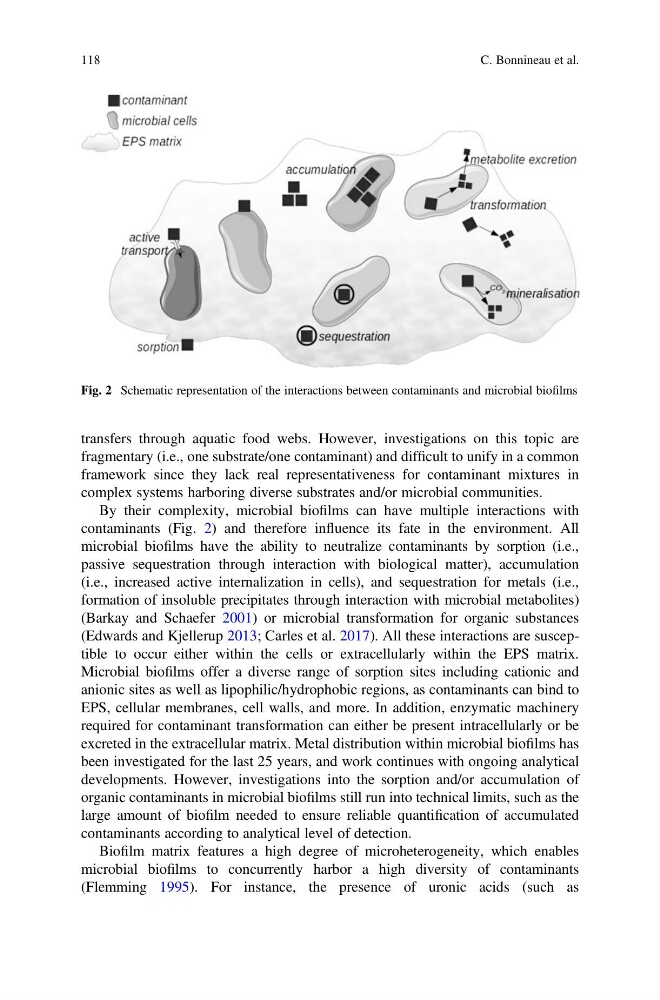
contaminants (Fig. 2) and therefore influence its fate in the environment. All
microbial biofilms have the ability to neutralize contaminants by sorption (i.e.,
passive sequestration through interaction with biological matter), accumulation
(i.e., increased active internalization in cells), and sequestration for metals (i.e.,
formation of insoluble precipitates through interaction with microbial metabolites)
(Barkay and Schaefer 2001) or microbial transformation for organic substances
(Edwards and Kjellerup 2013; Carles et al. 2017). All these interactions are susceptible to occur either within the cells or extracellularly within the EPS matrix.
Microbial biofilms offer a diverse range of sorption sites including cationic and
anionic sites as well as lipophilic/hydrophobic regions, as contaminants can bind to
EPS, cellular membranes, cell walls, and more. In addition, enzymatic machinery
required for contaminant transformation can either be present intracellularly or be
excreted in the extracellular matrix. Metal distribution within microbial biofilms has
been investigated for the last 25 years, and work continues with ongoing analytical
developments. However, investigations into the sorption and/or accumulation of
organic contaminants in microbial biofilms still run into technical limits, such as the
large amount of biofilm needed to ensure reliable quantification of accumulated
contaminants according to analytical level of detection.
Biofilm matrix features a high degree of microheterogeneity, which enables
microbial biofilms to concurrently harbor a high diversity of contaminants
(Flemming 1995). For instance, the presence of uronic acids (such as
Fig. 2 Schematic representation of the interactions between contaminants and microbial biofilms
118
C. Bonnineau et al.
fragmentary (i.e., one substrate/one contaminant) and difficult to unify in a common
framework since they lack real representativeness for contaminant mixtures in
complex systems harboring diverse substrates and/or microbial communities.
By their complexity, microbial biofilms can have multiple interactions with
contaminants (Fig. 2) and therefore influence its fate in the environment. All
microbial biofilms have the ability to neutralize contaminants by sorption (i.e.,
passive sequestration through interaction with biological matter), accumulation
(i.e., increased active internalization in cells), and sequestration for metals (i.e.,
formation of insoluble precipitates through interaction with microbial metabolites)
(Barkay and Schaefer 2001) or microbial transformation for organic substances
(Edwards and Kjellerup 2013; Carles et al. 2017). All these interactions are susceptible to occur either within the cells or extracellularly within the EPS matrix.
Microbial biofilms offer a diverse range of sorption sites including cationic and
anionic sites as well as lipophilic/hydrophobic regions, as contaminants can bind to
EPS, cellular membranes, cell walls, and more. In addition, enzymatic machinery
required for contaminant transformation can either be present intracellularly or be
excreted in the extracellular matrix. Metal distribution within microbial biofilms has
been investigated for the last 25 years, and work continues with ongoing analytical
developments. However, investigations into the sorption and/or accumulation of
organic contaminants in microbial biofilms still run into technical limits, such as the
large amount of biofilm needed to ensure reliable quantification of accumulated
contaminants according to analytical level of detection.
Biofilm matrix features a high degree of microheterogeneity, which enables
microbial biofilms to concurrently harbor a high diversity of contaminants
(Flemming 1995). For instance, the presence of uronic acids (such as
Fig. 2 Schematic representation of the interactions between contaminants and microbial biofilms
118
C. Bonnineau et al.