

prokaryotic (e.g., bacteria, cyanobacteria) microorganisms (Battin et al. 2016) whose
form, distribution, and metabolism (i.e., autotrophy, heterotrophy, mixotrophy) are
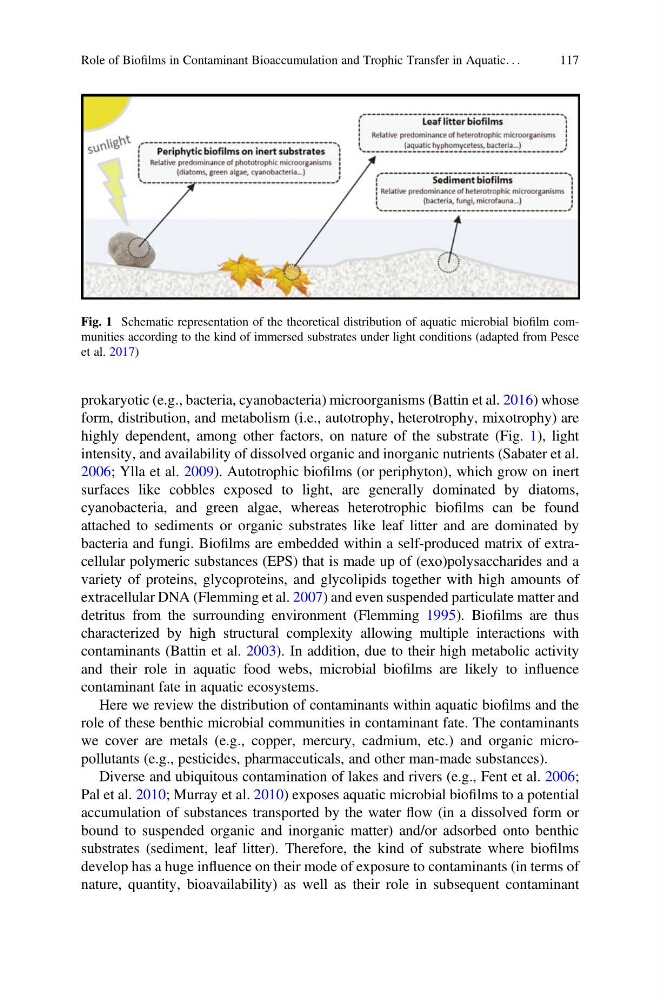
highly dependent, among other factors, on nature of the substrate (Fig. 1), light
intensity, and availability of dissolved organic and inorganic nutrients (Sabater et al.
2006; Ylla et al. 2009). Autotrophic biofilms (or periphyton), which grow on inert
surfaces like cobbles exposed to light, are generally dominated by diatoms,
cyanobacteria, and green algae, whereas heterotrophic biofilms can be found
attached to sediments or organic substrates like leaf litter and are dominated by
bacteria and fungi. Biofilms are embedded within a self-produced matrix of extracellular polymeric substances (EPS) that is made up of (exo)polysaccharides and a
variety of proteins, glycoproteins, and glycolipids together with high amounts of
extracellular DNA (Flemming et al. 2007) and even suspended particulate matter and
detritus from the surrounding environment (Flemming 1995). Biofilms are thus
characterized by high structural complexity allowing multiple interactions with
contaminants (Battin et al. 2003). In addition, due to their high metabolic activity
and their role in aquatic food webs, microbial biofilms are likely to influence
contaminant fate in aquatic ecosystems.
Here we review the distribution of contaminants within aquatic biofilms and the
role of these benthic microbial communities in contaminant fate. The contaminants
we cover are metals (e.g., copper, mercury, cadmium, etc.) and organic micropollutants (e.g., pesticides, pharmaceuticals, and other man-made substances).
Diverse and ubiquitous contamination of lakes and rivers (e.g., Fent et al. 2006;
Pal et al. 2010; Murray et al. 2010) exposes aquatic microbial biofilms to a potential
accumulation of substances transported by the water flow (in a dissolved form or
bound to suspended organic and inorganic matter) and/or adsorbed onto benthic
substrates (sediment, leaf litter). Therefore, the kind of substrate where biofilms
develop has a huge influence on their mode of exposure to contaminants (in terms of
nature, quantity, bioavailability) as well as their role in subsequent contaminant
Fig. 1 Schematic representation of the theoretical distribution of aquatic microbial biofilm communities according to the kind of immersed substrates under light conditions (adapted from Pesce
et al. 2017)
Role of Biofilms in Contaminant Bioaccumulation and Trophic Transfer in Aquatic. . .
117
form, distribution, and metabolism (i.e., autotrophy, heterotrophy, mixotrophy) are
highly dependent, among other factors, on nature of the substrate (Fig. 1), light
intensity, and availability of dissolved organic and inorganic nutrients (Sabater et al.
2006; Ylla et al. 2009). Autotrophic biofilms (or periphyton), which grow on inert
surfaces like cobbles exposed to light, are generally dominated by diatoms,
cyanobacteria, and green algae, whereas heterotrophic biofilms can be found
attached to sediments or organic substrates like leaf litter and are dominated by
bacteria and fungi. Biofilms are embedded within a self-produced matrix of extracellular polymeric substances (EPS) that is made up of (exo)polysaccharides and a
variety of proteins, glycoproteins, and glycolipids together with high amounts of
extracellular DNA (Flemming et al. 2007) and even suspended particulate matter and
detritus from the surrounding environment (Flemming 1995). Biofilms are thus
characterized by high structural complexity allowing multiple interactions with
contaminants (Battin et al. 2003). In addition, due to their high metabolic activity
and their role in aquatic food webs, microbial biofilms are likely to influence
contaminant fate in aquatic ecosystems.
Here we review the distribution of contaminants within aquatic biofilms and the
role of these benthic microbial communities in contaminant fate. The contaminants
we cover are metals (e.g., copper, mercury, cadmium, etc.) and organic micropollutants (e.g., pesticides, pharmaceuticals, and other man-made substances).
Diverse and ubiquitous contamination of lakes and rivers (e.g., Fent et al. 2006;
Pal et al. 2010; Murray et al. 2010) exposes aquatic microbial biofilms to a potential
accumulation of substances transported by the water flow (in a dissolved form or
bound to suspended organic and inorganic matter) and/or adsorbed onto benthic
substrates (sediment, leaf litter). Therefore, the kind of substrate where biofilms
develop has a huge influence on their mode of exposure to contaminants (in terms of
nature, quantity, bioavailability) as well as their role in subsequent contaminant
Fig. 1 Schematic representation of the theoretical distribution of aquatic microbial biofilm communities according to the kind of immersed substrates under light conditions (adapted from Pesce
et al. 2017)
Role of Biofilms in Contaminant Bioaccumulation and Trophic Transfer in Aquatic. . .
117