

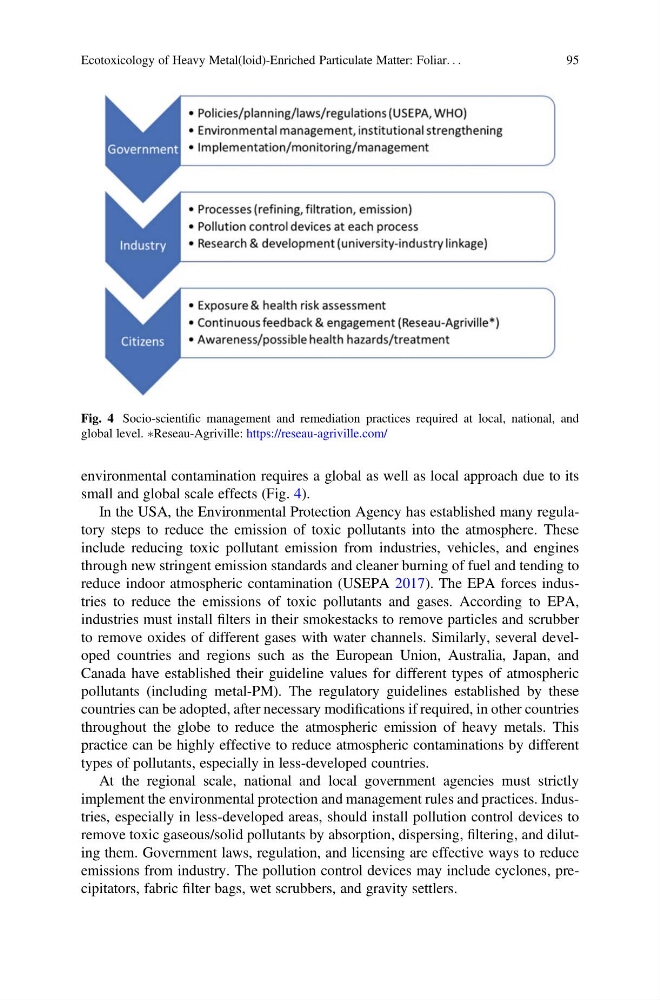
environmental contamination requires a global as well as local approach due to its
small and global scale effects (Fig. 4).
In the USA, the Environmental Protection Agency has established many regulatory steps to reduce the emission of toxic pollutants into the atmosphere. These
include reducing toxic pollutant emission from industries, vehicles, and engines
through new stringent emission standards and cleaner burning of fuel and tending to
reduce indoor atmospheric contamination (USEPA 2017). The EPA forces industries to reduce the emissions of toxic pollutants and gases. According to EPA,
industries must install filters in their smokestacks to remove particles and scrubber
to remove oxides of different gases with water channels. Similarly, several developed countries and regions such as the European Union, Australia, Japan, and
Canada have established their guideline values for different types of atmospheric
pollutants (including metal-PM). The regulatory guidelines established by these
countries can be adopted, after necessary modifications if required, in other countries
throughout the globe to reduce the atmospheric emission of heavy metals. This
practice can be highly effective to reduce atmospheric contaminations by different
types of pollutants, especially in less-developed countries.
At the regional scale, national and local government agencies must strictly
implement the environmental protection and management rules and practices. Industries, especially in less-developed areas, should install pollution control devices to
remove toxic gaseous/solid pollutants by absorption, dispersing, filtering, and diluting them. Government laws, regulation, and licensing are effective ways to reduce
emissions from industry. The pollution control devices may include cyclones, precipitators, fabric filter bags, wet scrubbers, and gravity settlers.
Fig. 4 Socio-scientific management and remediation practices required at local, national, and
global level. ÃReseau-Agriville: https://reseau-agriville.com/
Ecotoxicology of Heavy Metal(loid)-Enriched Particulate Matter: Foliar. . .
95
small and global scale effects (Fig. 4).
In the USA, the Environmental Protection Agency has established many regulatory steps to reduce the emission of toxic pollutants into the atmosphere. These
include reducing toxic pollutant emission from industries, vehicles, and engines
through new stringent emission standards and cleaner burning of fuel and tending to
reduce indoor atmospheric contamination (USEPA 2017). The EPA forces industries to reduce the emissions of toxic pollutants and gases. According to EPA,
industries must install filters in their smokestacks to remove particles and scrubber
to remove oxides of different gases with water channels. Similarly, several developed countries and regions such as the European Union, Australia, Japan, and
Canada have established their guideline values for different types of atmospheric
pollutants (including metal-PM). The regulatory guidelines established by these
countries can be adopted, after necessary modifications if required, in other countries
throughout the globe to reduce the atmospheric emission of heavy metals. This
practice can be highly effective to reduce atmospheric contaminations by different
types of pollutants, especially in less-developed countries.
At the regional scale, national and local government agencies must strictly
implement the environmental protection and management rules and practices. Industries, especially in less-developed areas, should install pollution control devices to
remove toxic gaseous/solid pollutants by absorption, dispersing, filtering, and diluting them. Government laws, regulation, and licensing are effective ways to reduce
emissions from industry. The pollution control devices may include cyclones, precipitators, fabric filter bags, wet scrubbers, and gravity settlers.
Fig. 4 Socio-scientific management and remediation practices required at local, national, and
global level. ÃReseau-Agriville: https://reseau-agriville.com/
Ecotoxicology of Heavy Metal(loid)-Enriched Particulate Matter: Foliar. . .
95