

MATERIELS AND METHODS
where:
E: is the integrated exposure index,
Zi: is the value of pressure i,
Wi: is the weight of pressure
i: and n: represents the number of pressures.
Based on a literature review (Maggi, 1972; 1973; Maggi et al., 1977; Picard 1978;
Peirano et Bianchi.,1997; Montefalcone et al 2007; McDonnell et al., 2009), we attributed a
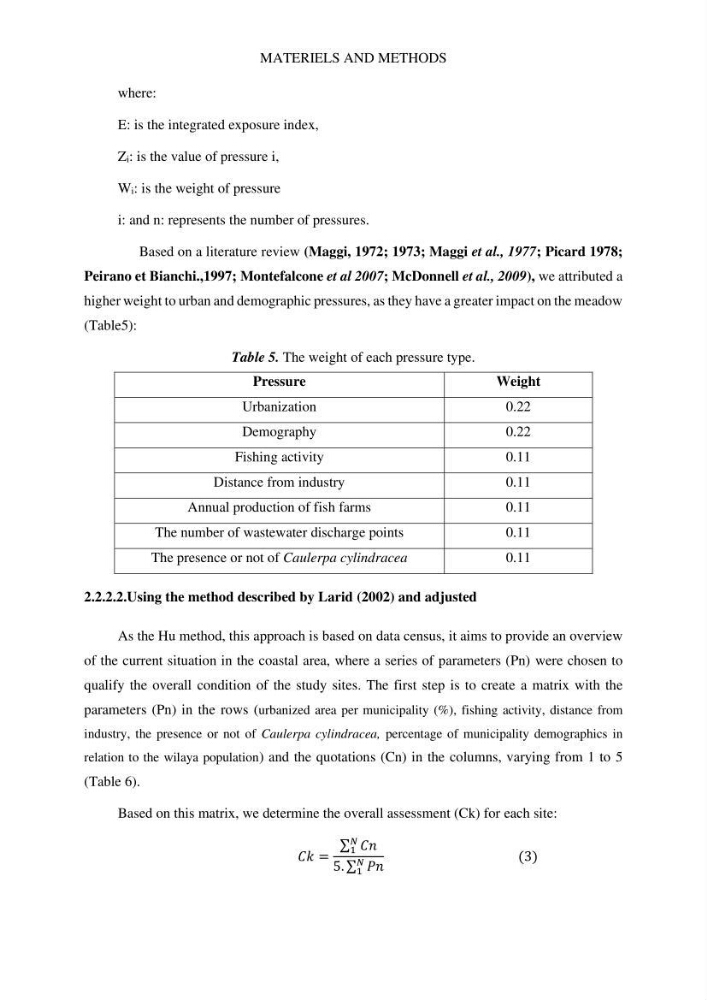
higher weight to urban and demographic pressures, as they have a greater impact on the meadow
(Table5):
Table 5. The weight of each pressure type.
Pressure
Weight
Urbanization
0.22
Demography
0.22
Fishing activity
0.11
Distance from industry
0.11
Annual production of fish farms
0.11
The number of wastewater discharge points
0.11
The presence or not of Caulerpa cylindracea
0.11
2.2.2.2.Using the method described by Larid (2002) and adjusted
As the Hu method, this approach is based on data census, it aims to provide an overview
of the current situation in the coastal area, where a series of parameters (Pn) were chosen to
qualify the overall condition of the study sites. The first step is to create a matrix with the
parameters (Pn) in the rows (urbanized area per municipality (%), fishing activity, distance from
industry, the presence or not of Caulerpa cylindracea, percentage of municipality demographics in
relation to the wilaya population) and the quotations (Cn) in the columns, varying from 1 to 5
(Table 6).
Based on this matrix, we determine the overall assessment (Ck) for each site:
í µí°¶í µí± =
∑ í µí°¶í µí±
í µí±
1
5. ∑ í µí±í µí±
í µí±
1
(3)
where:
E: is the integrated exposure index,
Zi: is the value of pressure i,
Wi: is the weight of pressure
i: and n: represents the number of pressures.
Based on a literature review (Maggi, 1972; 1973; Maggi et al., 1977; Picard 1978;
Peirano et Bianchi.,1997; Montefalcone et al 2007; McDonnell et al., 2009), we attributed a
higher weight to urban and demographic pressures, as they have a greater impact on the meadow
(Table5):
Table 5. The weight of each pressure type.
Pressure
Weight
Urbanization
0.22
Demography
0.22
Fishing activity
0.11
Distance from industry
0.11
Annual production of fish farms
0.11
The number of wastewater discharge points
0.11
The presence or not of Caulerpa cylindracea
0.11
2.2.2.2.Using the method described by Larid (2002) and adjusted
As the Hu method, this approach is based on data census, it aims to provide an overview
of the current situation in the coastal area, where a series of parameters (Pn) were chosen to
qualify the overall condition of the study sites. The first step is to create a matrix with the
parameters (Pn) in the rows (urbanized area per municipality (%), fishing activity, distance from
industry, the presence or not of Caulerpa cylindracea, percentage of municipality demographics in
relation to the wilaya population) and the quotations (Cn) in the columns, varying from 1 to 5
(Table 6).
Based on this matrix, we determine the overall assessment (Ck) for each site:
í µí°¶í µí± =
∑ í µí°¶í µí±
í µí±
1
5. ∑ í µí±í µí±
í µí±
1
(3)