

80
with iron oxides and phosphate has a high As(V) adsorption capacity of 5 mg/g
compared to carbon modified with only iron oxides (3.4 mg/g).
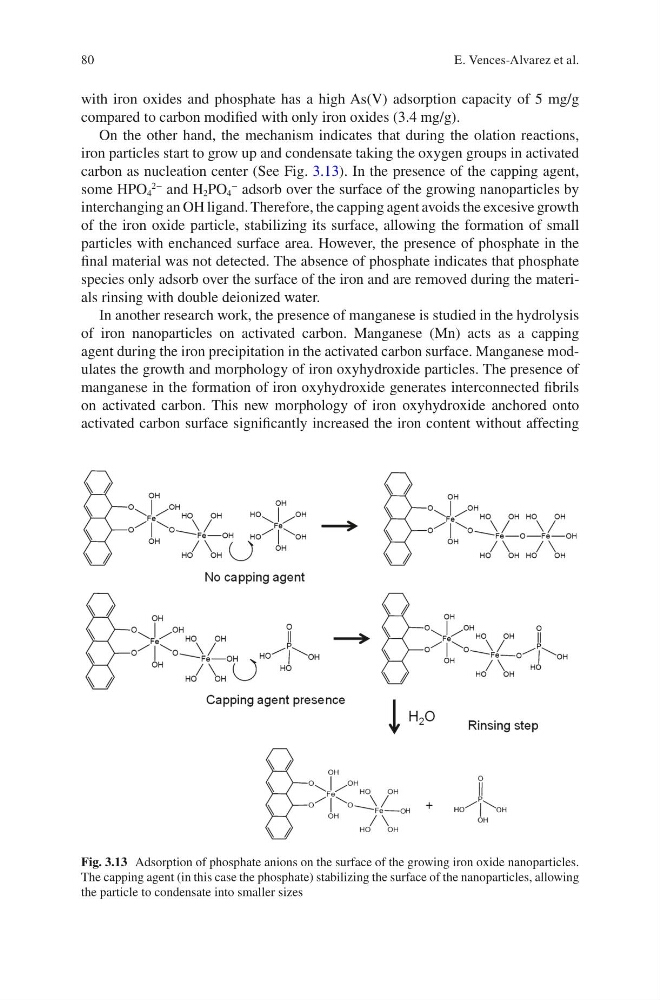
On the other hand, the mechanism indicates that during the olation reactions,
iron particles start to grow up and condensate taking the oxygen groups in activated
carbon as nucleation center (See Fig. 3.13). In the presence of the capping agent,
some HPO 4
2−
and H 2 PO 4
−
adsorb over the surface of the growing nanoparticles by
interchanging an OH ligand. Therefore, the capping agent avoids the excesive growth
of the iron oxide particle, stabilizing its surface, allowing the formation of small
particles with enchanced surface area. However, the presence of phosphate in the
final material was not detected. The absence of phosphate indicates that phosphate
species only adsorb over the surface of the iron and are removed during the materials rinsing with double deionized water.
In another research work, the presence of manganese is studied in the hydrolysis
of iron nanoparticles on activated carbon. Manganese (Mn) acts as a capping
agent during the iron precipitation in the activated carbon surface. Manganese modulates the growth and morphology of iron oxyhydroxide particles. The presence of
manganese in the formation of iron oxyhydroxide generates interconnected fibrils
on activated carbon. This new morphology of iron oxyhydroxide anchored onto
activated carbon surface significantly increased the iron content without affecting
Fig. 3.13 Adsorption of phosphate anions on the surface of the growing iron oxide nanoparticles.
The capping agent (in this case the phosphate) stabilizing the surface of the nanoparticles, allowing
the particle to condensate into smaller sizes
E. Vences-Alvarez et al.
with iron oxides and phosphate has a high As(V) adsorption capacity of 5 mg/g
compared to carbon modified with only iron oxides (3.4 mg/g).
On the other hand, the mechanism indicates that during the olation reactions,
iron particles start to grow up and condensate taking the oxygen groups in activated
carbon as nucleation center (See Fig. 3.13). In the presence of the capping agent,
some HPO 4
2−
and H 2 PO 4
−
adsorb over the surface of the growing nanoparticles by
interchanging an OH ligand. Therefore, the capping agent avoids the excesive growth
of the iron oxide particle, stabilizing its surface, allowing the formation of small
particles with enchanced surface area. However, the presence of phosphate in the
final material was not detected. The absence of phosphate indicates that phosphate
species only adsorb over the surface of the iron and are removed during the materials rinsing with double deionized water.
In another research work, the presence of manganese is studied in the hydrolysis
of iron nanoparticles on activated carbon. Manganese (Mn) acts as a capping
agent during the iron precipitation in the activated carbon surface. Manganese modulates the growth and morphology of iron oxyhydroxide particles. The presence of
manganese in the formation of iron oxyhydroxide generates interconnected fibrils
on activated carbon. This new morphology of iron oxyhydroxide anchored onto
activated carbon surface significantly increased the iron content without affecting
Fig. 3.13 Adsorption of phosphate anions on the surface of the growing iron oxide nanoparticles.
The capping agent (in this case the phosphate) stabilizing the surface of the nanoparticles, allowing
the particle to condensate into smaller sizes
E. Vences-Alvarez et al.