

79
3.4.4 Particle Size Control of Metal Oxides Using
Capping Agents
The modification of activated carbon with metal oxides has led us to consider the
physicochemical properties of both materials (Fierro et al. 2009), since the incorporation of metal oxides on activated carbon reduces the activated carbon surface area.
The reduction in the area of activated carbon can be attributed to the formation of
clusters that block the pores of activated carbons, thereby reducing the adsorption
capacity of the hybrid material. Therefore, the particle size of the metal oxides
incorporated onto activated carbon is a critical factor in the adsorption capacity of
the material. Studies have proven that smaller particles are more likely to adsorb
other molecules to become more stable (Zhang et al. 2013). Besides, a notable
increase in adsorption capacity has been observed when the particle size is ≤20 nm
(Yean et al. 2005).
Forced hydrolysis has been considered as one of the appropriate methods to synthesize iron oxyhydroxide nanoparticles (Meyer et al. 2000; Musić et al. 2003;
Kandori et al. 2006). Studies have shown that the nanoparticles have a significant
change in morphology, size, and crystallinity by adding a capping agent. Some
examples of chemical agents to modify the particle size of iron oxides are polymers,
heavy metals, surfactants, phosphates, amino acids, polymers, and silicon (Ishikawa
et al. 2002; Musić et al. 2003; Kandori et al. 2005, 2006; Kwon et al. 2007). For
example, phosphate can decrease the particle size of iron oxyhydroxides to less than
5 nm (Ishikawa et al. 2005).
In our research group, phosphate, oxalic acid, and manganese were used as capping agents, with the aim to controlling the particle size of the metal oxides incorporated in activated carbon. Arcibar-Orozco et al. (2012) used phosphate (PO 4 ) as a
protective agent in the incorporation of iron particles on the activated carbon surface. By characterization analysis, it was observed that the iron nanoparticles had a
size between 2 and 300 nm. Therefore, Fe–PO 4 -modified carbons with a molar ratio
of 1.5 showed a 40% increase in the As(V) adsorption capacity. Carbon modified
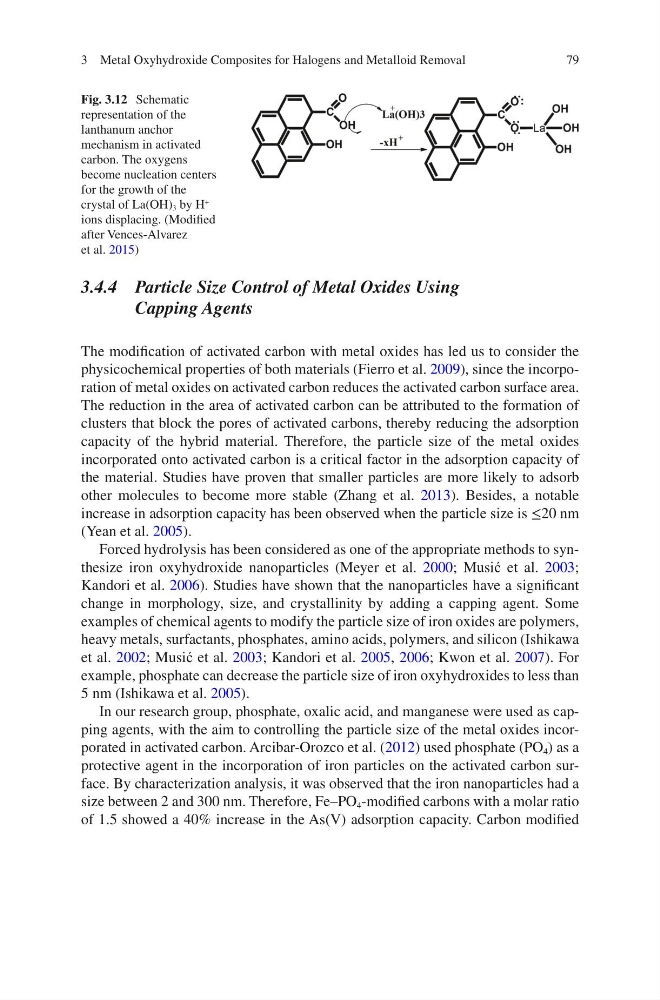
Fig. 3.12 Schematic
representation of the
lanthanum anchor
mechanism in activated
carbon. The oxygens
become nucleation centers
for the growth of the
crystal of La(OH) 3 by H
+
ions displacing. (Modified
after Vences-Alvarez
et al. 2015)
3 Metal Oxyhydroxide Composites for Halogens and Metalloid Removal
3.4.4 Particle Size Control of Metal Oxides Using
Capping Agents
The modification of activated carbon with metal oxides has led us to consider the
physicochemical properties of both materials (Fierro et al. 2009), since the incorporation of metal oxides on activated carbon reduces the activated carbon surface area.
The reduction in the area of activated carbon can be attributed to the formation of
clusters that block the pores of activated carbons, thereby reducing the adsorption
capacity of the hybrid material. Therefore, the particle size of the metal oxides
incorporated onto activated carbon is a critical factor in the adsorption capacity of
the material. Studies have proven that smaller particles are more likely to adsorb
other molecules to become more stable (Zhang et al. 2013). Besides, a notable
increase in adsorption capacity has been observed when the particle size is ≤20 nm
(Yean et al. 2005).
Forced hydrolysis has been considered as one of the appropriate methods to synthesize iron oxyhydroxide nanoparticles (Meyer et al. 2000; Musić et al. 2003;
Kandori et al. 2006). Studies have shown that the nanoparticles have a significant
change in morphology, size, and crystallinity by adding a capping agent. Some
examples of chemical agents to modify the particle size of iron oxides are polymers,
heavy metals, surfactants, phosphates, amino acids, polymers, and silicon (Ishikawa
et al. 2002; Musić et al. 2003; Kandori et al. 2005, 2006; Kwon et al. 2007). For
example, phosphate can decrease the particle size of iron oxyhydroxides to less than
5 nm (Ishikawa et al. 2005).
In our research group, phosphate, oxalic acid, and manganese were used as capping agents, with the aim to controlling the particle size of the metal oxides incorporated in activated carbon. Arcibar-Orozco et al. (2012) used phosphate (PO 4 ) as a
protective agent in the incorporation of iron particles on the activated carbon surface. By characterization analysis, it was observed that the iron nanoparticles had a
size between 2 and 300 nm. Therefore, Fe–PO 4 -modified carbons with a molar ratio
of 1.5 showed a 40% increase in the As(V) adsorption capacity. Carbon modified
Fig. 3.12 Schematic
representation of the
lanthanum anchor
mechanism in activated
carbon. The oxygens
become nucleation centers
for the growth of the
crystal of La(OH) 3 by H
+
ions displacing. (Modified
after Vences-Alvarez
et al. 2015)
3 Metal Oxyhydroxide Composites for Halogens and Metalloid Removal