

74
Due to the chemical charge of arsenate and arsenite ions at different solution
pH, the adsorption mechanism could change, including electrostatic interactions
(Chen and Huang 2012), coordination (Jun et al. 2015), and hydrogen bonds (Liu
et al. 2014). The electrostatic interactions occur mainly by attraction–repulsion
between the adsorbate and the adsorbent. When the solution pH is below the
point of zero charge of the adsorbent material, its surface is positively charged
due to hydroxyl groups on the protonated surface to form OH 2
+
(Sarkar et al.
2008). The positive charge of adsorbent material favors the adsorption of the
arsenate anion. On the other hand, when the pH is above the point of zero charge
of the adsorbent material, the hydroxyl groups of the surface are deprotonated,
whereby the material will be negatively charged. In these conditions, the arsenate
adsorption becomes unfavorable due to electrostatic repulsions (Zhang
et al. 2010).
In recent studies, zirconium oxyhydroxides have been tested for the arsenic
adsorption. He et al. 2019 used organic zirconium metal structures for the removal
of As(III) and As(V). The authors demonstrated through extended X-ray absorption
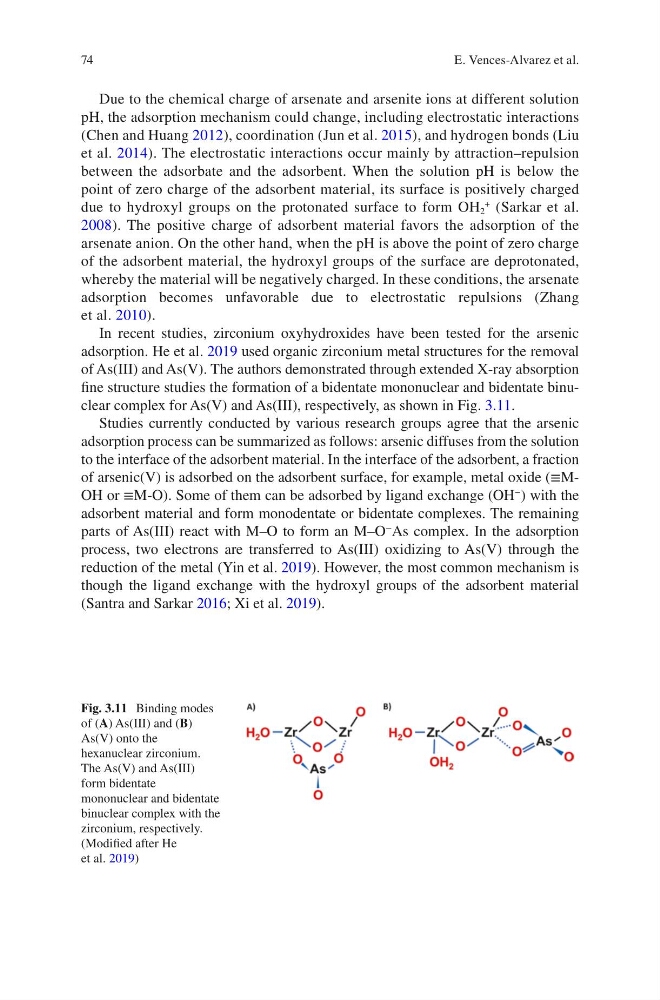
fine structure studies the formation of a bidentate mononuclear and bidentate binuclear complex for As(V) and As(III), respectively, as shown in Fig. 3.11.
Studies currently conducted by various research groups agree that the arsenic
adsorption process can be summarized as follows: arsenic diffuses from the solution
to the interface of the adsorbent material. In the interface of the adsorbent, a fraction
of arsenic(V) is adsorbed on the adsorbent surface, for example, metal oxide (≡MOH or ≡M-O). Some of them can be adsorbed by ligand exchange (OH
−
) with the
adsorbent material and form monodentate or bidentate complexes. The remaining
parts of As(III) react with M–O to form an M–O
−
As complex. In the adsorption
process, two electrons are transferred to As(III) oxidizing to As(V) through the
reduction of the metal (Yin et al. 2019). However, the most common mechanism is
though the ligand exchange with the hydroxyl groups of the adsorbent material
(Santra and Sarkar 2016; Xi et al. 2019).
Fig. 3.11 Binding modes
of (A) As(III) and (B)
As(V) onto the
hexanuclear zirconium.
The As(V) and As(III)
form bidentate
mononuclear and bidentate
binuclear complex with the
zirconium, respectively.
(Modified after He
et al. 2019)
E. Vences-Alvarez et al.
Due to the chemical charge of arsenate and arsenite ions at different solution
pH, the adsorption mechanism could change, including electrostatic interactions
(Chen and Huang 2012), coordination (Jun et al. 2015), and hydrogen bonds (Liu
et al. 2014). The electrostatic interactions occur mainly by attraction–repulsion
between the adsorbate and the adsorbent. When the solution pH is below the
point of zero charge of the adsorbent material, its surface is positively charged
due to hydroxyl groups on the protonated surface to form OH 2
+
(Sarkar et al.
2008). The positive charge of adsorbent material favors the adsorption of the
arsenate anion. On the other hand, when the pH is above the point of zero charge
of the adsorbent material, the hydroxyl groups of the surface are deprotonated,
whereby the material will be negatively charged. In these conditions, the arsenate
adsorption becomes unfavorable due to electrostatic repulsions (Zhang
et al. 2010).
In recent studies, zirconium oxyhydroxides have been tested for the arsenic
adsorption. He et al. 2019 used organic zirconium metal structures for the removal
of As(III) and As(V). The authors demonstrated through extended X-ray absorption
fine structure studies the formation of a bidentate mononuclear and bidentate binuclear complex for As(V) and As(III), respectively, as shown in Fig. 3.11.
Studies currently conducted by various research groups agree that the arsenic
adsorption process can be summarized as follows: arsenic diffuses from the solution
to the interface of the adsorbent material. In the interface of the adsorbent, a fraction
of arsenic(V) is adsorbed on the adsorbent surface, for example, metal oxide (≡MOH or ≡M-O). Some of them can be adsorbed by ligand exchange (OH
−
) with the
adsorbent material and form monodentate or bidentate complexes. The remaining
parts of As(III) react with M–O to form an M–O
−
As complex. In the adsorption
process, two electrons are transferred to As(III) oxidizing to As(V) through the
reduction of the metal (Yin et al. 2019). However, the most common mechanism is
though the ligand exchange with the hydroxyl groups of the adsorbent material
(Santra and Sarkar 2016; Xi et al. 2019).
Fig. 3.11 Binding modes
of (A) As(III) and (B)
As(V) onto the
hexanuclear zirconium.
The As(V) and As(III)
form bidentate
mononuclear and bidentate
binuclear complex with the
zirconium, respectively.
(Modified after He
et al. 2019)
E. Vences-Alvarez et al.