

73
lanthanides demonstrated that lanthanum could coordinate up to nine aquo complexes. However, in the presence of fluoride ions, the water molecues can be displaced, apparently because the bounded fluoride generates a more stable configuration
(Parker et al. 2002).
3.3.2 Arsenic Adsorption on Metal Oxyhydroxides
As revised in Sect. 3.1, the predominant chemical forms of arsenic in water are
arsenate and arsenite. The arsenate is in the water as hydroxide-anion and the arsenite is a reduced species that predominates as an uncharged molecule. In consequence, the adsorption mechanism of arsenate and arsenite has some differences.
The metal oxides often studied for arsenic adsorption are iron and aluminum
oxyhydroxides. Goldberg and Johnston studied the adsorption mechanism of arsenate and arsenite in amorphous aluminum and iron oxides. Accordingly, arsenate is
adsorbed through ligand exchange reactions with the surface coordinated molecules
such as water or hydroxyl, to form inner-sphere surface complexes on both metal
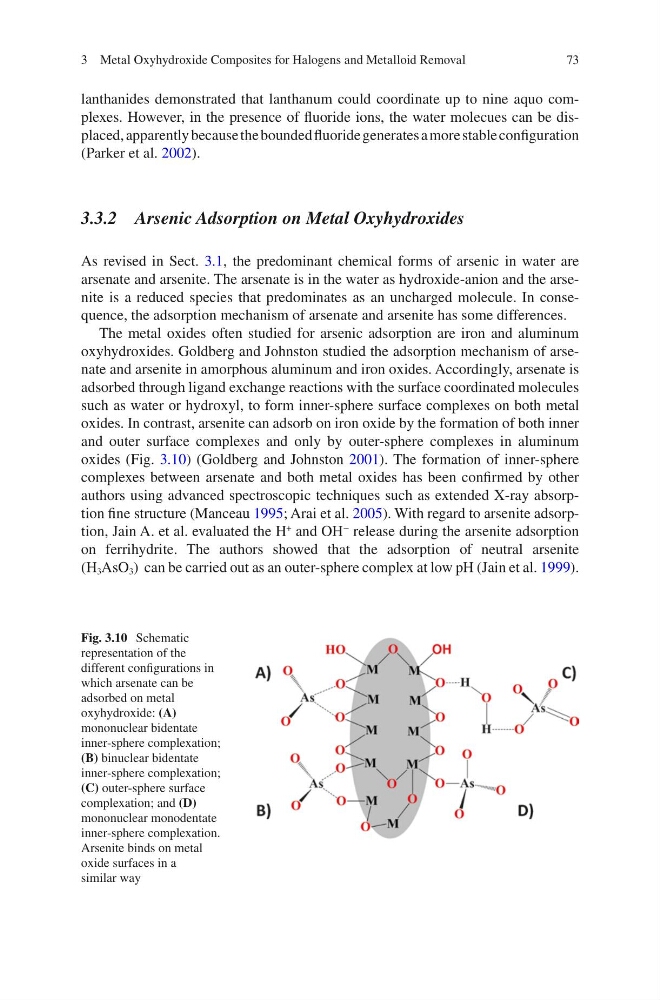
oxides. In contrast, arsenite can adsorb on iron oxide by the formation of both inner
and outer surface complexes and only by outer- sphere complexes in aluminum
oxides (Fig. 3.10) (Goldberg and Johnston 2001). The formation of inner-sphere
complexes between arsenate and both metal oxides has been confirmed by other
authors using advanced spectroscopic techniques such as extended X-ray absorption fine structure (Manceau 1995; Arai et al. 2005). With regard to arsenite adsorption, Jain A. et al. evaluated the H
+
and OH
−
release during the arsenite adsorption
on ferrihydrite. The authors showed that the adsorption of neutral arsenite
(H 3 AsO 3 ) can be carried out as an outer- sphere complex at low pH (Jain et al. 1999).
Fig. 3.10 Schematic
representation of the
different configurations in
which arsenate can be
adsorbed on metal
oxyhydroxide: (A)
mononuclear bidentate
inner-sphere complexation;
(B) binuclear bidentate
inner-sphere complexation;
(C) outer-sphere surface
complexation; and (D)
mononuclear monodentate
inner-sphere complexation.
Arsenite binds on metal
oxide surfaces in a
similar way
3 Metal Oxyhydroxide Composites for Halogens and Metalloid Removal
lanthanides demonstrated that lanthanum could coordinate up to nine aquo complexes. However, in the presence of fluoride ions, the water molecues can be displaced, apparently because the bounded fluoride generates a more stable configuration
(Parker et al. 2002).
3.3.2 Arsenic Adsorption on Metal Oxyhydroxides
As revised in Sect. 3.1, the predominant chemical forms of arsenic in water are
arsenate and arsenite. The arsenate is in the water as hydroxide-anion and the arsenite is a reduced species that predominates as an uncharged molecule. In consequence, the adsorption mechanism of arsenate and arsenite has some differences.
The metal oxides often studied for arsenic adsorption are iron and aluminum
oxyhydroxides. Goldberg and Johnston studied the adsorption mechanism of arsenate and arsenite in amorphous aluminum and iron oxides. Accordingly, arsenate is
adsorbed through ligand exchange reactions with the surface coordinated molecules
such as water or hydroxyl, to form inner-sphere surface complexes on both metal
oxides. In contrast, arsenite can adsorb on iron oxide by the formation of both inner
and outer surface complexes and only by outer- sphere complexes in aluminum
oxides (Fig. 3.10) (Goldberg and Johnston 2001). The formation of inner-sphere
complexes between arsenate and both metal oxides has been confirmed by other
authors using advanced spectroscopic techniques such as extended X-ray absorption fine structure (Manceau 1995; Arai et al. 2005). With regard to arsenite adsorption, Jain A. et al. evaluated the H
+
and OH
−
release during the arsenite adsorption
on ferrihydrite. The authors showed that the adsorption of neutral arsenite
(H 3 AsO 3 ) can be carried out as an outer- sphere complex at low pH (Jain et al. 1999).
Fig. 3.10 Schematic
representation of the
different configurations in
which arsenate can be
adsorbed on metal
oxyhydroxide: (A)
mononuclear bidentate
inner-sphere complexation;
(B) binuclear bidentate
inner-sphere complexation;
(C) outer-sphere surface
complexation; and (D)
mononuclear monodentate
inner-sphere complexation.
Arsenite binds on metal
oxide surfaces in a
similar way
3 Metal Oxyhydroxide Composites for Halogens and Metalloid Removal