

58
full-scale strategies for the elimination of arsenic and fluoride from water, considering only physicochemical processes. Afterward, we make emphasis on adsorption,
mainly by metal oxyhydroxides as adsorbent materials. The focus of the current
research on this topic is the generation of new materials with superior characteristics, including higher adsorption capacity and selectivity. Metal and bimetallic
oxyhydroxides have been developed and have shown to be promising materials to
remove up to 200 and 250 mg/g of arsenic and fluoride, respectively. Also, researchers have oriented their efforts to transform metal oxyhydroxides into granular materials that can be applied in full-scale drinking water operations. Among the strategies
are the synthesis of polymer composites, the agglomeration of metal oxide powder
with various binders, and the anchorage of particles onto granular materials such as
activated carbon: the processes involved are revised, with emphasis on the interactions between the carbonaceous matrix and the anchored metal oxyhydroxides.
Keywords Drinking water · Water remediation · Arsenic · Fluoride · Adsorption ·
Adsorption mechanism · Metal oxyhydroxides · Granular adsorbents · Metal
impregnation · Composites
3.1 Introduction to Halogens and Metalloid Water Pollution
Water is an essential liquid for living organisms and an important resource for
human development. Due to the expansion of both rural and urban spaces, water
supplies are being affected. The concentration of several inorganic pollutants in
drinking water and water supplies is under regulation. This is because of the association of presence of contaminants in water with the increment of illnesses and
diseases on human beings. Sometimes pollution has a non-anthropogenic origin,
which makes the matter more challenging to solve. The World Health Organization
provides international guidelines and standard settings on water quality and human
health and serves as a drinking water quality parameter in most of the nations.
According to the World Health Organization, the priority chemical pollutants that
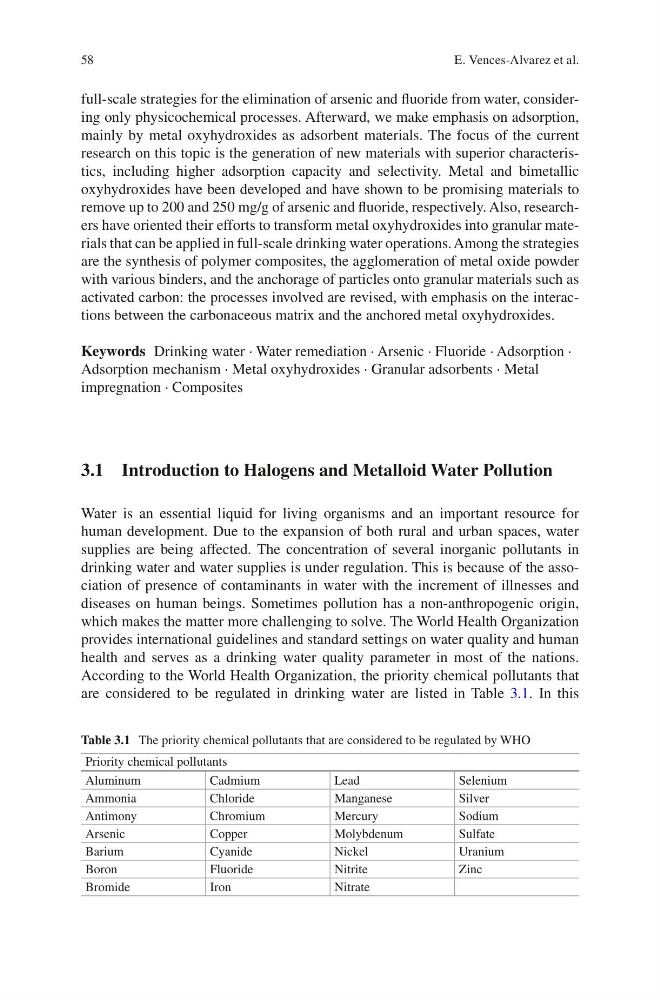
are considered to be regulated in drinking water are listed in Table 3.1. In this
Table 3.1 The priority chemical pollutants that are considered to be regulated by WHO
Priority chemical pollutants
Aluminum
Cadmium
Lead
Selenium
Ammonia
Chloride
Manganese
Silver
Antimony
Chromium
Mercury
Sodium
Arsenic
Copper
Molybdenum
Sulfate
Barium
Cyanide
Nickel
Uranium
Boron
Fluoride
Nitrite
Zinc
Bromide
Iron
Nitrate
E. Vences-Alvarez et al.
full-scale strategies for the elimination of arsenic and fluoride from water, considering only physicochemical processes. Afterward, we make emphasis on adsorption,
mainly by metal oxyhydroxides as adsorbent materials. The focus of the current
research on this topic is the generation of new materials with superior characteristics, including higher adsorption capacity and selectivity. Metal and bimetallic
oxyhydroxides have been developed and have shown to be promising materials to
remove up to 200 and 250 mg/g of arsenic and fluoride, respectively. Also, researchers have oriented their efforts to transform metal oxyhydroxides into granular materials that can be applied in full-scale drinking water operations. Among the strategies
are the synthesis of polymer composites, the agglomeration of metal oxide powder
with various binders, and the anchorage of particles onto granular materials such as
activated carbon: the processes involved are revised, with emphasis on the interactions between the carbonaceous matrix and the anchored metal oxyhydroxides.
Keywords Drinking water · Water remediation · Arsenic · Fluoride · Adsorption ·
Adsorption mechanism · Metal oxyhydroxides · Granular adsorbents · Metal
impregnation · Composites
3.1 Introduction to Halogens and Metalloid Water Pollution
Water is an essential liquid for living organisms and an important resource for
human development. Due to the expansion of both rural and urban spaces, water
supplies are being affected. The concentration of several inorganic pollutants in
drinking water and water supplies is under regulation. This is because of the association of presence of contaminants in water with the increment of illnesses and
diseases on human beings. Sometimes pollution has a non-anthropogenic origin,
which makes the matter more challenging to solve. The World Health Organization
provides international guidelines and standard settings on water quality and human
health and serves as a drinking water quality parameter in most of the nations.
According to the World Health Organization, the priority chemical pollutants that
are considered to be regulated in drinking water are listed in Table 3.1. In this
Table 3.1 The priority chemical pollutants that are considered to be regulated by WHO
Priority chemical pollutants
Aluminum
Cadmium
Lead
Selenium
Ammonia
Chloride
Manganese
Silver
Antimony
Chromium
Mercury
Sodium
Arsenic
Copper
Molybdenum
Sulfate
Barium
Cyanide
Nickel
Uranium
Boron
Fluoride
Nitrite
Zinc
Bromide
Iron
Nitrate
E. Vences-Alvarez et al.