

40
such as low original price, nontoxic by-product manufacturing, comparatively easy
design, and timely productivity. The properties of an optimal and suitable absorbent
for removal dye include comprehensive surface area, high capacity and absorption
capacity, pores with adequate size and quantity, comfortable accessibility, effective,
economical, high mechanical stability, compatibility, simple regeneration, environmentally friendly, high selectivity to remove multiple dyes, and the needless use of
high-tech processing. Researchers have therefore recently focused on extending
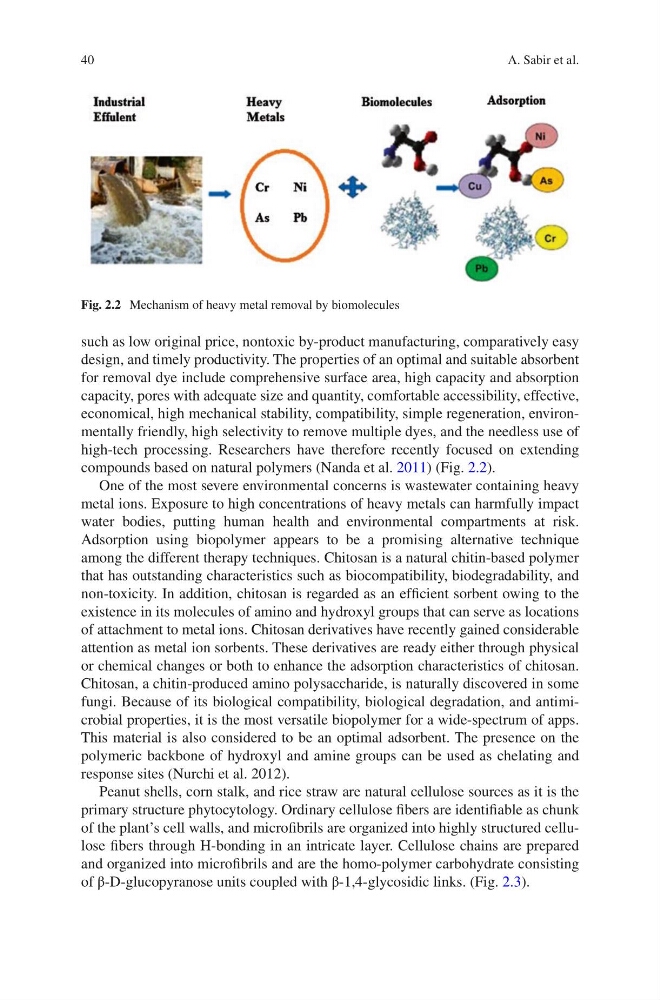
compounds based on natural polymers (Nanda et al. 2011) (Fig. 2.2).
One of the most severe environmental concerns is wastewater containing heavy
metal ions. Exposure to high concentrations of heavy metals can harmfully impact
water bodies, putting human health and environmental compartments at risk.
Adsorption using biopolymer appears to be a promising alternative technique
among the different therapy techniques. Chitosan is a natural chitin-based polymer
that has outstanding characteristics such as biocompatibility, biodegradability, and
non-toxicity. In addition, chitosan is regarded as an efficient sorbent owing to the
existence in its molecules of amino and hydroxyl groups that can serve as locations
of attachment to metal ions. Chitosan derivatives have recently gained considerable
attention as metal ion sorbents. These derivatives are ready either through physical
or chemical changes or both to enhance the adsorption characteristics of chitosan.
Chitosan, a chitin-produced amino polysaccharide, is naturally discovered in some
fungi. Because of its biological compatibility, biological degradation, and antimicrobial properties, it is the most versatile biopolymer for a wide-spectrum of apps.
This material is also considered to be an optimal adsorbent. The presence on the
polymeric backbone of hydroxyl and amine groups can be used as chelating and
response sites (Nurchi et al. 2012).
Peanut shells, corn stalk, and rice straw are natural cellulose sources as it is the
primary structure phytocytology. Ordinary cellulose fibers are identifiable as chunk
of the plant’s cell walls, and microfibrils are organized into highly structured cellulose fibers through H-bonding in an intricate layer. Cellulose chains are prepared
and organized into microfibrils and are the homo-polymer carbohydrate consisting
of β-D-glucopyranose units coupled with β-1,4-glycosidic links. (Fig. 2.3).
Fig. 2.2 Mechanism of heavy metal removal by biomolecules
A. Sabir et al.
such as low original price, nontoxic by-product manufacturing, comparatively easy
design, and timely productivity. The properties of an optimal and suitable absorbent
for removal dye include comprehensive surface area, high capacity and absorption
capacity, pores with adequate size and quantity, comfortable accessibility, effective,
economical, high mechanical stability, compatibility, simple regeneration, environmentally friendly, high selectivity to remove multiple dyes, and the needless use of
high-tech processing. Researchers have therefore recently focused on extending
compounds based on natural polymers (Nanda et al. 2011) (Fig. 2.2).
One of the most severe environmental concerns is wastewater containing heavy
metal ions. Exposure to high concentrations of heavy metals can harmfully impact
water bodies, putting human health and environmental compartments at risk.
Adsorption using biopolymer appears to be a promising alternative technique
among the different therapy techniques. Chitosan is a natural chitin-based polymer
that has outstanding characteristics such as biocompatibility, biodegradability, and
non-toxicity. In addition, chitosan is regarded as an efficient sorbent owing to the
existence in its molecules of amino and hydroxyl groups that can serve as locations
of attachment to metal ions. Chitosan derivatives have recently gained considerable
attention as metal ion sorbents. These derivatives are ready either through physical
or chemical changes or both to enhance the adsorption characteristics of chitosan.
Chitosan, a chitin-produced amino polysaccharide, is naturally discovered in some
fungi. Because of its biological compatibility, biological degradation, and antimicrobial properties, it is the most versatile biopolymer for a wide-spectrum of apps.
This material is also considered to be an optimal adsorbent. The presence on the
polymeric backbone of hydroxyl and amine groups can be used as chelating and
response sites (Nurchi et al. 2012).
Peanut shells, corn stalk, and rice straw are natural cellulose sources as it is the
primary structure phytocytology. Ordinary cellulose fibers are identifiable as chunk
of the plant’s cell walls, and microfibrils are organized into highly structured cellulose fibers through H-bonding in an intricate layer. Cellulose chains are prepared
and organized into microfibrils and are the homo-polymer carbohydrate consisting
of β-D-glucopyranose units coupled with β-1,4-glycosidic links. (Fig. 2.3).
Fig. 2.2 Mechanism of heavy metal removal by biomolecules
A. Sabir et al.