

418
16.5 Dye Removal Methods
Various removal techniques including electrocatalytic degradation, chemical oxidation, membrane separation, reverse osmosis, electro-Fenton process (Rosales et al.
2012), photocatalysis (Li et al. 2017a), adsorption, coagulation/flocculation, and
microbial degradation have been investigated for dye removal in wastewater
(Chinoune et al. 2016; Blanco et al. 2017). These methods have their own benefits
and disadvantages such as low dye removal capacity, slow dye removal kinetics, and
poor reusability. Of all the methods mentioned, adsorption is one of the most promising techniques due to its low cost, simple operation, and high efficiency especially
for low concentration solutions (Salama 2018; Oussalah et al. 2019). One of the
benefits of adsorption process is that the adsorbents can be regenerated and reused,
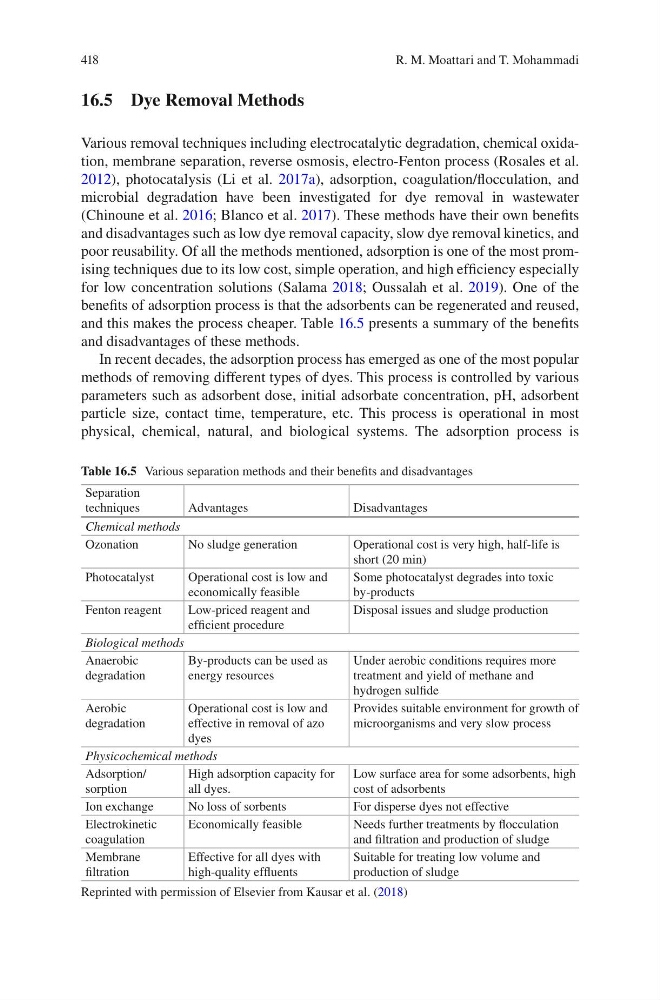
and this makes the process cheaper. Table 16.5 presents a summary of the benefits
and disadvantages of these methods.
In recent decades, the adsorption process has emerged as one of the most popular
methods of removing different types of dyes. This process is controlled by various
parameters such as adsorbent dose, initial adsorbate concentration, pH, adsorbent
particle size, contact time, temperature, etc. This process is operational in most
physical, chemical, natural, and biological systems. The adsorption process is
Table 16.5 Various separation methods and their benefits and disadvantages
Separation
techniques
Advantages
Disadvantages
Chemical methods
Ozonation
No sludge generation
Operational cost is very high, half-life is
short (20 min)
Photocatalyst
Operational cost is low and
economically feasible
Some photocatalyst degrades into toxic
by-products
Fenton reagent
Low-priced reagent and
efficient procedure
Disposal issues and sludge production
Biological methods
Anaerobic
degradation
By-products can be used as
energy resources
Under aerobic conditions requires more
treatment and yield of methane and
hydrogen sulfide
Aerobic
degradation
Operational cost is low and
effective in removal of azo
dyes
Provides suitable environment for growth of
microorganisms and very slow process
Physicochemical methods
Adsorption/
sorption
High adsorption capacity for
all dyes.
Low surface area for some adsorbents, high
cost of adsorbents
Ion exchange
No loss of sorbents
For disperse dyes not effective
Electrokinetic
coagulation
Economically feasible
Needs further treatments by flocculation
and filtration and production of sludge
Membrane
filtration
Effective for all dyes with
high-quality effluents
Suitable for treating low volume and
production of sludge
Reprinted with permission of Elsevier from Kausar et al. (2018)
R. M. Moattari and T. Mohammadi
16.5 Dye Removal Methods
Various removal techniques including electrocatalytic degradation, chemical oxidation, membrane separation, reverse osmosis, electro-Fenton process (Rosales et al.
2012), photocatalysis (Li et al. 2017a), adsorption, coagulation/flocculation, and
microbial degradation have been investigated for dye removal in wastewater
(Chinoune et al. 2016; Blanco et al. 2017). These methods have their own benefits
and disadvantages such as low dye removal capacity, slow dye removal kinetics, and
poor reusability. Of all the methods mentioned, adsorption is one of the most promising techniques due to its low cost, simple operation, and high efficiency especially
for low concentration solutions (Salama 2018; Oussalah et al. 2019). One of the
benefits of adsorption process is that the adsorbents can be regenerated and reused,
and this makes the process cheaper. Table 16.5 presents a summary of the benefits
and disadvantages of these methods.
In recent decades, the adsorption process has emerged as one of the most popular
methods of removing different types of dyes. This process is controlled by various
parameters such as adsorbent dose, initial adsorbate concentration, pH, adsorbent
particle size, contact time, temperature, etc. This process is operational in most
physical, chemical, natural, and biological systems. The adsorption process is
Table 16.5 Various separation methods and their benefits and disadvantages
Separation
techniques
Advantages
Disadvantages
Chemical methods
Ozonation
No sludge generation
Operational cost is very high, half-life is
short (20 min)
Photocatalyst
Operational cost is low and
economically feasible
Some photocatalyst degrades into toxic
by-products
Fenton reagent
Low-priced reagent and
efficient procedure
Disposal issues and sludge production
Biological methods
Anaerobic
degradation
By-products can be used as
energy resources
Under aerobic conditions requires more
treatment and yield of methane and
hydrogen sulfide
Aerobic
degradation
Operational cost is low and
effective in removal of azo
dyes
Provides suitable environment for growth of
microorganisms and very slow process
Physicochemical methods
Adsorption/
sorption
High adsorption capacity for
all dyes.
Low surface area for some adsorbents, high
cost of adsorbents
Ion exchange
No loss of sorbents
For disperse dyes not effective
Electrokinetic
coagulation
Economically feasible
Needs further treatments by flocculation
and filtration and production of sludge
Membrane
filtration
Effective for all dyes with
high-quality effluents
Suitable for treating low volume and
production of sludge
Reprinted with permission of Elsevier from Kausar et al. (2018)
R. M. Moattari and T. Mohammadi