

407
16.2 Dyes
16.2.1 Definition
Dyes are generally used as additives in the production of colored materials such as
colored papers, colored fabrics, and so on. Due to their highly conjugated structures,
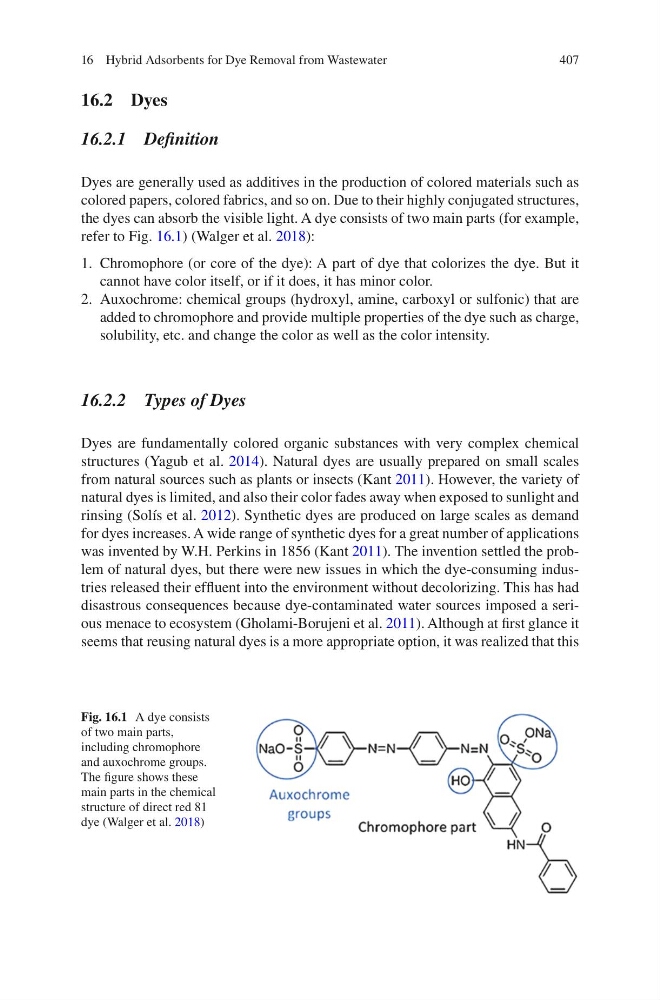
the dyes can absorb the visible light. A dye consists of two main parts (for example,
refer to Fig. 16.1) (Walger et al. 2018):
1. Chromophore (or core of the dye): A part of dye that colorizes the dye. But it
cannot have color itself, or if it does, it has minor color.
2. Auxochrome: chemical groups (hydroxyl, amine, carboxyl or sulfonic) that are
added to chromophore and provide multiple properties of the dye such as charge,
solubility, etc. and change the color as well as the color intensity.
16.2.2 Types of Dyes
Dyes are fundamentally colored organic substances with very complex chemical
structures (Yagub et al. 2014). Natural dyes are usually prepared on small scales
from natural sources such as plants or insects (Kant 2011). However, the variety of
natural dyes is limited, and also their color fades away when exposed to sunlight and
rinsing (Solís et al. 2012). Synthetic dyes are produced on large scales as demand
for dyes increases. A wide range of synthetic dyes for a great number of applications
was invented by W.H. Perkins in 1856 (Kant 2011). The invention settled the problem of natural dyes, but there were new issues in which the dye-consuming industries released their effluent into the environment without decolorizing. This has had
disastrous consequences because dye-contaminated water sources imposed a serious menace to ecosystem (Gholami-Borujeni et al. 2011). Although at first glance it
seems that reusing natural dyes is a more appropriate option, it was realized that this
Fig. 16.1 A dye consists
of two main parts,
including chromophore
and auxochrome groups.
The figure shows these
main parts in the chemical
structure of direct red 81
dye (Walger et al. 2018)
16 Hybrid Adsorbents for Dye Removal from Wastewater
16.2 Dyes
16.2.1 Definition
Dyes are generally used as additives in the production of colored materials such as
colored papers, colored fabrics, and so on. Due to their highly conjugated structures,
the dyes can absorb the visible light. A dye consists of two main parts (for example,
refer to Fig. 16.1) (Walger et al. 2018):
1. Chromophore (or core of the dye): A part of dye that colorizes the dye. But it
cannot have color itself, or if it does, it has minor color.
2. Auxochrome: chemical groups (hydroxyl, amine, carboxyl or sulfonic) that are
added to chromophore and provide multiple properties of the dye such as charge,
solubility, etc. and change the color as well as the color intensity.
16.2.2 Types of Dyes
Dyes are fundamentally colored organic substances with very complex chemical
structures (Yagub et al. 2014). Natural dyes are usually prepared on small scales
from natural sources such as plants or insects (Kant 2011). However, the variety of
natural dyes is limited, and also their color fades away when exposed to sunlight and
rinsing (Solís et al. 2012). Synthetic dyes are produced on large scales as demand
for dyes increases. A wide range of synthetic dyes for a great number of applications
was invented by W.H. Perkins in 1856 (Kant 2011). The invention settled the problem of natural dyes, but there were new issues in which the dye-consuming industries released their effluent into the environment without decolorizing. This has had
disastrous consequences because dye-contaminated water sources imposed a serious menace to ecosystem (Gholami-Borujeni et al. 2011). Although at first glance it
seems that reusing natural dyes is a more appropriate option, it was realized that this
Fig. 16.1 A dye consists
of two main parts,
including chromophore
and auxochrome groups.
The figure shows these
main parts in the chemical
structure of direct red 81
dye (Walger et al. 2018)
16 Hybrid Adsorbents for Dye Removal from Wastewater