

384
to treat the various kinds of dyes as well as hazardous organic contaminants from
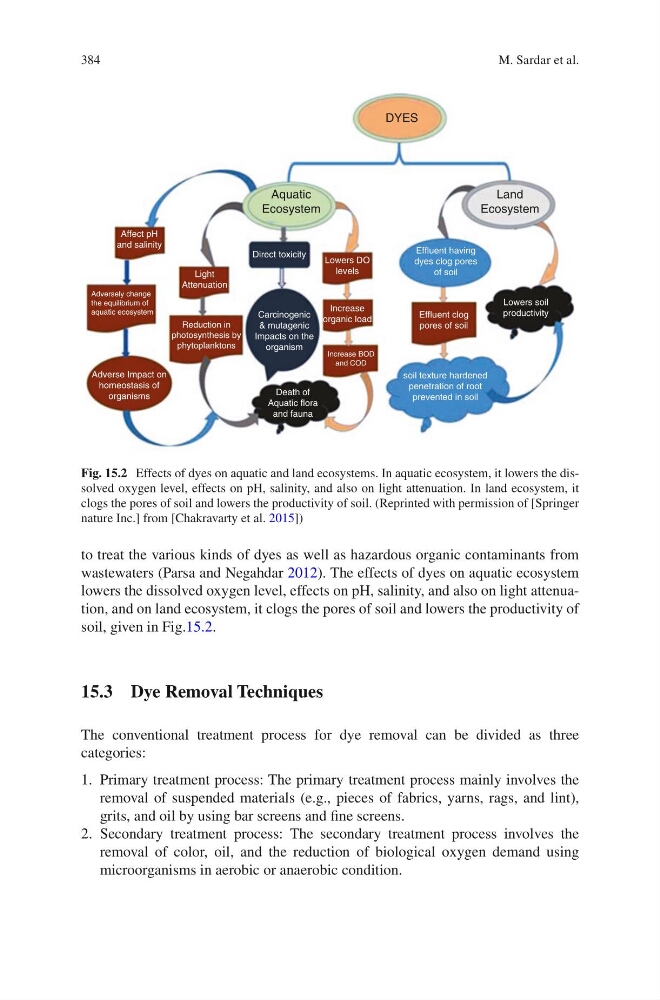
wastewaters (Parsa and Negahdar 2012). The effects of dyes on aquatic ecosystem
lowers the dissolved oxygen level, effects on pH, salinity, and also on light attenuation, and on land ecosystem, it clogs the pores of soil and lowers the productivity of
soil, given in Fig.15.2.
15.3 Dye Removal Techniques
The conventional treatment process for dye removal can be divided as three
categories:
1. Primary treatment process: The primary treatment process mainly involves the
removal of suspended materials (e.g., pieces of fabrics, yarns, rags, and lint),
grits, and oil by using bar screens and fine screens.
2. Secondary treatment process: The secondary treatment process involves the
removal of color, oil, and the reduction of biological oxygen demand using
microorganisms in aerobic or anaerobic condition.
DYES
Aquatic
Ecosystem
Land
Ecosystem
Affect pH
and salinity
Light
Attenuation
Direct toxicity
Carcinogenic
& mutagenic
Impacts on the
organism
Lowers DO
levels
Increase
organic load
Effluent clog
pores of soil
Effluent having
dyes clog pores
of soil
Lowers soil
productivity
Death of
Aquatic flora
and fauna
Reduction in
photosynthesis by
phytoplanktons
Adversely change
the equilibrium of
aquatic ecosystem
Increase BOD
and COD
Adverse Impact on
homeostasis of
organisms
soil texture hardened
penetration of root
prevented in soil
Fig. 15.2 Effects of dyes on aquatic and land ecosystems. In aquatic ecosystem, it lowers the dissolved oxygen level, effects on pH, salinity, and also on light attenuation. In land ecosystem, it
clogs the pores of soil and lowers the productivity of soil. (Reprinted with permission of [Springer
nature Inc.] from [Chakravarty et al. 2015])
M. Sardar et al.
to treat the various kinds of dyes as well as hazardous organic contaminants from
wastewaters (Parsa and Negahdar 2012). The effects of dyes on aquatic ecosystem
lowers the dissolved oxygen level, effects on pH, salinity, and also on light attenuation, and on land ecosystem, it clogs the pores of soil and lowers the productivity of
soil, given in Fig.15.2.
15.3 Dye Removal Techniques
The conventional treatment process for dye removal can be divided as three
categories:
1. Primary treatment process: The primary treatment process mainly involves the
removal of suspended materials (e.g., pieces of fabrics, yarns, rags, and lint),
grits, and oil by using bar screens and fine screens.
2. Secondary treatment process: The secondary treatment process involves the
removal of color, oil, and the reduction of biological oxygen demand using
microorganisms in aerobic or anaerobic condition.
DYES
Aquatic
Ecosystem
Land
Ecosystem
Affect pH
and salinity
Light
Attenuation
Direct toxicity
Carcinogenic
& mutagenic
Impacts on the
organism
Lowers DO
levels
Increase
organic load
Effluent clog
pores of soil
Effluent having
dyes clog pores
of soil
Lowers soil
productivity
Death of
Aquatic flora
and fauna
Reduction in
photosynthesis by
phytoplanktons
Adversely change
the equilibrium of
aquatic ecosystem
Increase BOD
and COD
Adverse Impact on
homeostasis of
organisms
soil texture hardened
penetration of root
prevented in soil
Fig. 15.2 Effects of dyes on aquatic and land ecosystems. In aquatic ecosystem, it lowers the dissolved oxygen level, effects on pH, salinity, and also on light attenuation. In land ecosystem, it
clogs the pores of soil and lowers the productivity of soil. (Reprinted with permission of [Springer
nature Inc.] from [Chakravarty et al. 2015])
M. Sardar et al.