

357
process for the long time, and efficient results were observed (Tassel et al. 1997,
1998). Yuan and his team (Yuan et al. 2008) utilized bio-surfactant for the separation of Cd, Pd, and Cu where the removal percentages were 71.17%, 89.95%, and
81.13%. Medina et al. tested the process for removal of trivalent chromium where
96.2% removal was observed (Medina et al. 2005). Though the process is good, the
process alone is not capable to give the higher removal efficiency in many times.
14.3.6 Electrochemical Treatment
Electrochemical treatment is another efficient treatment process which is widely
used in recent research. The method is very useful to maintain the discharge limit of
the metal ions as instructed by the various regulatory bodies (Wang et al. 2007). As
electrocoagulation is the part of the electrochemical treatment process, the researchers utilized aluminum or iron electrodes in this treatment process (Chen 2004). In
this process, hydrogen gas is generated which helps the impurities to float.
Researchers (Heidmann and Calmano 2008) applied this process by using aluminum electrodes to remove the zinc, copper, nickel, and chromium. Zn and Ni were
removed by utilizing electrochemical treatment, and 100% removal was found
(Kabdasli et al. 2009). Nanseu-Njiki et al. utilized the electrochemical process for
the removal of mercury where 99.9% removal was observed (Nanseu-Njiki et al.
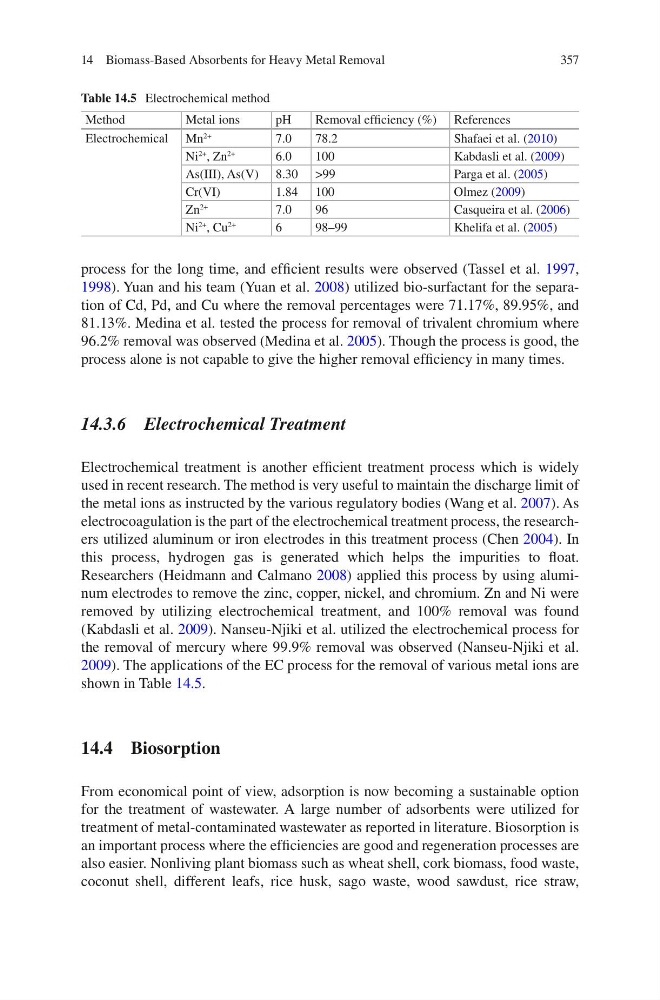
2009). The applications of the EC process for the removal of various metal ions are
shown in Table 14.5.
14.4 Biosorption
From economical point of view, adsorption is now becoming a sustainable option
for the treatment of wastewater. A large number of adsorbents were utilized for
treatment of metal-contaminated wastewater as reported in literature. Biosorption is
an important process where the efficiencies are good and regeneration processes are
also easier. Nonliving plant biomass such as wheat shell, cork biomass, food waste,
coconut shell, different leafs, rice husk, sago waste, wood sawdust, rice straw,
Table 14.5 Electrochemical method
Method
Metal ions
pH
Removal efficiency (%) References
Electrochemical Mn
2+
7.0
78.2
Shafaei et al. (2010)
Ni
2+
, Zn
2+
6.0
100
Kabdasli et al. (2009)
As(III), As(V) 8.30 >99
Parga et al. (2005)
Cr(VI)
1.84 100
Olmez (2009)
Zn
2+
7.0
96
Casqueira et al. (2006)
Ni
2+
, Cu
2+
6
98–99
Khelifa et al. (2005)
14 Biomass-Based Absorbents for Heavy Metal Removal
process for the long time, and efficient results were observed (Tassel et al. 1997,
1998). Yuan and his team (Yuan et al. 2008) utilized bio-surfactant for the separation of Cd, Pd, and Cu where the removal percentages were 71.17%, 89.95%, and
81.13%. Medina et al. tested the process for removal of trivalent chromium where
96.2% removal was observed (Medina et al. 2005). Though the process is good, the
process alone is not capable to give the higher removal efficiency in many times.
14.3.6 Electrochemical Treatment
Electrochemical treatment is another efficient treatment process which is widely
used in recent research. The method is very useful to maintain the discharge limit of
the metal ions as instructed by the various regulatory bodies (Wang et al. 2007). As
electrocoagulation is the part of the electrochemical treatment process, the researchers utilized aluminum or iron electrodes in this treatment process (Chen 2004). In
this process, hydrogen gas is generated which helps the impurities to float.
Researchers (Heidmann and Calmano 2008) applied this process by using aluminum electrodes to remove the zinc, copper, nickel, and chromium. Zn and Ni were
removed by utilizing electrochemical treatment, and 100% removal was found
(Kabdasli et al. 2009). Nanseu-Njiki et al. utilized the electrochemical process for
the removal of mercury where 99.9% removal was observed (Nanseu-Njiki et al.
2009). The applications of the EC process for the removal of various metal ions are
shown in Table 14.5.
14.4 Biosorption
From economical point of view, adsorption is now becoming a sustainable option
for the treatment of wastewater. A large number of adsorbents were utilized for
treatment of metal-contaminated wastewater as reported in literature. Biosorption is
an important process where the efficiencies are good and regeneration processes are
also easier. Nonliving plant biomass such as wheat shell, cork biomass, food waste,
coconut shell, different leafs, rice husk, sago waste, wood sawdust, rice straw,
Table 14.5 Electrochemical method
Method
Metal ions
pH
Removal efficiency (%) References
Electrochemical Mn
2+
7.0
78.2
Shafaei et al. (2010)
Ni
2+
, Zn
2+
6.0
100
Kabdasli et al. (2009)
As(III), As(V) 8.30 >99
Parga et al. (2005)
Cr(VI)
1.84 100
Olmez (2009)
Zn
2+
7.0
96
Casqueira et al. (2006)
Ni
2+
, Cu
2+
6
98–99
Khelifa et al. (2005)
14 Biomass-Based Absorbents for Heavy Metal Removal