

352
because of their poor removal rate, problem of disposal, and high operating cost.
Biosorption is now becoming a good alternative and environmentally friendly
option. Biosorption of heavy metals is a metal uptake process by using ion exchange,
precipitation, surface complexation, etc.. Various sources of waste biomaterials are
utilized for the treatment of metal-contaminated wastewater stream. As natural biosorbents are not giving higher efficiency, modifications are done by physical and
chemical activation of the biomaterials. Scientific developments were done for
improving the efficiency, but limited research was conducted for the regeneration or
reuse of the biosorbents. In recent years, researchers are paying attention on the
reuse of the spent biosorbents by using eluent solutions such as acids, bases, chelating agents, etc. and getting the potential results. This makes the biosorption process
more efficient and economic than the other conventional methods for the treatment
of metal-tainted effluent. This chapter highlights the toxic metals and the various
sources of biomaterials which are utilized for heavy metal removal.
Keywords Biosorption · Heavy metal ions · Wastewater · Agricultural biosorbents
· Bacterial biomass · Fungal biomass · Algal biomass · Regeneration
14.1 Introduction
Heavy metal contamination with the surface and groundwater becomes a serious
problem nowadays. The toxic metals which have higher specific gravity (>5) are
known as heavy metals. The metals such as Hg, Pb, Cu, Co, Cd, As, Fe, Se, V, Ni,
Cr, and Zn make various toxic effects to the human health. The toxic metals coming
out from various industries like mining operations, refining process, fertilizer processing, tanneries, battery manufacturing, paper mill, and pesticides are contaminating water bodies (Celik and Demirbas 2005; Kjellstrom et al. 1977; Pastircakova
2004). To avoid such problems, various national and international regulatory bodies
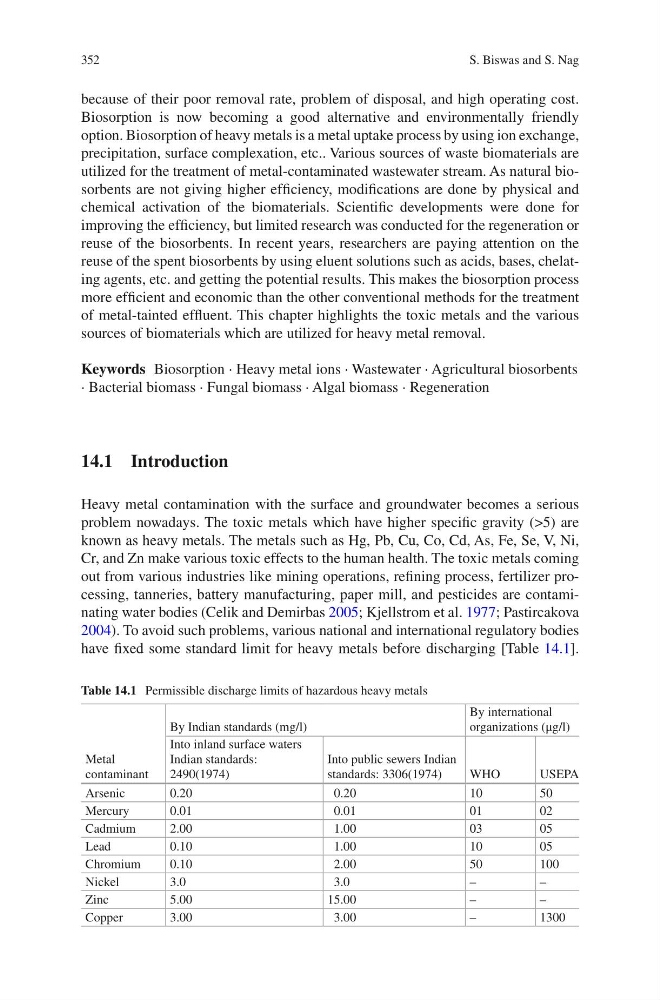
have fixed some standard limit for heavy metals before discharging [Table 14.1].
Table 14.1 Permissible discharge limits of hazardous heavy metals
Metal
contaminant
By Indian standards (mg/l)
By international
organizations (μg/l)
Into inland surface waters
Indian standards:
2490(1974)
Into public sewers Indian
standards: 3306(1974)
WHO
USEPA
Arsenic
0.20
0.20
10
50
Mercury
0.01
0.01
01
02
Cadmium
2.00
1.00
03
05
Lead
0.10
1.00
10
05
Chromium
0.10
2.00
50
100
Nickel
3.0
3.0
–
–
Zinc
5.00
15.00
–
–
Copper
3.00
3.00
–
1300
S. Biswas and S. Nag
because of their poor removal rate, problem of disposal, and high operating cost.
Biosorption is now becoming a good alternative and environmentally friendly
option. Biosorption of heavy metals is a metal uptake process by using ion exchange,
precipitation, surface complexation, etc.. Various sources of waste biomaterials are
utilized for the treatment of metal-contaminated wastewater stream. As natural biosorbents are not giving higher efficiency, modifications are done by physical and
chemical activation of the biomaterials. Scientific developments were done for
improving the efficiency, but limited research was conducted for the regeneration or
reuse of the biosorbents. In recent years, researchers are paying attention on the
reuse of the spent biosorbents by using eluent solutions such as acids, bases, chelating agents, etc. and getting the potential results. This makes the biosorption process
more efficient and economic than the other conventional methods for the treatment
of metal-tainted effluent. This chapter highlights the toxic metals and the various
sources of biomaterials which are utilized for heavy metal removal.
Keywords Biosorption · Heavy metal ions · Wastewater · Agricultural biosorbents
· Bacterial biomass · Fungal biomass · Algal biomass · Regeneration
14.1 Introduction
Heavy metal contamination with the surface and groundwater becomes a serious
problem nowadays. The toxic metals which have higher specific gravity (>5) are
known as heavy metals. The metals such as Hg, Pb, Cu, Co, Cd, As, Fe, Se, V, Ni,
Cr, and Zn make various toxic effects to the human health. The toxic metals coming
out from various industries like mining operations, refining process, fertilizer processing, tanneries, battery manufacturing, paper mill, and pesticides are contaminating water bodies (Celik and Demirbas 2005; Kjellstrom et al. 1977; Pastircakova
2004). To avoid such problems, various national and international regulatory bodies
have fixed some standard limit for heavy metals before discharging [Table 14.1].
Table 14.1 Permissible discharge limits of hazardous heavy metals
Metal
contaminant
By Indian standards (mg/l)
By international
organizations (μg/l)
Into inland surface waters
Indian standards:
2490(1974)
Into public sewers Indian
standards: 3306(1974)
WHO
USEPA
Arsenic
0.20
0.20
10
50
Mercury
0.01
0.01
01
02
Cadmium
2.00
1.00
03
05
Lead
0.10
1.00
10
05
Chromium
0.10
2.00
50
100
Nickel
3.0
3.0
–
–
Zinc
5.00
15.00
–
–
Copper
3.00
3.00
–
1300
S. Biswas and S. Nag