

342
13.6 Equilibrium Isotherms for Biosorption
The relationship between mass of heavy metals adsorbed and mass of biosorbent as
well as the concentration of the heavy metals in the solution can be best described
using biosorption isotherms. The surface properties and affinities of the biosorbent
can be expressed with the parameters involved in the biosorption isotherms. The
isotherm is also useful to compare the adsorptive capacities of the biosorbent for
varying pollutants (Bulgariu and Bulgariu 2012; Tuzen and Sari 2010).
Several equilibrium isotherm models were used to study the biosorption process.
If two parameters were involved, Langmuir, Freundlich, Temkin, and Dubinin–
Radushkevich were used. Meanwhile, if three parameters were involved in the isotherms, Sips and Redlich–Peterson were used.
13.6.1 Langmuir Isotherm
Most studies on waste fruit cortexes as the biosorbent for heavy metals from water
reported the use of Langmuir isotherm. In a Langmuir isotherm model, it is assumed
that the surface has homogeneous binding sites and the sorption energies are equivalent with no interaction between sorbed species (Vinod K. Gupta et al. 2010). This
model also explains that no sorption will take place once the sorption sites are filled.
The maximum adsorption capacity of the surface is reflected when the surface
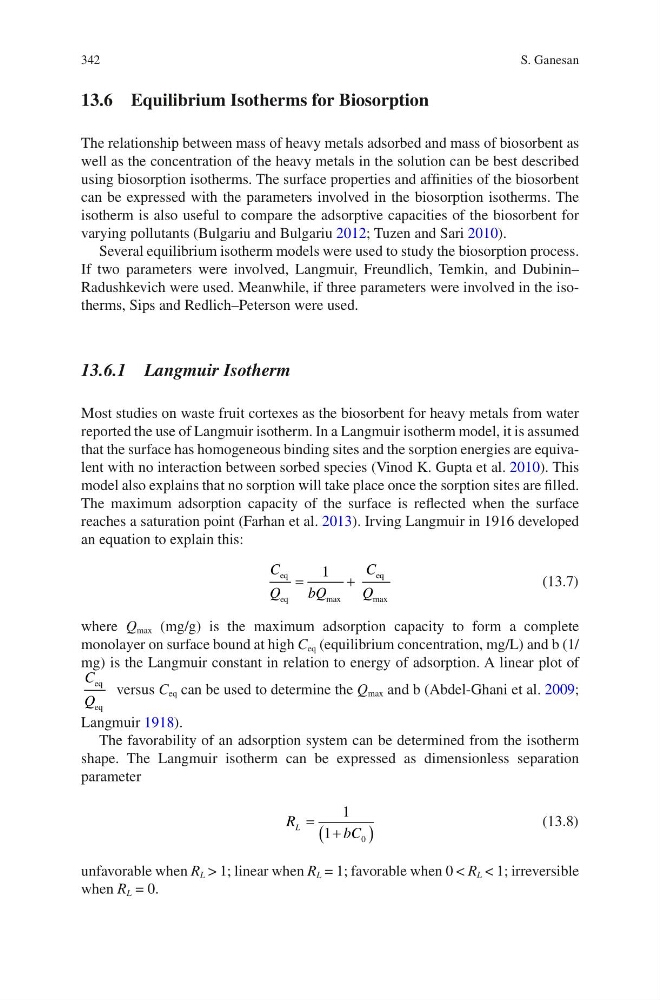
reaches a saturation point (Farhan et al. 2013). Irving Langmuir in 1916 developed
an equation to explain this:
C
Q
bQ
C
Q
eq
eq
eq
=
+
1
max
m ax
(13.7)
where Q max (mg/g) is the maximum adsorption capacity to form a complete
monolayer on surface bound at high C eq (equilibrium concentration, mg/L) and b (1/
mg) is the Langmuir constant in relation to energy of adsorption. A linear plot of
C
Q
eq
eq
versus C eq can be used to determine the Q max and b (Abdel-Ghani et al. 2009;
Langmuir 1918).
The favorability of an adsorption system can be determined from the isotherm
shape. The Langmuir isotherm can be expressed as dimensionless separation
parameter
R
bC
L = +
(
)
1
1
0
(13.8)
unfavorable when R L > 1; linear when R L = 1; favorable when 0 < R L < 1; irreversible
when R L = 0.
S. Ganesan
13.6 Equilibrium Isotherms for Biosorption
The relationship between mass of heavy metals adsorbed and mass of biosorbent as
well as the concentration of the heavy metals in the solution can be best described
using biosorption isotherms. The surface properties and affinities of the biosorbent
can be expressed with the parameters involved in the biosorption isotherms. The
isotherm is also useful to compare the adsorptive capacities of the biosorbent for
varying pollutants (Bulgariu and Bulgariu 2012; Tuzen and Sari 2010).
Several equilibrium isotherm models were used to study the biosorption process.
If two parameters were involved, Langmuir, Freundlich, Temkin, and Dubinin–
Radushkevich were used. Meanwhile, if three parameters were involved in the isotherms, Sips and Redlich–Peterson were used.
13.6.1 Langmuir Isotherm
Most studies on waste fruit cortexes as the biosorbent for heavy metals from water
reported the use of Langmuir isotherm. In a Langmuir isotherm model, it is assumed
that the surface has homogeneous binding sites and the sorption energies are equivalent with no interaction between sorbed species (Vinod K. Gupta et al. 2010). This
model also explains that no sorption will take place once the sorption sites are filled.
The maximum adsorption capacity of the surface is reflected when the surface
reaches a saturation point (Farhan et al. 2013). Irving Langmuir in 1916 developed
an equation to explain this:
C
Q
bQ
C
Q
eq
eq
eq
=
+
1
max
m ax
(13.7)
where Q max (mg/g) is the maximum adsorption capacity to form a complete
monolayer on surface bound at high C eq (equilibrium concentration, mg/L) and b (1/
mg) is the Langmuir constant in relation to energy of adsorption. A linear plot of
C
Q
eq
eq
versus C eq can be used to determine the Q max and b (Abdel-Ghani et al. 2009;
Langmuir 1918).
The favorability of an adsorption system can be determined from the isotherm
shape. The Langmuir isotherm can be expressed as dimensionless separation
parameter
R
bC
L = +
(
)
1
1
0
(13.8)
unfavorable when R L > 1; linear when R L = 1; favorable when 0 < R L < 1; irreversible
when R L = 0.
S. Ganesan