

341
adsorption of a solute. Heterogeneous reactive surface, physicochemical conditions,
and state of the solid influence the adsorption rate significantly. For the study of
orange peel for the adsorption of Ni(II) from wastewater, a pseudo-second-order
model and intraparticle diffusion kinetic model were also employed for the kinetics
study (Gönen and Selen 2012).
The adsorption of heavy metal by waste fruit cortexes such as lemon peel was
also found to be exothermic. The biosorbent adsorption system does not follow a
pseudo-first-order model but adheres to the pseudo-second-order model and the
intraparticle diffusion model (Bhatnagar et al. 2010a). According to the intraparticle
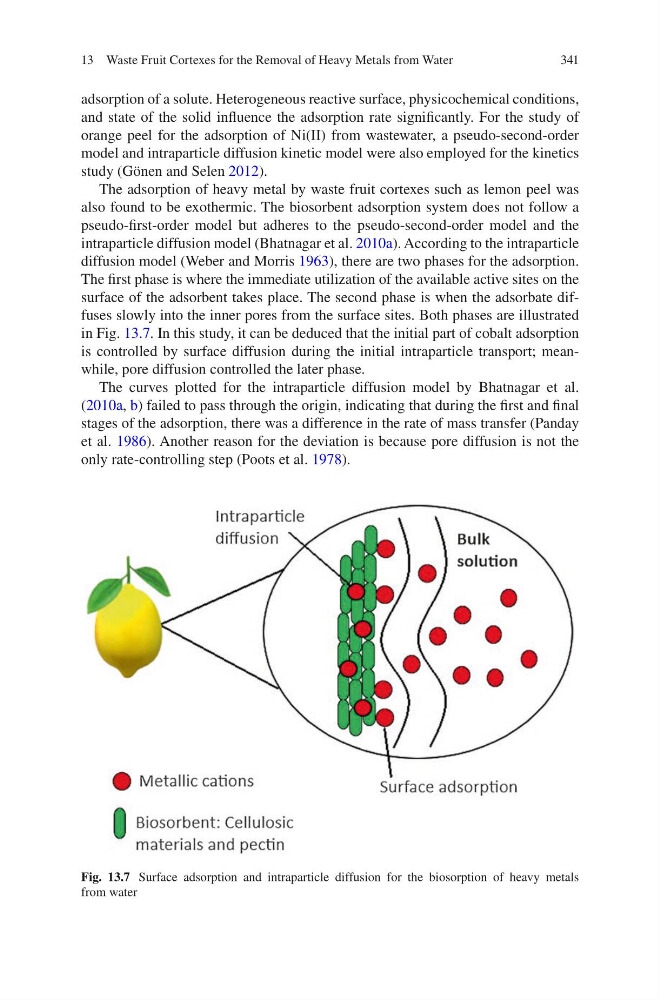
diffusion model (Weber and Morris 1963), there are two phases for the adsorption.
The first phase is where the immediate utilization of the available active sites on the
surface of the adsorbent takes place. The second phase is when the adsorbate diffuses slowly into the inner pores from the surface sites. Both phases are illustrated
in Fig. 13.7. In this study, it can be deduced that the initial part of cobalt adsorption
is controlled by surface diffusion during the initial intraparticle transport; meanwhile, pore diffusion controlled the later phase.
The curves plotted for the intraparticle diffusion model by Bhatnagar et al.
(2010a, b) failed to pass through the origin, indicating that during the first and final
stages of the adsorption, there was a difference in the rate of mass transfer (Panday
et al. 1986). Another reason for the deviation is because pore diffusion is not the
only rate-controlling step (Poots et al. 1978).
Fig. 13.7 Surface adsorption and intraparticle diffusion for the biosorption of heavy metals
from water
13 Waste Fruit Cortexes for the Removal of Heavy Metals from Water
adsorption of a solute. Heterogeneous reactive surface, physicochemical conditions,
and state of the solid influence the adsorption rate significantly. For the study of
orange peel for the adsorption of Ni(II) from wastewater, a pseudo-second-order
model and intraparticle diffusion kinetic model were also employed for the kinetics
study (Gönen and Selen 2012).
The adsorption of heavy metal by waste fruit cortexes such as lemon peel was
also found to be exothermic. The biosorbent adsorption system does not follow a
pseudo-first-order model but adheres to the pseudo-second-order model and the
intraparticle diffusion model (Bhatnagar et al. 2010a). According to the intraparticle
diffusion model (Weber and Morris 1963), there are two phases for the adsorption.
The first phase is where the immediate utilization of the available active sites on the
surface of the adsorbent takes place. The second phase is when the adsorbate diffuses slowly into the inner pores from the surface sites. Both phases are illustrated
in Fig. 13.7. In this study, it can be deduced that the initial part of cobalt adsorption
is controlled by surface diffusion during the initial intraparticle transport; meanwhile, pore diffusion controlled the later phase.
The curves plotted for the intraparticle diffusion model by Bhatnagar et al.
(2010a, b) failed to pass through the origin, indicating that during the first and final
stages of the adsorption, there was a difference in the rate of mass transfer (Panday
et al. 1986). Another reason for the deviation is because pore diffusion is not the
only rate-controlling step (Poots et al. 1978).
Fig. 13.7 Surface adsorption and intraparticle diffusion for the biosorption of heavy metals
from water
13 Waste Fruit Cortexes for the Removal of Heavy Metals from Water