

298
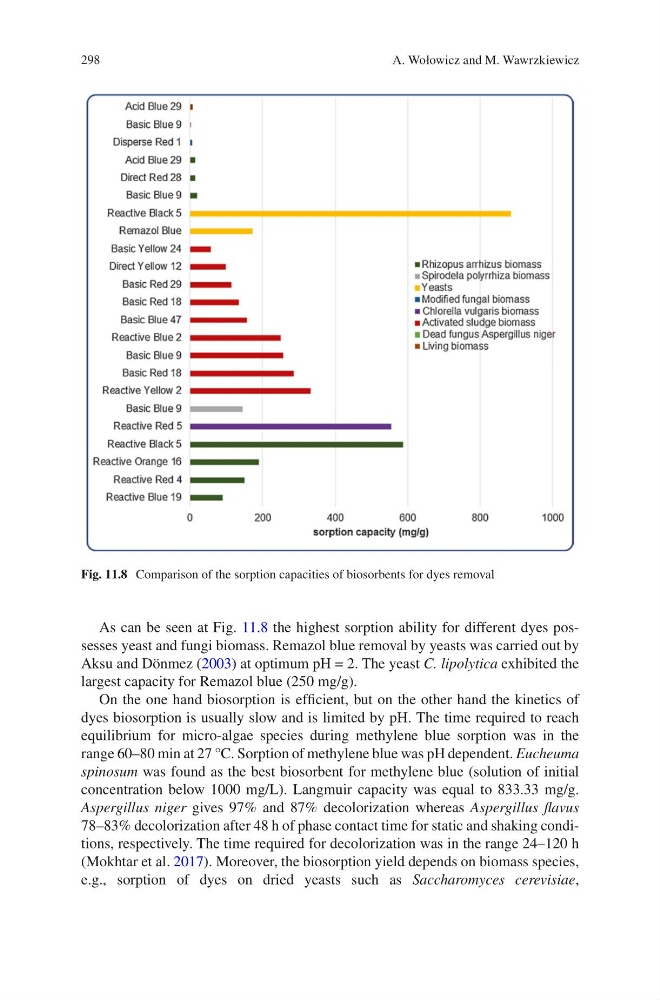
As can be seen at Fig. 11.8 the highest sorption ability for different dyes possesses yeast and fungi biomass. Remazol blue removal by yeasts was carried out by
Aksu and Dönmez (2003) at optimum pH = 2. The yeast C. lipolytica exhibited the
largest capacity for Remazol blue (250 mg/g).
On the one hand biosorption is efficient, but on the other hand the kinetics of
dyes biosorption is usually slow and is limited by pH. The time required to reach
equilibrium for micro-algae species during methylene blue sorption was in the
range 60–80 min at 27 °C. Sorption of methylene blue was pH dependent. Eucheuma
spinosum was found as the best biosorbent for methylene blue (solution of initial
concentration below 1000 mg/L). Langmuir capacity was equal to 833.33 mg/g.
Aspergillus niger gives 97% and 87% decolorization whereas Aspergillus flavus
78–83% decolorization after 48 h of phase contact time for static and shaking conditions, respectively. The time required for decolorization was in the range 24–120 h
(Mokhtar et al. 2017). Moreover, the biosorption yield depends on biomass species,
e.g., sorption of dyes on dried yeasts such as Saccharomyces cerevisiae,
Fig. 11.8 Comparison of the sorption capacities of biosorbents for dyes removal
A. Wołowicz and M. Wawrzkiewicz
As can be seen at Fig. 11.8 the highest sorption ability for different dyes possesses yeast and fungi biomass. Remazol blue removal by yeasts was carried out by
Aksu and Dönmez (2003) at optimum pH = 2. The yeast C. lipolytica exhibited the
largest capacity for Remazol blue (250 mg/g).
On the one hand biosorption is efficient, but on the other hand the kinetics of
dyes biosorption is usually slow and is limited by pH. The time required to reach
equilibrium for micro-algae species during methylene blue sorption was in the
range 60–80 min at 27 °C. Sorption of methylene blue was pH dependent. Eucheuma
spinosum was found as the best biosorbent for methylene blue (solution of initial
concentration below 1000 mg/L). Langmuir capacity was equal to 833.33 mg/g.
Aspergillus niger gives 97% and 87% decolorization whereas Aspergillus flavus
78–83% decolorization after 48 h of phase contact time for static and shaking conditions, respectively. The time required for decolorization was in the range 24–120 h
(Mokhtar et al. 2017). Moreover, the biosorption yield depends on biomass species,
e.g., sorption of dyes on dried yeasts such as Saccharomyces cerevisiae,
Fig. 11.8 Comparison of the sorption capacities of biosorbents for dyes removal
A. Wołowicz and M. Wawrzkiewicz