

232
9.2 Different Methods for Metal Pollutants
Removal: Overview
Researchers have found numerous physiochemical methods like hydrolysis, membrane process, pyrolysis, precipitation, floatation, electrocoagulation, adsorption, and
ion exchange for the removal of these hazardous contaminants from our environment
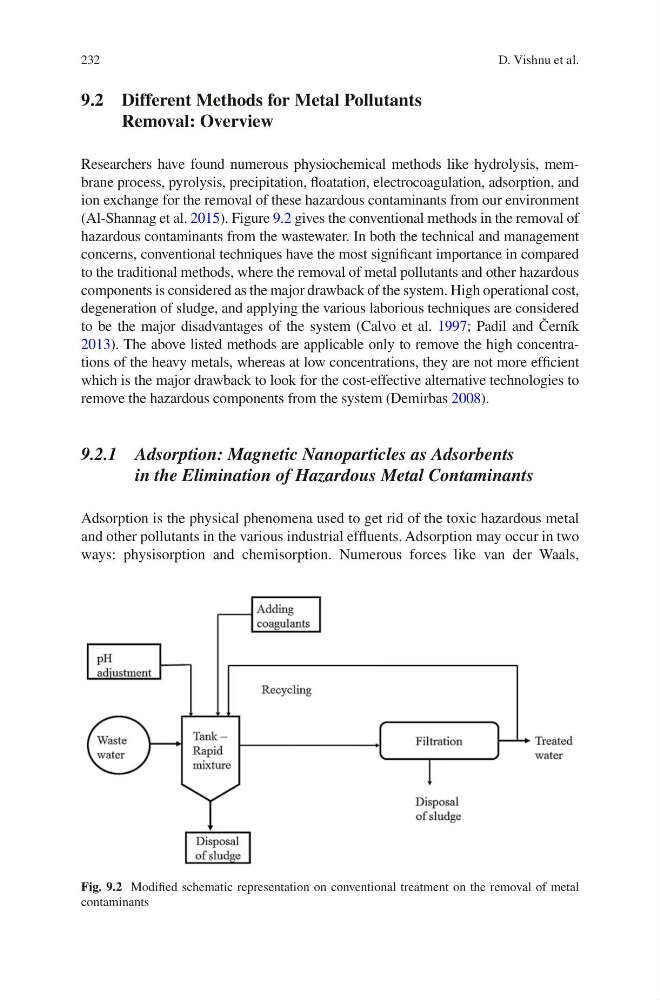
(Al-Shannag et al. 2015). Figure 9.2 gives the conventional methods in the removal of
hazardous contaminants from the wastewater. In both the technical and management
concerns, conventional techniques have the most significant importance in compared
to the traditional methods, where the removal of metal pollutants and other hazardous
components is considered as the major drawback of the system. High operational cost,
degeneration of sludge, and applying the various laborious techniques are considered
to be the major disadvantages of the system (Calvo et al. 1997; Padil and Černík
2013). The above listed methods are applicable only to remove the high concentrations of the heavy metals, whereas at low concentrations, they are not more efficient
which is the major drawback to look for the cost- effective alternative technologies to
remove the hazardous components from the system (Demirbas 2008).
9.2.1 Adsorption: Magnetic Nanoparticles as Adsorbents
in the Elimination of Hazardous Metal Contaminants
Adsorption is the physical phenomena used to get rid of the toxic hazardous metal
and other pollutants in the various industrial effluents. Adsorption may occur in two
ways: physisorption and chemisorption. Numerous forces like van der Waals,
Fig. 9.2 Modified schematic representation on conventional treatment on the removal of metal
contaminants
D. Vishnu et al.
9.2 Different Methods for Metal Pollutants
Removal: Overview
Researchers have found numerous physiochemical methods like hydrolysis, membrane process, pyrolysis, precipitation, floatation, electrocoagulation, adsorption, and
ion exchange for the removal of these hazardous contaminants from our environment
(Al-Shannag et al. 2015). Figure 9.2 gives the conventional methods in the removal of
hazardous contaminants from the wastewater. In both the technical and management
concerns, conventional techniques have the most significant importance in compared
to the traditional methods, where the removal of metal pollutants and other hazardous
components is considered as the major drawback of the system. High operational cost,
degeneration of sludge, and applying the various laborious techniques are considered
to be the major disadvantages of the system (Calvo et al. 1997; Padil and Černík
2013). The above listed methods are applicable only to remove the high concentrations of the heavy metals, whereas at low concentrations, they are not more efficient
which is the major drawback to look for the cost- effective alternative technologies to
remove the hazardous components from the system (Demirbas 2008).
9.2.1 Adsorption: Magnetic Nanoparticles as Adsorbents
in the Elimination of Hazardous Metal Contaminants
Adsorption is the physical phenomena used to get rid of the toxic hazardous metal
and other pollutants in the various industrial effluents. Adsorption may occur in two
ways: physisorption and chemisorption. Numerous forces like van der Waals,
Fig. 9.2 Modified schematic representation on conventional treatment on the removal of metal
contaminants
D. Vishnu et al.