

230
like Be, Ba, Cu, Co, Cr, Ni, Zn, Mn, As, Pb, Hg, Cd, Pd, U, and V as the toxic pollutants responsible to damage the genetic mechanisms of both flora and fauna community via free radical production. Superparamagnetic support nanomaterials are
prepared via Fe, Cu, Ni, Mn, and Mg and coated with the distinct materials like
mesoporous and amorphous silica, polyvinyl alcohol and pyrrolidine, polyethylene
glycol, polystyrene, chitosan, dextran, starch, gelatin, polystyrene, polyacrylic acid,
and poly(methyl methacrylate). These surface-modified superparamagnetic support
nanomaterials tend to possess the enhanced stability and specific reactivity in the
system and are used in the elimination of organic and inorganic hazardous contaminants in the industrial wastewater.
Keywords Immobilization · Nanoparticles · Plant extracts · Pollutants ·
Contaminants · Industrialization · Urbanization · Organic · Inorganic · Hazardous
9.1 Introduction
Industrialization and urbanization mainly elucidate the discharge of major hazardous pollutants like heavy metals and polyhydrocarbons into the water and pollutes
the ecosystem. By implementing the different phenomena of clean technology,
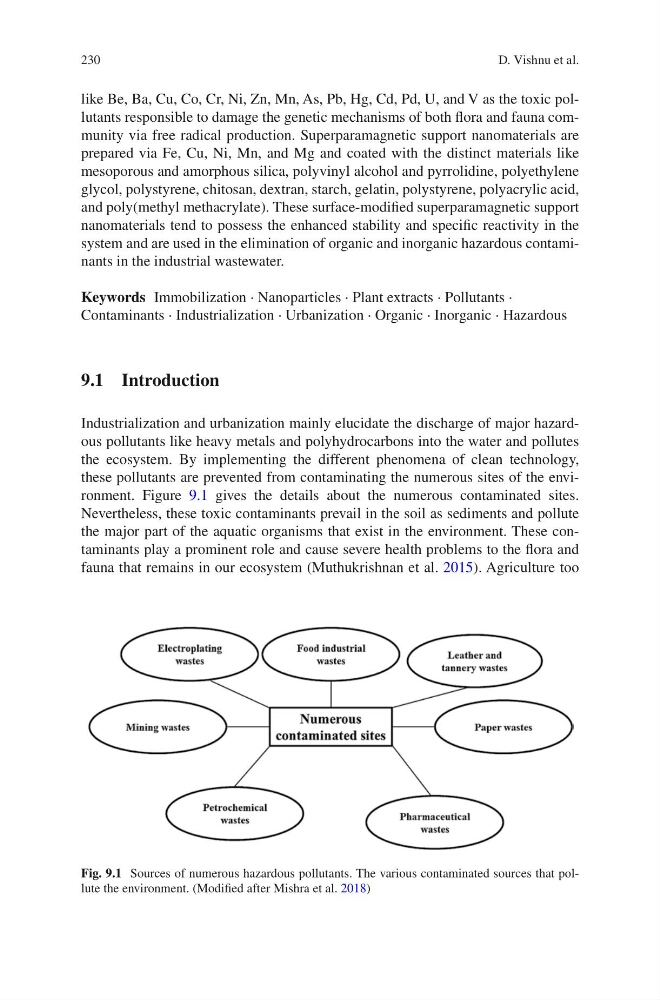
these pollutants are prevented from contaminating the numerous sites of the environment. Figure 9.1 gives the details about the numerous contaminated sites.
Nevertheless, these toxic contaminants prevail in the soil as sediments and pollute
the major part of the aquatic organisms that exist in the environment. These contaminants play a prominent role and cause severe health problems to the flora and
fauna that remains in our ecosystem (Muthukrishnan et al. 2015). Agriculture too
Fig. 9.1 Sources of numerous hazardous pollutants. The various contaminated sources that pollute the environment. (Modified after Mishra et al. 2018)
D. Vishnu et al.
like Be, Ba, Cu, Co, Cr, Ni, Zn, Mn, As, Pb, Hg, Cd, Pd, U, and V as the toxic pollutants responsible to damage the genetic mechanisms of both flora and fauna community via free radical production. Superparamagnetic support nanomaterials are
prepared via Fe, Cu, Ni, Mn, and Mg and coated with the distinct materials like
mesoporous and amorphous silica, polyvinyl alcohol and pyrrolidine, polyethylene
glycol, polystyrene, chitosan, dextran, starch, gelatin, polystyrene, polyacrylic acid,
and poly(methyl methacrylate). These surface-modified superparamagnetic support
nanomaterials tend to possess the enhanced stability and specific reactivity in the
system and are used in the elimination of organic and inorganic hazardous contaminants in the industrial wastewater.
Keywords Immobilization · Nanoparticles · Plant extracts · Pollutants ·
Contaminants · Industrialization · Urbanization · Organic · Inorganic · Hazardous
9.1 Introduction
Industrialization and urbanization mainly elucidate the discharge of major hazardous pollutants like heavy metals and polyhydrocarbons into the water and pollutes
the ecosystem. By implementing the different phenomena of clean technology,
these pollutants are prevented from contaminating the numerous sites of the environment. Figure 9.1 gives the details about the numerous contaminated sites.
Nevertheless, these toxic contaminants prevail in the soil as sediments and pollute
the major part of the aquatic organisms that exist in the environment. These contaminants play a prominent role and cause severe health problems to the flora and
fauna that remains in our ecosystem (Muthukrishnan et al. 2015). Agriculture too
Fig. 9.1 Sources of numerous hazardous pollutants. The various contaminated sources that pollute the environment. (Modified after Mishra et al. 2018)
D. Vishnu et al.