

219
sorbent material that can expel toxicants from aqueous media (Morin-Crini
et al. 2019).
Different agricultural wastes such as coconut husk and rice husk, palm oil, nutshell, and fruit bagasse have been used as adsorbents as reported in many studies.
Sawdust and wood dust are promising adsorbents. The dust is comprised of fine
wood items, which is made up of lignin, cellulose, and hemicelluloses that are polyphenolic compounds having a great tendency to bind heavy metals through different
mechanisms. Seaweeds are natural and abundant source of biosorption materials.
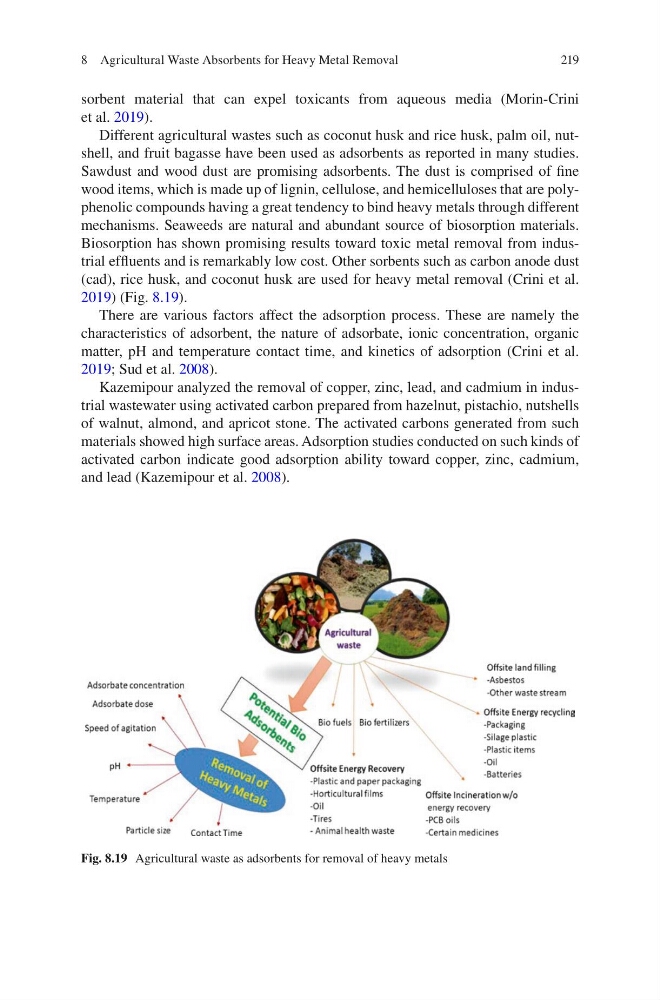
Biosorption has shown promising results toward toxic metal removal from industrial effluents and is remarkably low cost. Other sorbents such as carbon anode dust
(cad), rice husk, and coconut husk are used for heavy metal removal (Crini et al.
2019) (Fig. 8.19).
There are various factors affect the adsorption process. These are namely the
characteristics of adsorbent, the nature of adsorbate, ionic concentration, organic
matter, pH and temperature contact time, and kinetics of adsorption (Crini et al.
2019; Sud et al. 2008).
Kazemipour analyzed the removal of copper, zinc, lead, and cadmium in industrial wastewater using activated carbon prepared from hazelnut, pistachio, nutshells
of walnut, almond, and apricot stone. The activated carbons generated from such
materials showed high surface areas. Adsorption studies conducted on such kinds of
activated carbon indicate good adsorption ability toward copper, zinc, cadmium,
and lead (Kazemipour et al. 2008).
Fig. 8.19 Agricultural waste as adsorbents for removal of heavy metals
8 Agricultural Waste Absorbents for Heavy Metal Removal
sorbent material that can expel toxicants from aqueous media (Morin-Crini
et al. 2019).
Different agricultural wastes such as coconut husk and rice husk, palm oil, nutshell, and fruit bagasse have been used as adsorbents as reported in many studies.
Sawdust and wood dust are promising adsorbents. The dust is comprised of fine
wood items, which is made up of lignin, cellulose, and hemicelluloses that are polyphenolic compounds having a great tendency to bind heavy metals through different
mechanisms. Seaweeds are natural and abundant source of biosorption materials.
Biosorption has shown promising results toward toxic metal removal from industrial effluents and is remarkably low cost. Other sorbents such as carbon anode dust
(cad), rice husk, and coconut husk are used for heavy metal removal (Crini et al.
2019) (Fig. 8.19).
There are various factors affect the adsorption process. These are namely the
characteristics of adsorbent, the nature of adsorbate, ionic concentration, organic
matter, pH and temperature contact time, and kinetics of adsorption (Crini et al.
2019; Sud et al. 2008).
Kazemipour analyzed the removal of copper, zinc, lead, and cadmium in industrial wastewater using activated carbon prepared from hazelnut, pistachio, nutshells
of walnut, almond, and apricot stone. The activated carbons generated from such
materials showed high surface areas. Adsorption studies conducted on such kinds of
activated carbon indicate good adsorption ability toward copper, zinc, cadmium,
and lead (Kazemipour et al. 2008).
Fig. 8.19 Agricultural waste as adsorbents for removal of heavy metals
8 Agricultural Waste Absorbents for Heavy Metal Removal