

217
8.4 Agricultural Wastes
Agricultural waste is the reaming product that comes from the growing and initially
processed agricultural stuff, for example, organic products, vegetables, fruits, meat,
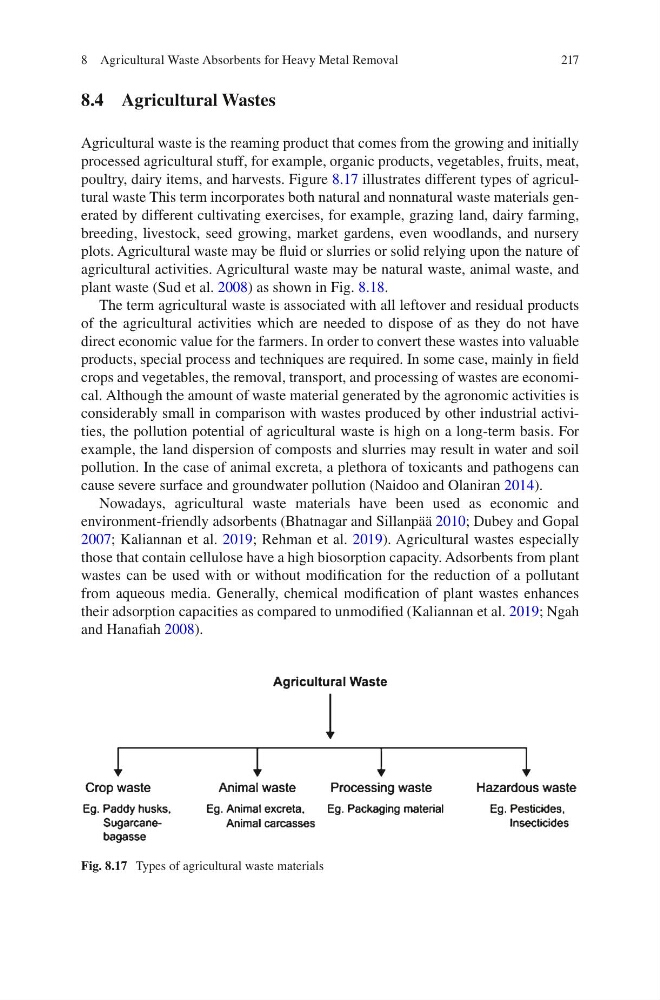
poultry, dairy items, and harvests. Figure 8.17 illustrates different types of agricultural waste This term incorporates both natural and nonnatural waste materials generated by different cultivating exercises, for example, grazing land, dairy farming,
breeding, livestock, seed growing, market gardens, even woodlands, and nursery
plots. Agricultural waste may be fluid or slurries or solid relying upon the nature of
agricultural activities. Agricultural waste may be natural waste, animal waste, and
plant waste (Sud et al. 2008) as shown in Fig. 8.18.
The term agricultural waste is associated with all leftover and residual products
of the agricultural activities which are needed to dispose of as they do not have
direct economic value for the farmers. In order to convert these wastes into valuable
products, special process and techniques are required. In some case, mainly in field
crops and vegetables, the removal, transport, and processing of wastes are economical. Although the amount of waste material generated by the agronomic activities is
considerably small in comparison with wastes produced by other industrial activities, the pollution potential of agricultural waste is high on a long-term basis. For
example, the land dispersion of composts and slurries may result in water and soil
pollution. In the case of animal excreta, a plethora of toxicants and pathogens can
cause severe surface and groundwater pollution (Naidoo and Olaniran 2014).
Nowadays, agricultural waste materials have been used as economic and
environment- friendly adsorbents (Bhatnagar and Sillanpää 2010; Dubey and Gopal
2007; Kaliannan et al. 2019; Rehman et al. 2019). Agricultural wastes especially
those that contain cellulose have a high biosorption capacity. Adsorbents from plant
wastes can be used with or without modification for the reduction of a pollutant
from aqueous media. Generally, chemical modification of plant wastes enhances
their adsorption capacities as compared to unmodified (Kaliannan et al. 2019; Ngah
and Hanafiah 2008).
Fig. 8.17 Types of agricultural waste materials
8 Agricultural Waste Absorbents for Heavy Metal Removal
8.4 Agricultural Wastes
Agricultural waste is the reaming product that comes from the growing and initially
processed agricultural stuff, for example, organic products, vegetables, fruits, meat,
poultry, dairy items, and harvests. Figure 8.17 illustrates different types of agricultural waste This term incorporates both natural and nonnatural waste materials generated by different cultivating exercises, for example, grazing land, dairy farming,
breeding, livestock, seed growing, market gardens, even woodlands, and nursery
plots. Agricultural waste may be fluid or slurries or solid relying upon the nature of
agricultural activities. Agricultural waste may be natural waste, animal waste, and
plant waste (Sud et al. 2008) as shown in Fig. 8.18.
The term agricultural waste is associated with all leftover and residual products
of the agricultural activities which are needed to dispose of as they do not have
direct economic value for the farmers. In order to convert these wastes into valuable
products, special process and techniques are required. In some case, mainly in field
crops and vegetables, the removal, transport, and processing of wastes are economical. Although the amount of waste material generated by the agronomic activities is
considerably small in comparison with wastes produced by other industrial activities, the pollution potential of agricultural waste is high on a long-term basis. For
example, the land dispersion of composts and slurries may result in water and soil
pollution. In the case of animal excreta, a plethora of toxicants and pathogens can
cause severe surface and groundwater pollution (Naidoo and Olaniran 2014).
Nowadays, agricultural waste materials have been used as economic and
environment- friendly adsorbents (Bhatnagar and Sillanpää 2010; Dubey and Gopal
2007; Kaliannan et al. 2019; Rehman et al. 2019). Agricultural wastes especially
those that contain cellulose have a high biosorption capacity. Adsorbents from plant
wastes can be used with or without modification for the reduction of a pollutant
from aqueous media. Generally, chemical modification of plant wastes enhances
their adsorption capacities as compared to unmodified (Kaliannan et al. 2019; Ngah
and Hanafiah 2008).
Fig. 8.17 Types of agricultural waste materials
8 Agricultural Waste Absorbents for Heavy Metal Removal