

216
greatest regenerating ability and stability in the aquatic environment and outstanding capacity toward heavy metals removal (Pu et al. 2018).
• Eggshell
Eggshells are crystalline calcium carbonate. The natural and boiled hen and duck
eggshells are washed several times using tap water and then allowed to dry in air
and incubated in hot air oven at 40 °C. Consequently, egg shells were ground to
prepare fine a powder. Literature proved that eggshells can be used as adsorbent to
treat heavy metals. Eggshells can be converted into nanoporous materials which
increase their surface area and improve absorption capacity. Setiawan et al. performed a study to evaluate the adsorption capacity of various eggshell toward heavy
metal ions. They found that the nanoporous eggshell showed improved adsorption
capacity as activated carbon and can be applied in reducing heavy metal from aqueous media (Setiawan et al. 2018).
• Lignin
It is a complex compound derived commonly from wood. It is a basic building
block of plant cell wall and algae. It is the second most widely distributed organic
adsorbent polymers available after cellulose (Fig. 8.18). It is an unusual biopolymer
due to its heterogeneity in primary structure. Its primary function is to strengthen
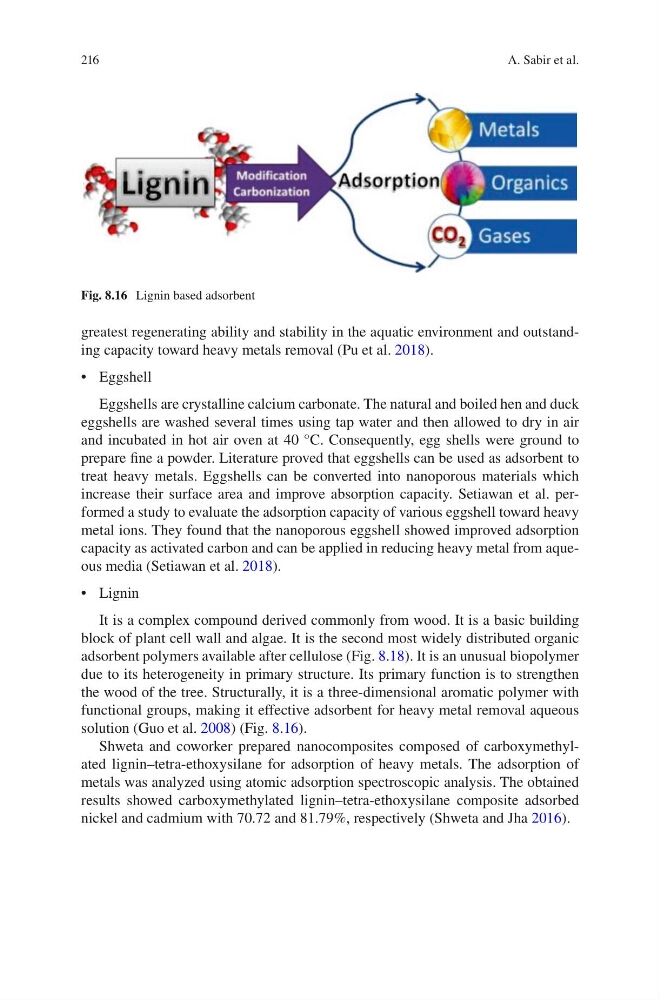
the wood of the tree. Structurally, it is a three-dimensional aromatic polymer with
functional groups, making it effective adsorbent for heavy metal removal aqueous
solution (Guo et al. 2008) (Fig. 8.16).
Shweta and coworker prepared nanocomposites composed of carboxymethylated lignin–tetra-ethoxysilane for adsorption of heavy metals. The adsorption of
metals was analyzed using atomic adsorption spectroscopic analysis. The obtained
results showed carboxymethylated lignin–tetra-ethoxysilane composite adsorbed
nickel and cadmium with 70.72 and 81.79%, respectively (Shweta and Jha 2016).
Fig. 8.16 Lignin based adsorbent
A. Sabir et al.
greatest regenerating ability and stability in the aquatic environment and outstanding capacity toward heavy metals removal (Pu et al. 2018).
• Eggshell
Eggshells are crystalline calcium carbonate. The natural and boiled hen and duck
eggshells are washed several times using tap water and then allowed to dry in air
and incubated in hot air oven at 40 °C. Consequently, egg shells were ground to
prepare fine a powder. Literature proved that eggshells can be used as adsorbent to
treat heavy metals. Eggshells can be converted into nanoporous materials which
increase their surface area and improve absorption capacity. Setiawan et al. performed a study to evaluate the adsorption capacity of various eggshell toward heavy
metal ions. They found that the nanoporous eggshell showed improved adsorption
capacity as activated carbon and can be applied in reducing heavy metal from aqueous media (Setiawan et al. 2018).
• Lignin
It is a complex compound derived commonly from wood. It is a basic building
block of plant cell wall and algae. It is the second most widely distributed organic
adsorbent polymers available after cellulose (Fig. 8.18). It is an unusual biopolymer
due to its heterogeneity in primary structure. Its primary function is to strengthen
the wood of the tree. Structurally, it is a three-dimensional aromatic polymer with
functional groups, making it effective adsorbent for heavy metal removal aqueous
solution (Guo et al. 2008) (Fig. 8.16).
Shweta and coworker prepared nanocomposites composed of carboxymethylated lignin–tetra-ethoxysilane for adsorption of heavy metals. The adsorption of
metals was analyzed using atomic adsorption spectroscopic analysis. The obtained
results showed carboxymethylated lignin–tetra-ethoxysilane composite adsorbed
nickel and cadmium with 70.72 and 81.79%, respectively (Shweta and Jha 2016).
Fig. 8.16 Lignin based adsorbent
A. Sabir et al.