

214
8.3.13 Low-Cost Adsorbent
The adsorbent is considered to be low cost if it is found abundantly in nature and
does not need much processing or is produced as a by-product from industry. The
main sources regarded as low-cost absorbent providers include natural mineral or
agricultural and industrial by-products. Usually, these materials are abundantly
available and in huge quantities, hence having little economic value making them
inexpensive (Lim and Aris 2014).
Some low-cost adsorbents are discussed as follows:
• Chitosan
Chitosan and its derivatives are inexpensive value-added materials. These are
made from deacetylation of chitin, which is a naturally occurring material obtained
from exoskeleton of arthropods and crustaceans. It is also found in the cell wall of
some fungi. Different studies proved that chitosan adsorbent has the ability to
remove heavy metals from wastewater and industrial affluent (Liu et al. 2019; Sun
et al. 2019).
In chitosan, the presence of amino groups (NH 2 -) may undergo protonation to
form protonated amine which have the ability to adsorb metal by different kinds of
interactive mechanisms including chelation and electrostatic attractions. Pu et al.
prepared (Fig. 8.14) magnetic chitosan nanopowder for removal of heavy metals.
The prepared magnetic chitosan nanopowder had high surface area, specific
functionalities, and greater adsorption capability. The maximum lead (II) and copper adsorptions were 113.38 mg/g and 92.34 mg/g, respectively. The use of Fe3O4
nanoparticles enables prepared magnetic chitosan nonabsorbent to detach easily via
magnetic separation. (Fig. 8.15) nano-Fe3O4 t also enables chitosan to retain excellent adsorption capacity over a pH range. Moreover, the nanocomposite exhibited
effective recyclable features of up to several cycles.
They found that magnetic chitosan nanocomposite can be reproduced by ethylenediaminetetraacetic acid 2 Na washing method and showed superior stability and
reusability upon five times usage. Overall, the prepared nanocomposite exhibited
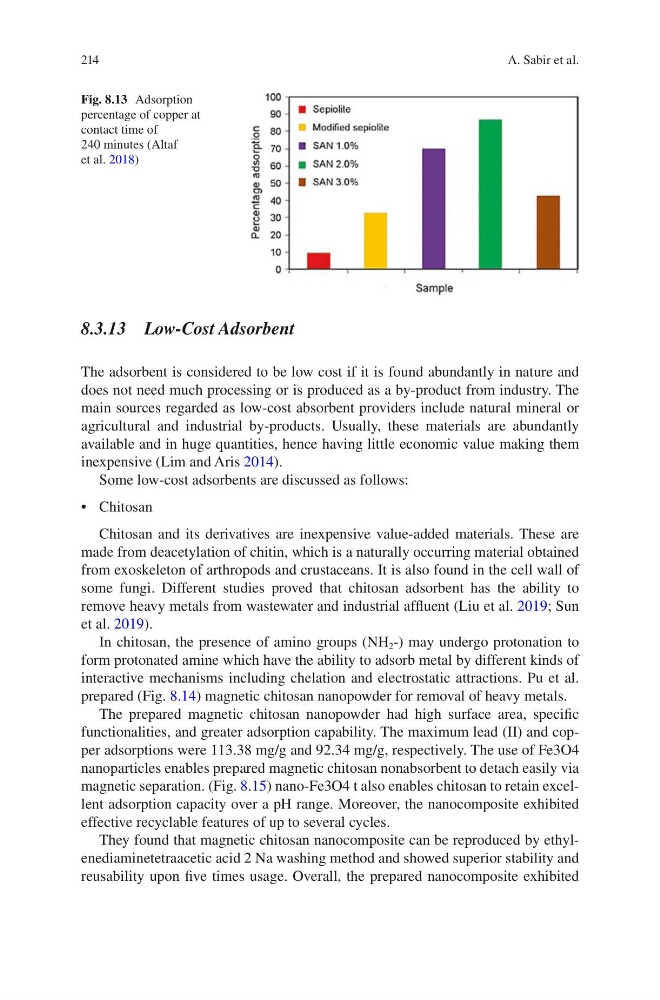
Fig. 8.13 Adsorption
percentage of copper at
contact time of
240 minutes (Altaf
et al. 2018)
A. Sabir et al.
8.3.13 Low-Cost Adsorbent
The adsorbent is considered to be low cost if it is found abundantly in nature and
does not need much processing or is produced as a by-product from industry. The
main sources regarded as low-cost absorbent providers include natural mineral or
agricultural and industrial by-products. Usually, these materials are abundantly
available and in huge quantities, hence having little economic value making them
inexpensive (Lim and Aris 2014).
Some low-cost adsorbents are discussed as follows:
• Chitosan
Chitosan and its derivatives are inexpensive value-added materials. These are
made from deacetylation of chitin, which is a naturally occurring material obtained
from exoskeleton of arthropods and crustaceans. It is also found in the cell wall of
some fungi. Different studies proved that chitosan adsorbent has the ability to
remove heavy metals from wastewater and industrial affluent (Liu et al. 2019; Sun
et al. 2019).
In chitosan, the presence of amino groups (NH 2 -) may undergo protonation to
form protonated amine which have the ability to adsorb metal by different kinds of
interactive mechanisms including chelation and electrostatic attractions. Pu et al.
prepared (Fig. 8.14) magnetic chitosan nanopowder for removal of heavy metals.
The prepared magnetic chitosan nanopowder had high surface area, specific
functionalities, and greater adsorption capability. The maximum lead (II) and copper adsorptions were 113.38 mg/g and 92.34 mg/g, respectively. The use of Fe3O4
nanoparticles enables prepared magnetic chitosan nonabsorbent to detach easily via
magnetic separation. (Fig. 8.15) nano-Fe3O4 t also enables chitosan to retain excellent adsorption capacity over a pH range. Moreover, the nanocomposite exhibited
effective recyclable features of up to several cycles.
They found that magnetic chitosan nanocomposite can be reproduced by ethylenediaminetetraacetic acid 2 Na washing method and showed superior stability and
reusability upon five times usage. Overall, the prepared nanocomposite exhibited
Fig. 8.13 Adsorption
percentage of copper at
contact time of
240 minutes (Altaf
et al. 2018)
A. Sabir et al.