

213
composite showed performance toward removal of metals from contaminated water
(Şölener et al. 2008).
Metal adsorption efficiency of the nanocomposite material can be increased
through additional modification. Various types of complexing groups (thiol, amidoxime, mercaptoimidazole. and ionic species including phosphate, carboxy, and
carboxymethyl groups), are utilized for this purpose. These groups are introduced
on solid adsorbents (polymer/clay adsorbents) to enhance their adsorption capacities (Ulusoy et al. 2003). For example, dithiocarbamate-anchored polystyrene/
organosmectite has been used to adsorbed mercury from aqueous solutions with
high rate (Say et al. 2008). Similarly, amidoximated polyacrylonitrile/organobentonite composite has been prepared and used for the elimination of copper (II), zinc
(II), mercury (Hg), and cadmium (II) from wastewater and industrial affluent
(Anirudhan and Ramachandran 2008).
The polymeric chelating materials are synthesized by attaching a functional
group to a polymeric backbone (synthetic polymer) (Kato et al. 2003). This functional group shows higher selectivity toward some metal ions. The specific property
of metal-chelating ligands is beneficial in many applications, especially in this context. Among different kinds of chelating ligands, the poly(amidoxime) is the most
popular chelating ligand. It has the ability to bind the wide variety of metal ions
(Raman et al. 2012).
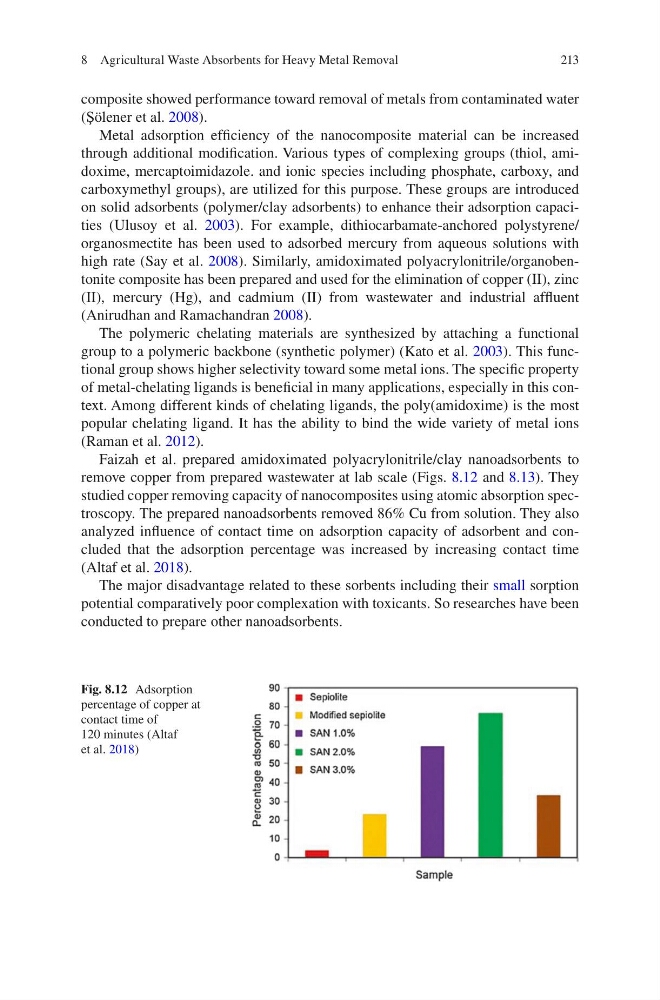
Faizah et al. prepared amidoximated polyacrylonitrile/clay nanoadsorbents to
remove copper from prepared wastewater at lab scale (Figs. 8.12 and 8.13). They
studied copper removing capacity of nanocomposites using atomic absorption spectroscopy. The prepared nanoadsorbents removed 86% Cu from solution. They also
analyzed influence of contact time on adsorption capacity of adsorbent and concluded that the adsorption percentage was increased by increasing contact time
(Altaf et al. 2018).
The major disadvantage related to these sorbents including their small sorption
potential comparatively poor complexation with toxicants. So researches have been
conducted to prepare other nanoadsorbents.
Fig. 8.12 Adsorption
percentage of copper at
contact time of
120 minutes (Altaf
et al. 2018)
8 Agricultural Waste Absorbents for Heavy Metal Removal
composite showed performance toward removal of metals from contaminated water
(Şölener et al. 2008).
Metal adsorption efficiency of the nanocomposite material can be increased
through additional modification. Various types of complexing groups (thiol, amidoxime, mercaptoimidazole. and ionic species including phosphate, carboxy, and
carboxymethyl groups), are utilized for this purpose. These groups are introduced
on solid adsorbents (polymer/clay adsorbents) to enhance their adsorption capacities (Ulusoy et al. 2003). For example, dithiocarbamate-anchored polystyrene/
organosmectite has been used to adsorbed mercury from aqueous solutions with
high rate (Say et al. 2008). Similarly, amidoximated polyacrylonitrile/organobentonite composite has been prepared and used for the elimination of copper (II), zinc
(II), mercury (Hg), and cadmium (II) from wastewater and industrial affluent
(Anirudhan and Ramachandran 2008).
The polymeric chelating materials are synthesized by attaching a functional
group to a polymeric backbone (synthetic polymer) (Kato et al. 2003). This functional group shows higher selectivity toward some metal ions. The specific property
of metal-chelating ligands is beneficial in many applications, especially in this context. Among different kinds of chelating ligands, the poly(amidoxime) is the most
popular chelating ligand. It has the ability to bind the wide variety of metal ions
(Raman et al. 2012).
Faizah et al. prepared amidoximated polyacrylonitrile/clay nanoadsorbents to
remove copper from prepared wastewater at lab scale (Figs. 8.12 and 8.13). They
studied copper removing capacity of nanocomposites using atomic absorption spectroscopy. The prepared nanoadsorbents removed 86% Cu from solution. They also
analyzed influence of contact time on adsorption capacity of adsorbent and concluded that the adsorption percentage was increased by increasing contact time
(Altaf et al. 2018).
The major disadvantage related to these sorbents including their small sorption
potential comparatively poor complexation with toxicants. So researches have been
conducted to prepare other nanoadsorbents.
Fig. 8.12 Adsorption
percentage of copper at
contact time of
120 minutes (Altaf
et al. 2018)
8 Agricultural Waste Absorbents for Heavy Metal Removal